

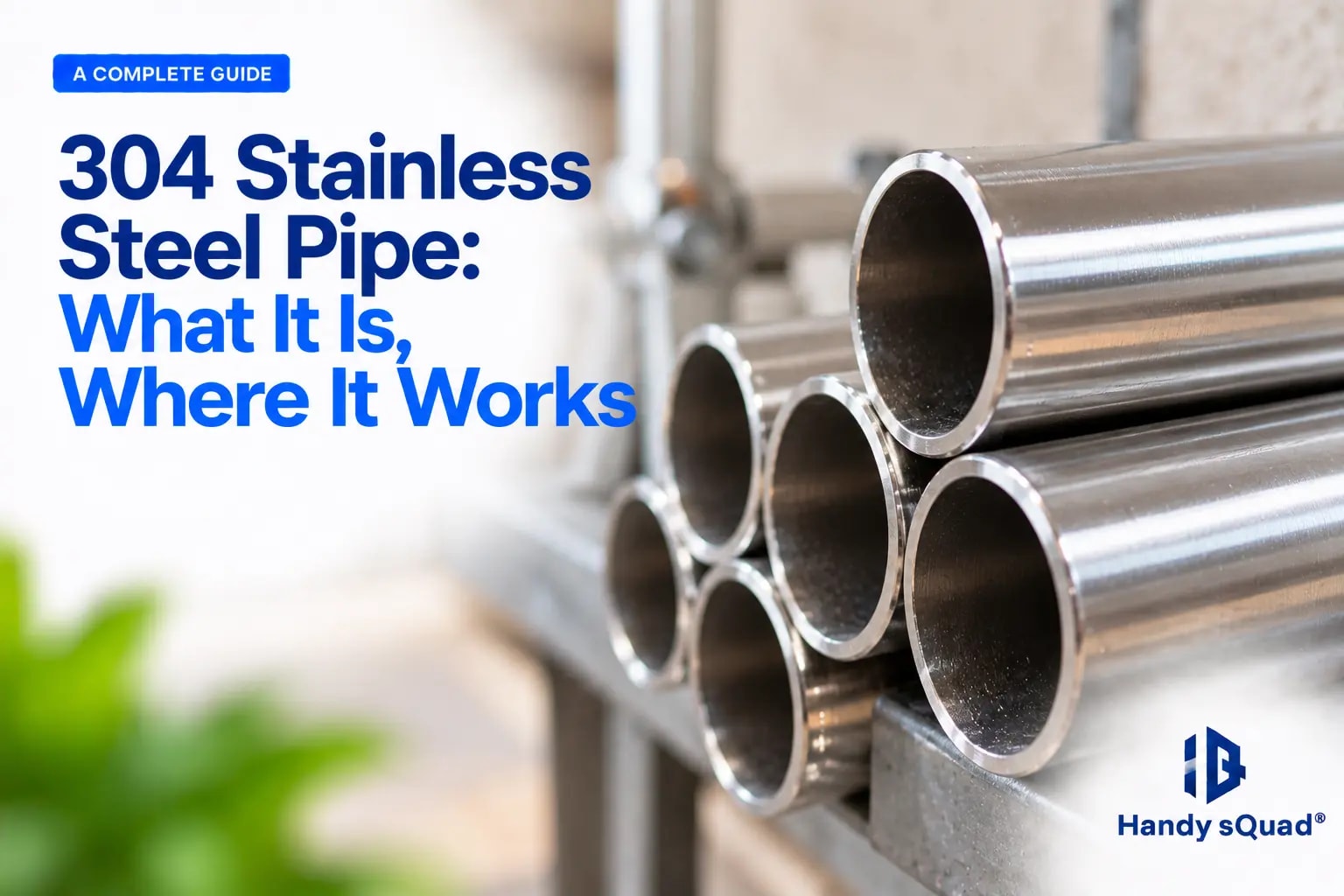
Most of us buy steel pipe the way we hail an auto: nearest one, lowest price, no questions. With 304 stainless steel pipe, that habit can cost you a railing. Here's what to know before you pay.
Ask a dealer for stainless steel pipe, and he'll throw back a question: "304 or 202? "Most of us just shrug.
Big mistake, though. That shrug is where the money leaks out.
Picture it. Two pipes on the rack, same shine, same diameter. One's cheaper, so that one goes home. Fourteen months later, the balcony railing has rust-colored streaks, and the fabricator is blaming the weather. You hear this story a lot.
Let me save you from it. Below: what 304 really is, when it's worth the money, and how to check the pipe in your hand.
What Is a 304 Stainless Steel Pipe? 18/8 Austenitic Grade, Chromium-Nickel Composition, and Corrosion Resistance
Quick bit of chemistry, and I promise it's short. 304 has around 18% chromium and 8% nickel. That's the "18/8" you see stamped on steel cutlery. The chromium makes an invisible skin that fights rust, and if you scratch it, the skin grows back. The nickel is what lets the pipe bend and take welding without cracking. That's pretty much it.
At the shop, it goes by SS 304, 304 grade, or plain "steel pipe." It's popular because it's decent at everything: it looks good, wipes clean, and welds well. What it isn't is salt-proof. More on that in a second.
304 vs 304L vs 316 vs 202 Stainless Steel: Which Grade Suits Your Home, Coastal Property, or Kitchen?
Short version, no fancy talk.
304L is 304 with less carbon. It only matters with heavy welding on thick pipe. A home railing? Won't notice.
316 is 304 plus molybdenum, and that little addition is what stands up to salt. Close to the sea? Spend the extra, honestly. Same goes for anything near a pool. Plain 304 by the coast can go spotty and brown, which people call tea staining.
202 is the budget cousin with far less nickel. Fine for dry, indoor jobs. Outdoors it gives up early. And yes, sometimes it's sold as 304. We'll get to that.
304 Stainless Steel Pipe vs. Tube
Pipe and tube sound alike, but the shop treats them differently. Pipes go by NB (nominal bore, basically the inside) plus a schedule number, say Sch 10 or Sch 40, which tells you how thick the wall is. Tubes for railings and gates go by outside diameter instead.
Mix them up, and the railing posts won't fit, or the "pipe" you got can't hold water. Easy mistake, annoying fix.
Seamless vs. Welded 304 Stainless Steel Pipe
Seamless has no joint along its length and handles real pressure, so it's mostly for industrial lines. Welded is rolled from a strip and seam-welded. Cheaper, more sizes. For a house or a shop, welded is what you'll use, and that's fine.
Where Is 304 Stainless Steel Pipe Used?
Railings, mostly. Staircases, balconies, and gates. Then water lines, kitchen exhaust ducts, restaurant counters, and display racks. If it'll be seen and splashed in Kerala's damp, 304 is usually the pick.
How to Check If a Stainless Steel Pipe Is Really 304
Now the bit I'd read twice. Cheaper grades sold as 304 are a real problem, and from the outside you can't tell them apart.
Everyone loves the magnet test. Skip it. 304 is non-magnetic when annealed, sure, but bending and welding can make it slightly magnetic, and 202 can act the same way. A magnet won't settle anything.
So what works? Ask for the mill test certificate, MTC for short, a sheet showing what's inside that batch. Then look at the pipe itself for stamps like ASTM A312 (pipes) or A554 (decorative tubes). Nickel test kits cost very little. Big order? Ask for XRF testing, where a handheld gun reads the metal in a few seconds.
And if one quote is way under the rest, ask why. There's usually an answer, and it's usually not a nice one.
Why Does 304 Stainless Steel Rust?
Here's the twist: real 304 can still rust if the work is careless. Welding leaves a straw-to-blue heat tint around the joint, and that patch loses its protection. It has to be pickled or polished off.
Then there's the carbon steel wire brush, a quiet killer. Use it on stainless, and you leave iron dust behind, and a few weeks later there are orange freckles all over a pipe that was fine. A proper stainless job uses separate tools. Worth asking about.
Steel Fabrication in Trivandrum: Why Professional Welding and Finishing Matter for 304 Pipework
The pipe is only half the story. The other half is who cuts, welds and finishes it. A welder who does mild steel gates all day will often treat stainless the same way, and that's how a good pipe gets ruined.
If you'd rather get it done properly, see how steel fabrication in Trivandrum works at Handy sQuad: a site visit first, scope and cost explained before any cutting, then the work, then a check and a record of what was done.
Comparing steel fabricators in Trivandrum instead? Ask each the same four things. Which grade? Can I see the test certificate? How will the welds be finished? Who's doing the work? Then listen to how they answer. Hesitation tells you plenty.
Frequently Asked Questions
Does 304 stainless steel pipe rust?
Hardly, if it's indoors. By the sea, or near pool chemicals and strong cleaners, it can, and that's 316 territory. Plenty of the rust people pin on 304 is actually bad welding or dirty tools.
Is 304 stainless steel pipe safe for drinking water and food?
Yes. Dairy and food units use it everywhere. Just get the joints cleaned up, because rough, discoloured welds are where gunk collects.
Why do 304 stainless steel pipe prices vary so much?
Thickness, finish, seamless or welded, and the grade itself. Rates keep moving too, so ask for today's quote. Super-low price? Check the grade before you celebrate.
Should I use 304 or 316 for a balcony railing?
Inland, 304 usually does fine. Near the coast, go 316. Not sure? Ask the fabricator how far you are from the sea and what has lasted in your area.
How long does a 304 stainless steel pipe last?
Years and years if it's fabricated, right? Wipe it now and then and keep bleach and salt off it.
Final Thoughts on Choosing 304 Stainless Steel Pipe
304 is a good pipe. Really. It just has to be the real thing, and it needs welding by someone who respects stainless. Pick the grade for your location, ask to see proof, and keep mild-steel habits away from it.
Handy sQuad's fabrication team handles stainless that way: right grade, clean welds, proper finishing, and a record of the job. Do it right once, and you skip the redo.