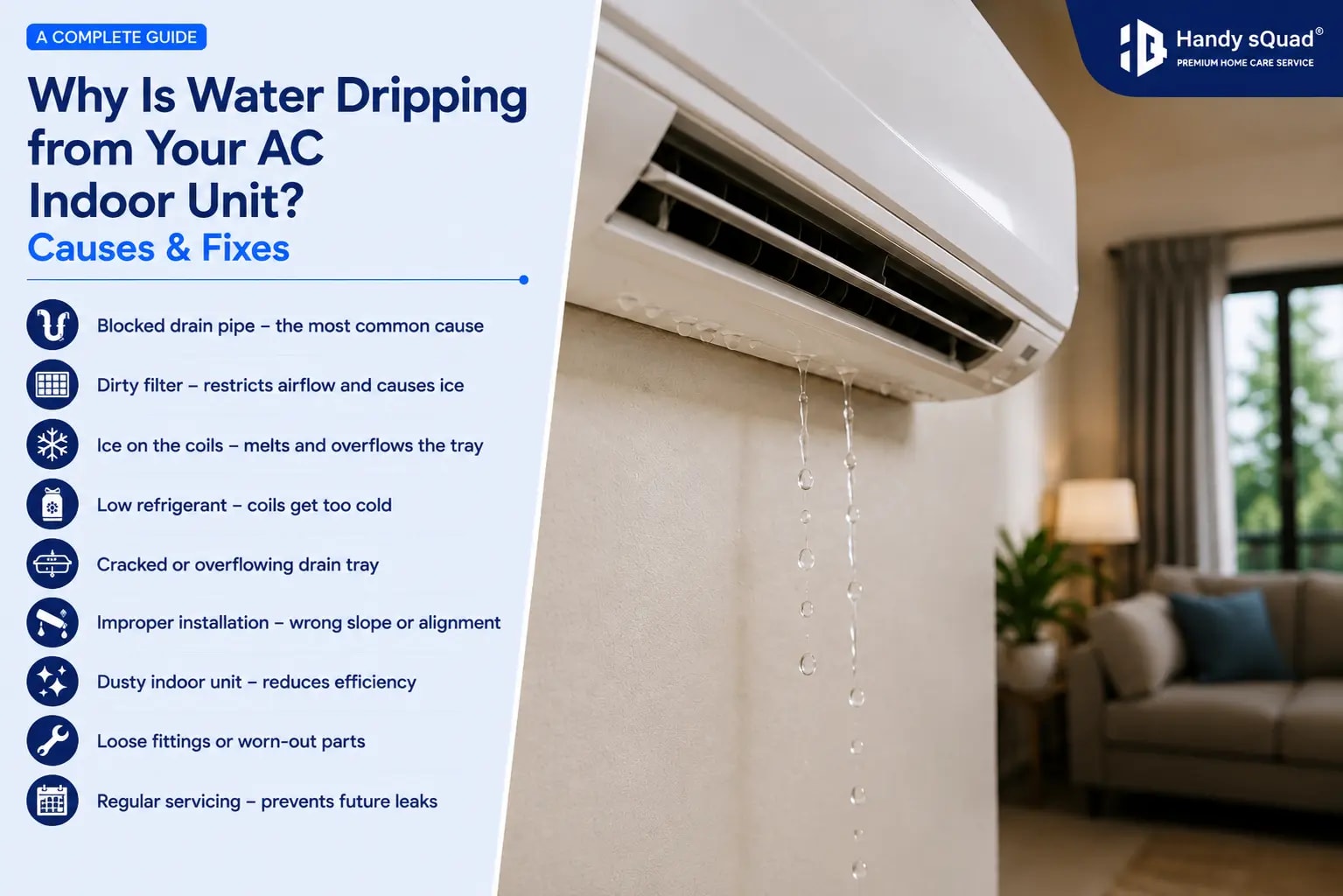
Water dripping from an AC indoor unit is one of the most common issues we deal with at Handy sQuad, especially across homes in Trivandrum. People notice it in different ways — a damp patch on the floor, water stains forming along the wall below the unit, or just a slow drip that wasn't there a week ago.
Most of the time, it's not a serious problem. But it does mean something in the system needs attention, and leaving it too long tends to make the fix more involved than it needs to be.
In this post, we'll walk through exactly why this happens, what each cause actually looks like, and what you should do about it — based on what we see day-to-day in AC service in Trivandrum.
Here's the Short Version of How AC and Water Are Connected
Your AC isn't purely a cooling machine. It also pulls moisture out of the air constantly — that's part of how it makes a room feel more comfortable, not just cooler. That moisture condenses on the coils inside the unit, drips down into a collection tray, and drains out through a pipe to the outside.
None of this is supposed to involve you. It just happens quietly in the background every time the AC runs.
When water starts showing up inside the room, it means something in that chain stopped working.
The condensation is still happening — it just has nowhere to go, so it goes somewhere it shouldn't.
That's really the whole problem. Everything else is just figuring out which part of the chain failed.
The Reasons It Happens — Honestly, in Order of How Often We See Them
Blocked Drain Pipe
This is the answer most of the time. I'd estimate it's behind somewhere around 65% of the water leaking from AC indoor unit calls we take, maybe more.
The drain pipe — a narrow plastic pipe running from the indoor unit to an outside wall — carries all that condensation away. Over months of use, algae forms inside it. Mould grows. Dust settles.
Eventually, the pipe restricts, then blocks, and the water that has nowhere to go just overflows from the tray into your room.
Trivandrum makes this worse. The combination of heat and humidity here creates near-perfect growing conditions for the algae and mould that clog these pipes. I've seen units where the drain line
was completely blocked inside of three months during a particularly humid stretch between April and June. In a drier city, the same unit might go two years before needing attention.
One thing I'll mention — the smell usually shows up before the dripping does. A faint stale or musty smell from the unit is often the drain line telling you something is growing in there. Most people
don't connect the two. By the time water actually appears, the block is usually well established.
The fix is simple. Flush it out, vacuum it clear, done. But the smarter move is regular servicing so it
never reaches that point in the first place.
Dirty Filter
Awkward to mention because it's a maintenance thing, not a breakdown — but it directly causes water leaks so it needs to be here.
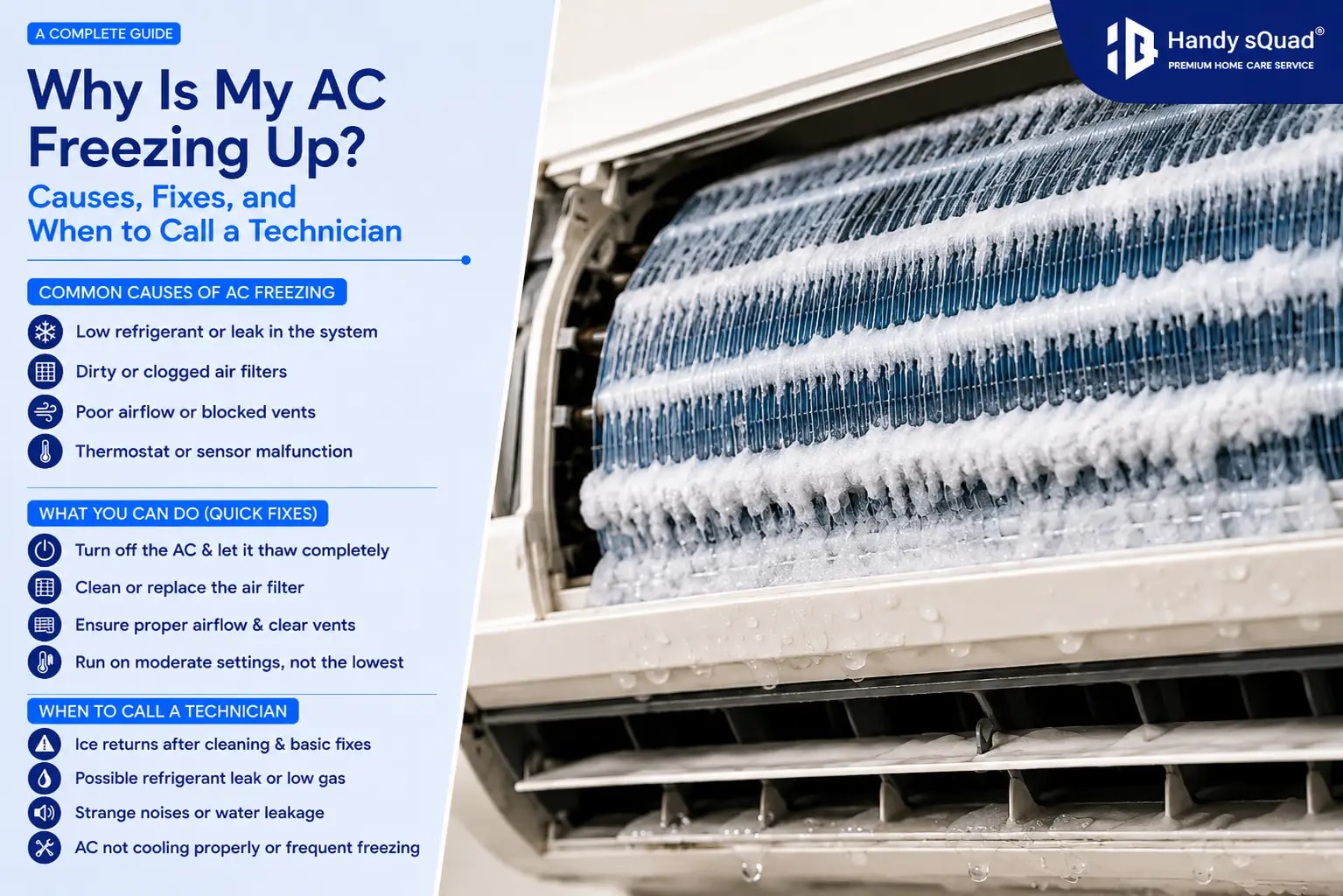
When the filter clogs with dust, the airflow over the cooling coils drops. The coils get colder than designed — sometimes cold enough to actually ice over. When the AC shuts off, that ice melts fast.
More water arrives in the drain tray than it was built to handle, it overflows, and you get water dripping inside.
In homes running the AC 10 to 12 hours a day through summer — which is most homes in Trivandrum — the filter can go from clean to problematic in three weeks. Near construction sites or
with pets in the house, sometimes faster.
Cleaning it takes five minutes. Rinse it under a tap, let it dry completely before putting it back. That's
it. One of those things that sounds too simple but genuinely prevents a lot of problems.
Ice on the Coils
If you ever spot actual frost on the indoor unit — white buildup on the copper pipes or the coil fins — switch it off. Not down, not to fan mode. Off.
Iced coils form when airflow is poor or when refrigerant levels are low. The water issue comes from the thawing, which releases more water than the drain tray can handle at once. But the real reason
to act quickly is the AC compressor.
The compressor is essentially the engine of the whole system. Running it while the coils are frozen
creates pressure conditions it was never designed for. A freeze caught early costs very little to fix. A freeze that runs for days while the unit keeps cycling can do lasting damage to the compressor — and replacing a compressor is the kind of repair that reframes what "an AC problem" means in terms of cost.
Switch it off, give it an hour or two to thaw, then call someone to find out what caused it.
Low Refrigerant
Refrigerant is what removes heat from your room. When it leaks — hairline crack in a fitting, worn seal, sometimes just age — the system loses pressure, and the coils run far colder than intended.
That leads to the freezing scenario above and eventually to water overflow.
What makes refrigerant different from a dirty filter or blocked drain is what happens over time. A clogged pipe builds up slowly. A refrigerant leak actively wears on the AC compressor week after week as it tries to compensate for the pressure loss. Catching it early is a real cost difference.
The signs tend to cluster together: the room isn't getting as cold as it should, electricity usage has quietly climbed, occasionally there's a faint hissing sound near the unit, and now there's water dripping from the indoor unit too.
Refrigerant handling requires a certified technician and proper equipment — it's not a DIY situation.
If you've been searching ac service near me in Trivandrum and you recognise these symptoms, it's worth getting someone out sooner rather than later.
Cracked or Rusted Drain Tray
Less common, but worth knowing. The tray underneath the coils that catches all the condensation is usually plastic or light metal. After years of constant moisture — five, six, seven years of daily use — it can rust through, crack, or warp enough that water bypasses the drain outlet entirely.
The giveaway is usually rust staining at the base of the indoor unit. If the drain line is clear, the filter is clean, and water is still getting into the room, a damaged tray is often what's left. Straightforward repair or replacement, relatively inexpensive compared to other AC work.
It Was Installed Wrong
We see this more than we'd like. The indoor unit needs a very slight backward tilt — just enough that condensation naturally flows toward the drain side. Mounted completely level, water pools inside the unit. Tilted even slightly the wrong way, same problem.
The drain pipe has to slope consistently downward from the unit to the outside wall. If it runs level for a stretch, or loops upward anywhere, water won't flow through it by gravity. We've come across installations where the pipe ran up over a ceiling beam before going back down — basically a built-in
reservoir that stayed full indefinitely.
Dripping that starts immediately after installation or within the first few weeks almost always comes
back to this. Quick fix: remount the unit at the right angle, re-route the drain pipe properly.
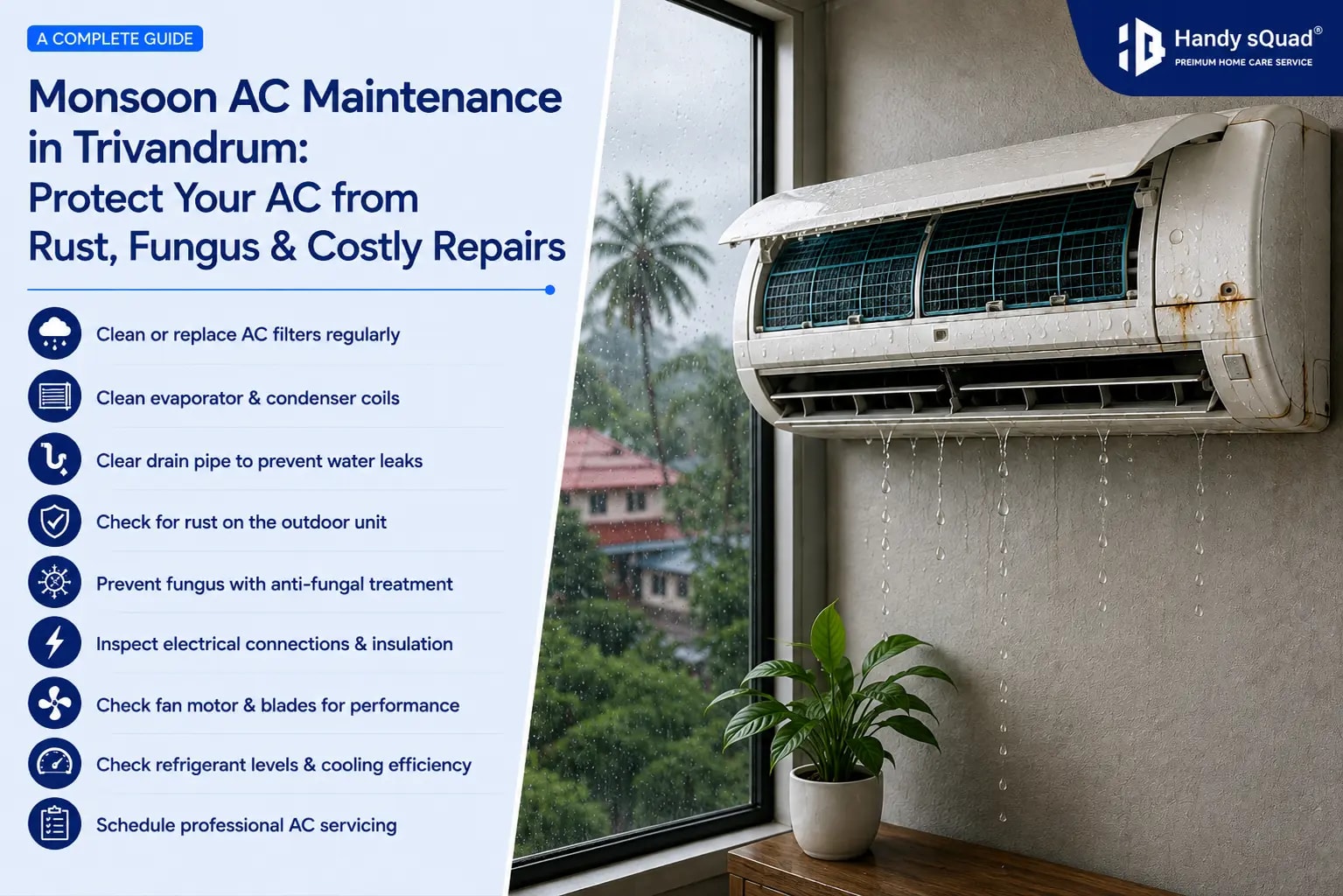
What Happens During Monsoon
This one is specific to living here.
Between May and August, Trivandrum's humidity is high enough that the AC is pulling considerably
more moisture out of the air than it does in drier months. More condensation means more water moving through the drain system, which means less margin for anything to go wrong.
A drain pipe that's 60% blocked might go unnoticed in December. In July, with the system pushing more water through it, that same partial block causes an overflow. A tray with a hairline crack that
wasn't visibly leaking in February starts leaking steadily by June.
Getting the AC serviced in April — before humidity peaks — catches small problems when they're
still small. Calling us in July means working around a fully booked schedule with a worse problem than you would have had three months earlier. We see this pattern every year without exception.
When You Really Need to Call Someone Now
Any leak that persists for more than an hour or two should get looked at. Beyond that, don't wait at all if:
There's ice visible anywhere on the indoor unit. The air coming out is warm or only mildly cool despite the AC running at full settings. There's a hissing sound from somewhere on the unit. Water
has reached the wall, ceiling, or the flooring underneath. You've cleaned the filter recently and it's still leaking.
Particularly the first three — that point toward refrigerant or compressor issues. Not the kind of thing where a wait-and-see approach works out well.
A Few Things You Can Actually Do Right Now
Go check the filter. Seriously, right after reading this. If it's been more than a month and the AC has been running daily, there's a good chance it needs cleaning. Five minutes.
Look at the drain pipe outlet on the outside wall. It's a small opening near where the pipes exit the building. Geckos nest in them. Mud daubers build in them. Sometimes it's just a solid plug of dust.
Takes ten seconds to look and clear it if needed.
If there's any dripping happening — even minor, even occasional—don't wait to see if it sorts itself
out. It usually doesn't.
And if you want to skip all of this as a concern, book a service in April. One visit before monsoon
season, drain line cleared, filter checked, coils cleaned. We've had the same customers do this every year for years, and they genuinely don't have AC problems. That's the whole point.
On Our End
Handy sQuad has been doing AC service in Trivandrum long enough that I've personally seen every version of the water dripping from AC indoor unit problem — from the quick drain flush to the refrigerant leak that had quietly been destroying a compressor for months before anyone noticed.
We show up when we say we will. We tell you what's wrong without inflating it. And we do the job properly the first time.
If your AC is dripping and you'd rather spend the afternoon doing something else — call us.
Thanks for reading