

Woke up with itchy bumps again? Three or four in a row, maybe on your forearm or the back of your neck? Most of us blame mosquitoes first. That's fair, especially in Kerala, where mosquitoes are never really off the menu. But when the itching keeps showing up after nights in your own bed and nowhere else, don't wait. Lift the mattress and check it yourself.
Nobody enjoys thinking about bed bugs. They're a lot more common than people let on, though, and finding some says nothing about how clean your house is. So here's how to spot them, what actually helps, what's a waste of effort, and when to hand it over to someone else.
Why Bed Bugs Live on Mattresses and How They Get Into Your Home
Because that's where the food is. Bed bugs live on blood, and you spend seven or eight hours a night lying still, warm, and breathing right next to them. Your mattress happens to be full of stitched seams, tags, folds, and a dark underside, which means they hardly have to travel. They don't live on you like lice. They hide close by, come out at night for a quick feed, and disappear again before morning.
And no, a dirty room isn't the cause. This is the part people hate hearing. A very clean house can have them. They come in with luggage, bags, bundles of laundry, or a second-hand sofa. Ask yourself: any recent hotel or PG stay? A relative who visited for Onam with a big suitcase? A bargain used sofa you brought home? Any one of those is enough.
What Do Bed Bugs Look Like? Signs of Bed Bugs on a Mattress
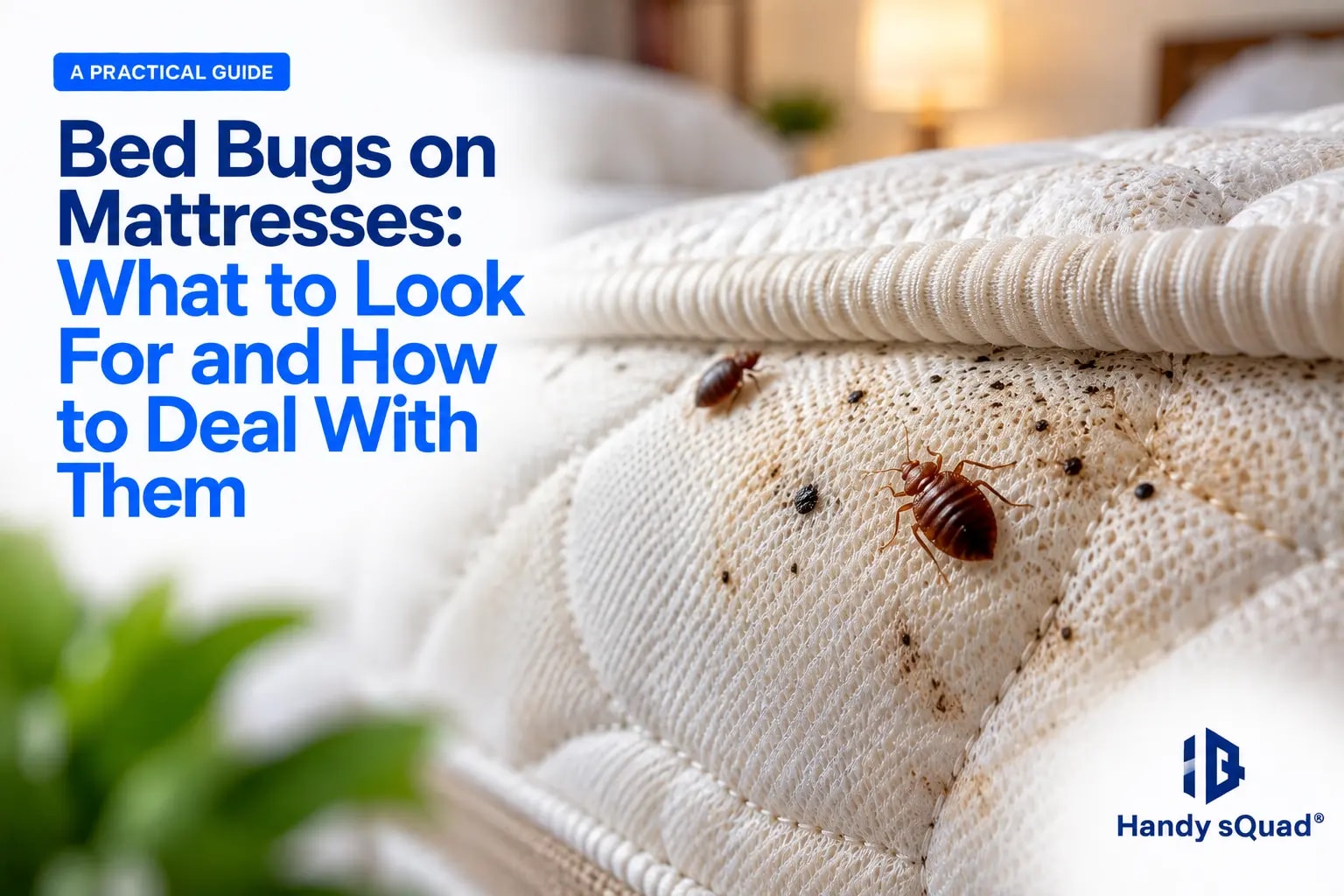
Adults are about 4 to 5 mm, roughly an apple seed. Flat, oval, reddish-brown. After feeding, they puff up and go darker. Babies (nymphs) are pale and nearly see-through, so honestly, you might miss them completely. They can't fly, and they don't jump. They just crawl quickly, and that's enough to lose them the moment you turn on a light.
Most of the time you'll find the traces first.
Tiny black dots along seams and piping. They look like someone touched a fine pen to the fabric. Wipe with a damp cloth, and they smear, which is how you tell them from ordinary dirt.
Small rusty-red marks on the sheet, usually from a bug crushed while you slept.
Empty pale shells, left behind as young bugs grow.
Tiny white eggs, about 1 mm, stuck in the folds.
A slightly sweet, musty smell, though only in heavier cases.
Bites? Useful clue, but not proof. Some people come up in red welts, some show nothing at all, and lots of other insects cause similar marks. What confirms bed bugs is finding them or their traces on the mattress.
Where to Check for Bed Bugs Besides the Mattress
Don't stop at the top of the mattress. Turn it over. Look at the base, the frame joints, the screw holes, and the slats. Got a headboard screwed to the wall? Check behind that too. After that, widen the hunt to switchboards, photo frames, peeling wallpaper, curtain folds, the sofa in the same room, and the bedside table.
They need surprisingly little space. About the thickness of a credit card. That's why "I looked everywhere and saw nothing" doesn't always mean you're clear.
Are Bed Bugs Dangerous? Bites, Health Risks, and When to See a Doctor
Not in the way mosquitoes can be. Serious diseases aren't something bed bugs are known to pass on. The damage is more of a slow grind: constant itching, scratched skin that sometimes gets infected, and nights where you can't properly relax. Children and older relatives usually feel it the most. If a bite swells badly or a rash keeps spreading, go and see a doctor.
How to Get Rid of Bed Bugs on a Mattress at Home
A few of these help quite a bit. None of them is a sure fix on its own.
First, sleep where you normally sleep. Shifting to the sofa or another room feels logical, but you might carry bugs with you and end up spreading them.
Then wash everything you can pull off the bed, meaning sheets, pillow covers, and blankets. Hot water, 60°C or above if the fabric allows it, followed by a hot dry. No dryer at home? A few hours in strong sun works. It's the heat that kills them, so don't bother buying anything fancy for the wash.
Vacuum next. Use the crevice tool on seams, edges, the frame, and the floor along the wall. Then tie up the dust in a bag and take it out of the house immediately. Don't leave it sitting in the bin inside.
If you own a handheld steamer, now's the time to use it. Move slowly along the seams, because rushing through won't hold the heat long enough to matter. It's also worth buying a zippered bed bug cover for the mattress. It traps whatever's already inside and stops new arrivals, though I'd treat it as a helper rather than the real solution. Last thing: shift the heaps of clothes and boxes away from the bed, since every pile is another hiding place.
Bed Bug Treatment Mistakes to Avoid
Insecticide fogging, for a start. It tends to push bed bugs further into walls and into the next room. Random sprays from the local store aren't dependable either, since plenty of bed bugs have built up resistance to common household products. What usually happens is a few die and the rest scatter.
Chucking the mattress out feels decisive, but it rarely solves anything. Chances are the bugs are in the frame and the wall behind it as well, so whatever mattress you buy next simply becomes their new home. And hauling the old one through the house can spread them further. Neem oil, camphor, turmeric, and other home remedies? They may put some insects off, but I wouldn't count on them to clear an actual infestation. There isn't good evidence for it.
Why Bed Bugs Keep Coming Back After Cleaning
So you cleaned, you washed, and they're still turning up. Don't beat yourself up over it; this is how bedbugs behave.
They tuck themselves into cracks you'll never reach with a vacuum, the eggs are tiny and stick to surfaces, and grown bugs can go months between meals. If even a handful survive, the count is back up in a few weeks. That's why one round of home cleaning hardly ever finishes the job. A proper treatment goes over the mattress, the frame, the walls, and furniture close by, and then a second visit to catch whatever hatches afterwards.
When to Call Bed Bugs Pest Control in Trivandrum
If you're seeing live bugs, if the bites carry on after you've done the washing and vacuuming, if it has spread to a second bed or room, or if you just want it sorted properly once, call someone. Trained technicians know where these things hide and which treatments actually work on them, and they plan the follow-up so you're not dealing with this again next month.
If you live in Trivandrum, Handy sQuad takes care of bed bug pest control for homes across the city, covering inspection, treatment, and follow-up. For reliable bed bugs pest control trivandrum service, their team can inspect your mattress, frame, and the areas around them to find where the problem really is. And when you'd rather have thorough bed bugs control trivandrum than another round of trial and error, they can handle it start to finish.
How to Prevent Bed Bugs From Coming Back
Small habits do most of the work. When you check into a hotel or PG, look at the mattress seams and headboard before you unpack, and don't put your bag on the bed. After a trip, wash your clothes and dry them hot. Check second-hand furniture properly before it comes in. Leave a mattress cover on permanently, keep washing the bedding, and run the vacuum around the bed every week or so. If there are cracks or a loose skirting board nearby, fill them in.
Final Thoughts on Dealing With Bed Bugs on Mattresses
Bed bugs on a mattress are annoying, but they can be sorted. Spot them early, avoid the shortcuts that only spread them, do what you can at home, and once it's clearly beyond a wash and a vacuum, get professionals in. The earlier you act, the less it tends to cost.
Thanks for reading