

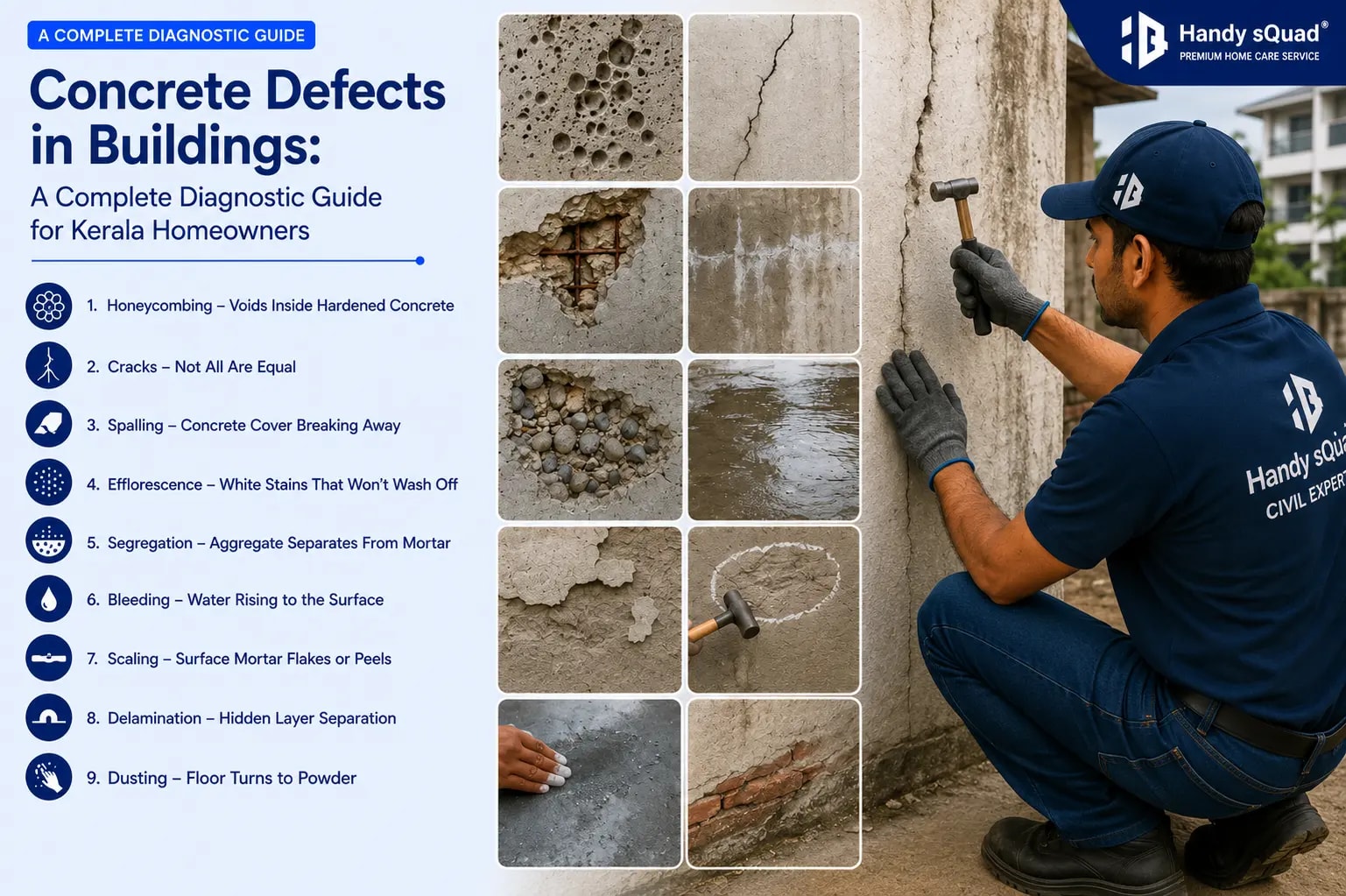
Concrete doesn't fail overnight. Long before a slab collapses or a column loses strength, it leaves clues — a hairline crack that keeps growing, a patch of wall that sounds hollow when you tap it, a white crust creeping up a boundary wall, or a floor that turns your socks grey with dust.
Most homeowners in Trivandrum notice these signs and do one of two things: ignore them because "it's just cosmetic," or panic and assume the building is about to fall. The truth is almost always somewhere in between, and figuring out which one you're dealing with is the entire game.
This guide walks through the 9 most common concrete defects found in homes, terraces, compound walls, and RCC structures across Kerala's humid, monsoon-heavy climate—what causes each one, how serious it usually is, and the first checks you can do yourself before calling in a professional.
Why Concrete Develops Defects in the First Place
Concrete is essentially a controlled chemical reaction—cement, water, sand, and aggregate curing into a rock-like matrix around a steel skeleton. Almost every defect on this list traces back to one of four root causes:
Water—too much of it in the mix, too little curing water afterwards, or moisture finding its way in from outside years later
Poor compaction or placement — concrete not vibrated, dropped from too high, or crowded around dense reinforcement
Corrosion — steel rusting inside concrete and expanding, cracking the cover from within
Mix design and workmanship errors — wrong proportions, rushed finishing, inadequate curing time
Kerala's climate makes water-related defects especially common — high humidity, heavy monsoon rainfall, and coastal salt air all accelerate the moisture and corrosion pathways above. If you own a home here, it's worth knowing what to look for.
The 9 Concrete Defects Every Homeowner Should Recognize
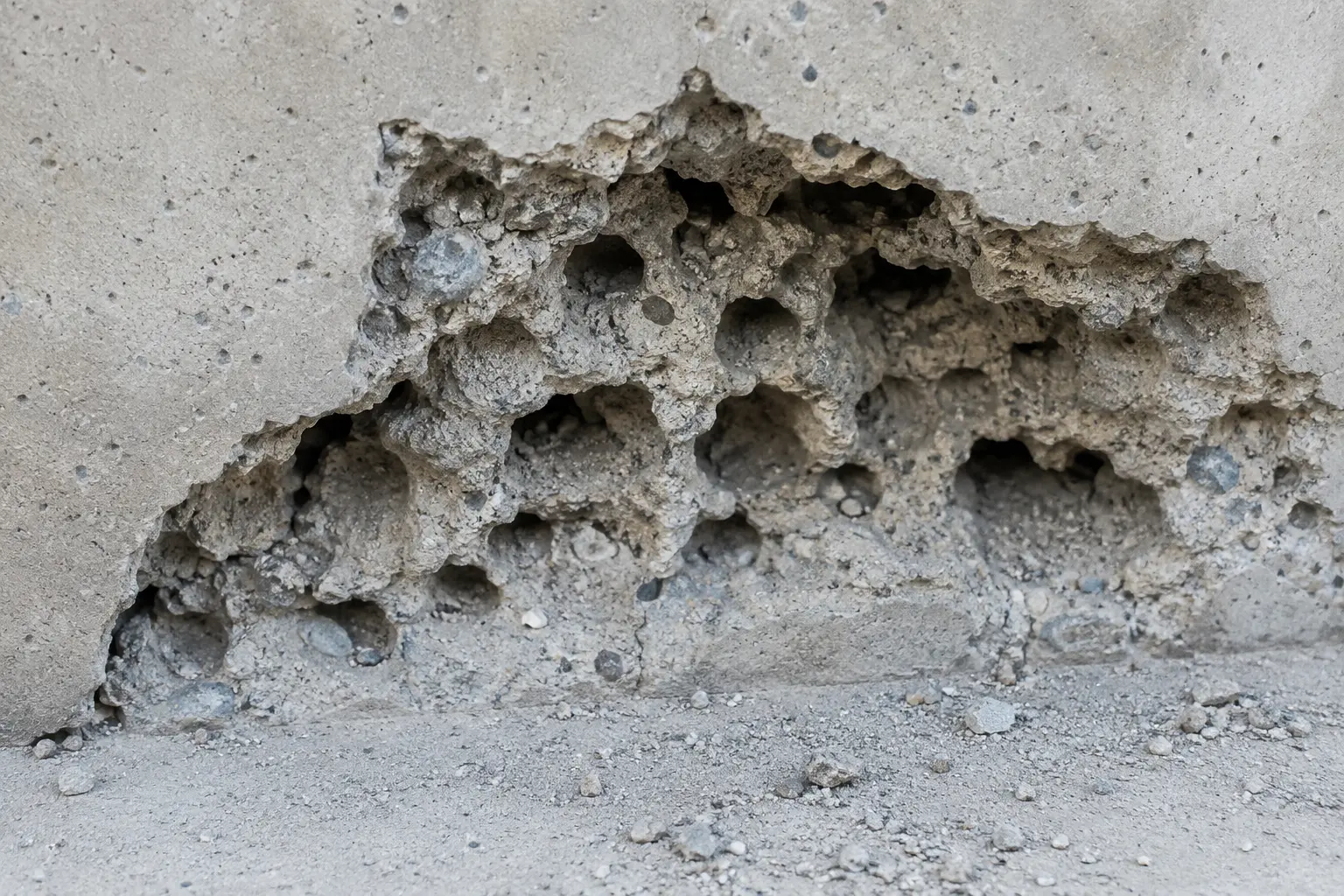
1. Honeycombing — Voids Inside Hardened Concrete
Honeycombing looks exactly like its name suggests: a pockmarked, cavity-riddled surface where mortar failed to fill around the coarse aggregate. It's caused by inadequate compaction, congested reinforcement, or a mix that's too stiff to flow properly during placement.
The danger isn't just cosmetic — honeycombing reduces strength, lets water travel straight to the reinforcement, and often extends far deeper than it looks on the surface. A patch of honeycombing the size of your palm on the outside can hide a cavity reaching the rebar. → Full guide: Honeycombing in Concrete
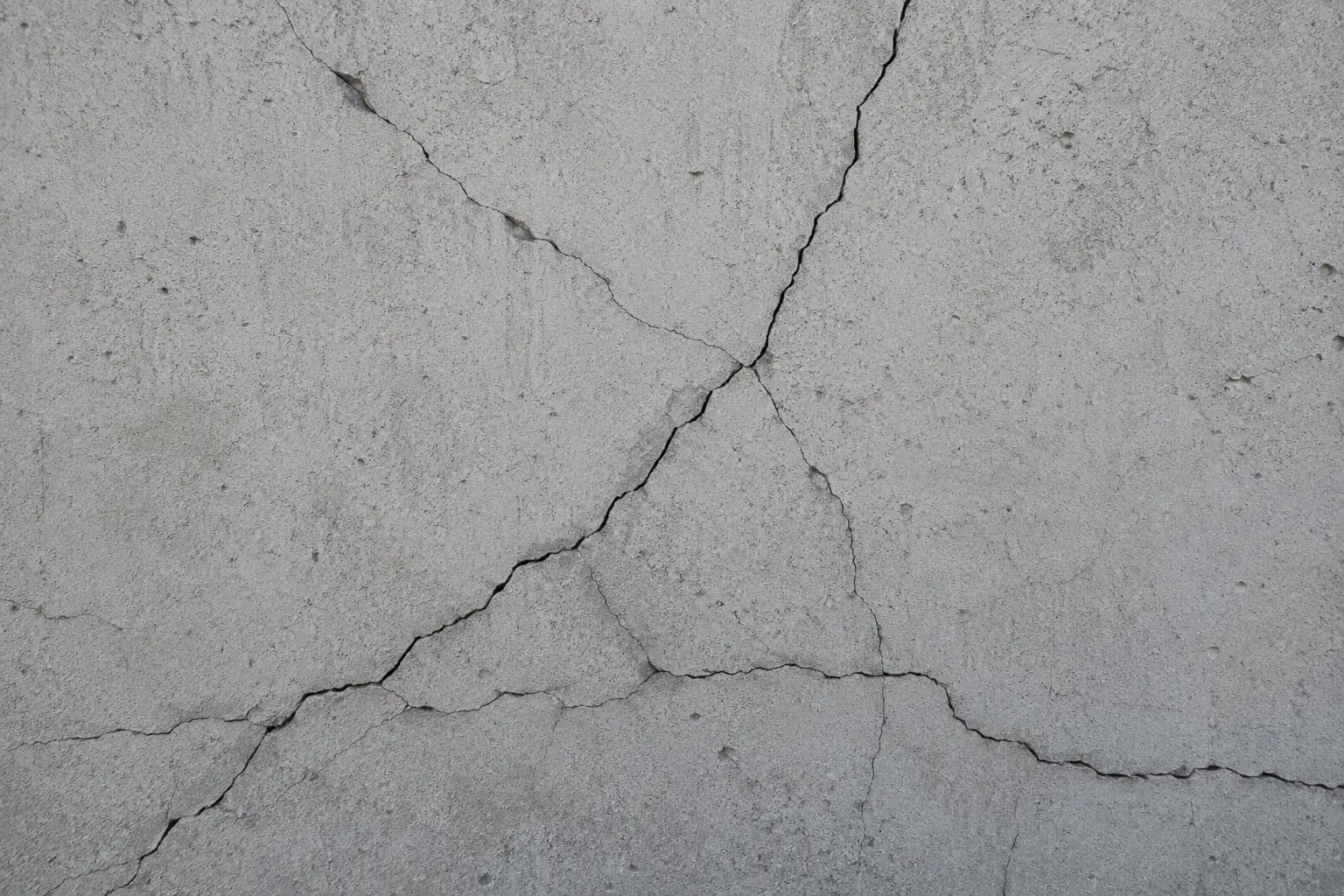
2. Cracks — Not All Are Equal
Every concrete structure cracks eventually; the question is which kind. Plastic shrinkage cracks appear within hours of placement and are usually shallow. Drying shrinkage cracks show up as fine vertical lines as the concrete loses moisture. Settlement cracks appear over openings or where the ground beneath has shifted. Structural cracks — often diagonal — are the ones that need immediate investigation, since they can indicate overloading or genuine distress in the member.
The classification matters more than the crack itself: width, direction, and whether it's still moving over time tell you far more than a single glance. → Full guide: Concrete Cracks Explained
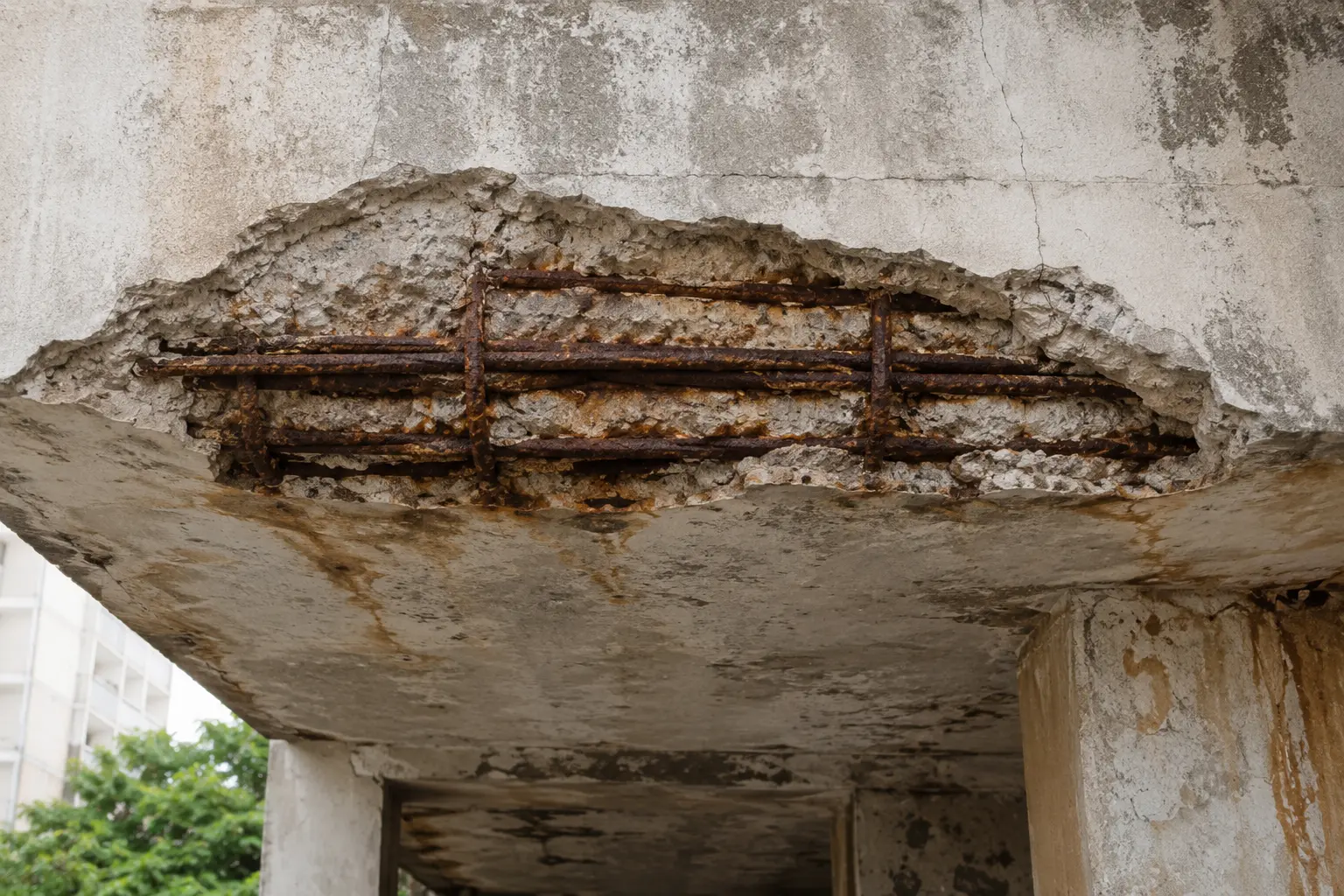
3. Spalling — Concrete Cover Breaking Away
Spalling is what happens when corrosion has been quietly working for years. Water and oxygen reach the reinforcement, the steel rusts, and rust occupies 6–10 times the volume of the original steel. That expansion cracks and eventually pushes off the concrete cover, exposing the bars underneath.
Rust staining on a wall or ceiling is often the earliest visible warning, well before any concrete actually falls away. Once you see exposed, corroding rebar, the repair needs to address the corrosion itself — not just patch over the hole. → Full guide: Spalling Concrete
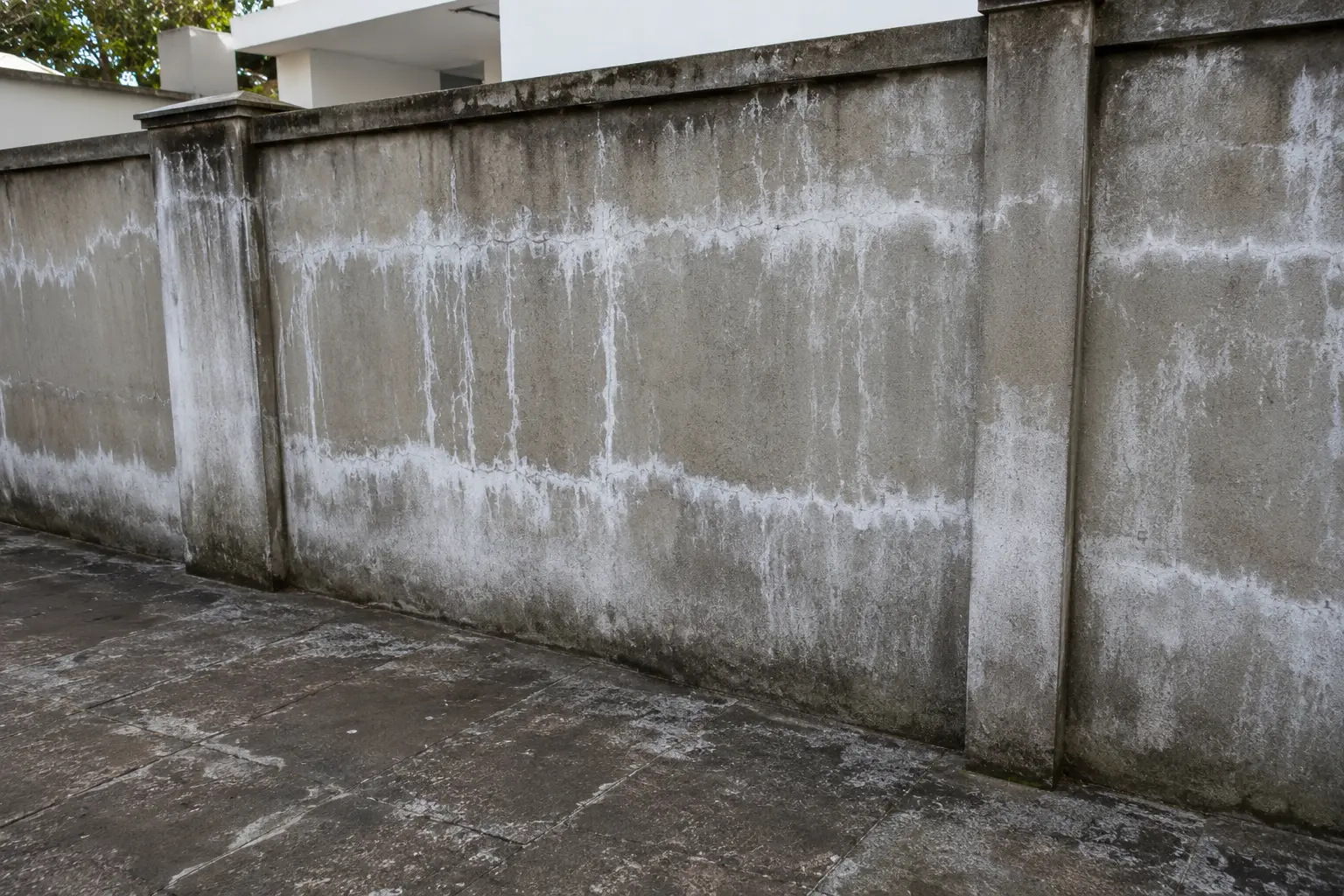
4. Efflorescence — The White Stains That Won't Wash Off
Those white, powdery streaks on a boundary wall or basement floor are salts—calcium carbonate, sodium carbonate, or magnesium sulfate—left behind after water carrying dissolved minerals evaporates at the surface. Efflorescence itself is often cosmetic, but it's a flag that water is actively moving through your concrete or masonry.
Cleaning it without finding the moisture source is a losing battle — it will simply return in a few weeks. → Full guide: Efflorescence on Walls
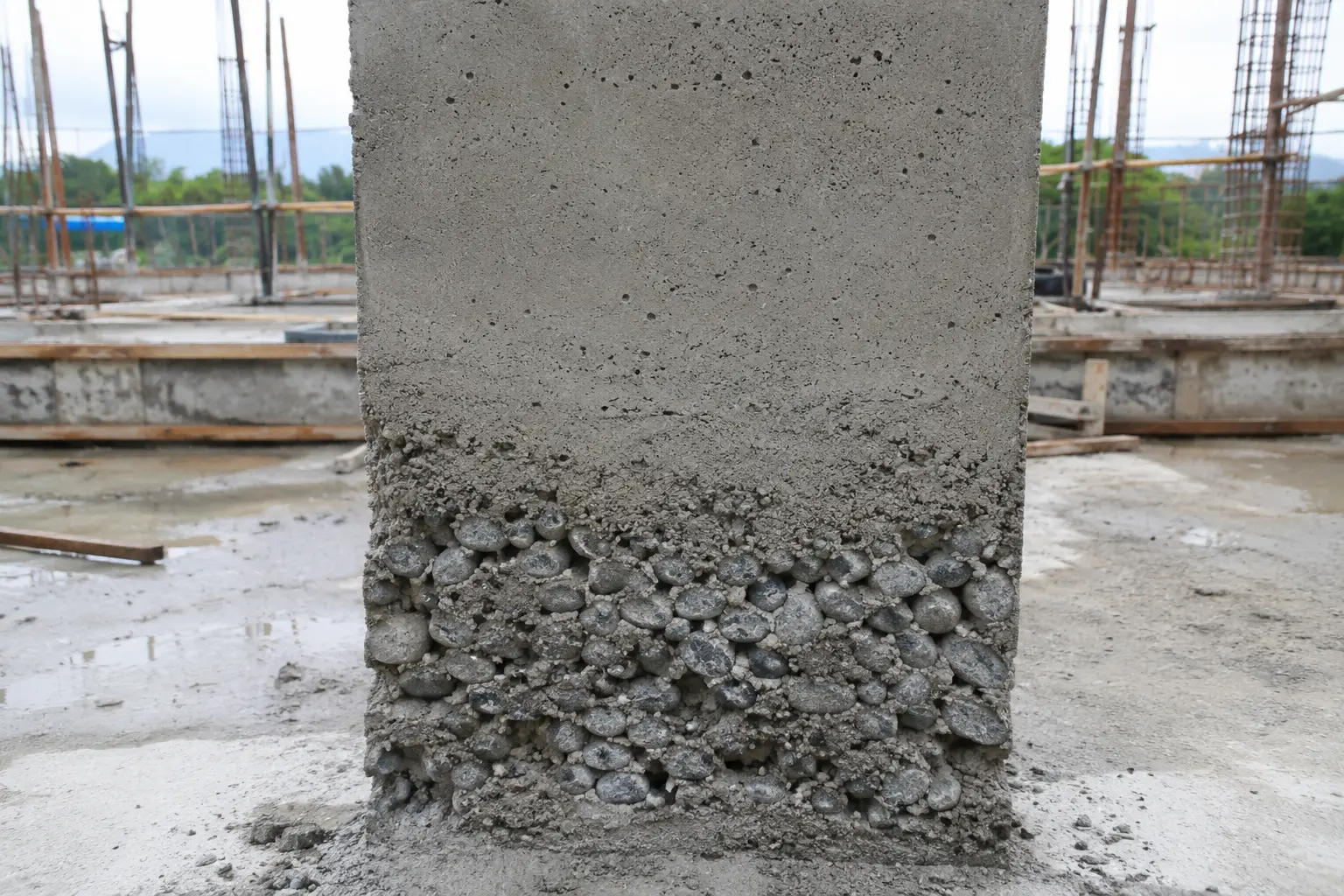
5. Segregation — When Aggregate Separates From Mortar
Segregation happens during transport or placement, when coarse aggregate and mortar separate instead of staying uniformly mixed—often from excess water, dropping concrete from too great a height, or over-vibration. The result is a column or slab with a mortar-rich zone at the top and an aggregate-heavy, weak, porous zone lower down.
It's largely a workmanship issue at the placement stage, which is exactly why site supervision during a pour matters as much as the mix design itself. → Full guide: Segregation in Concrete
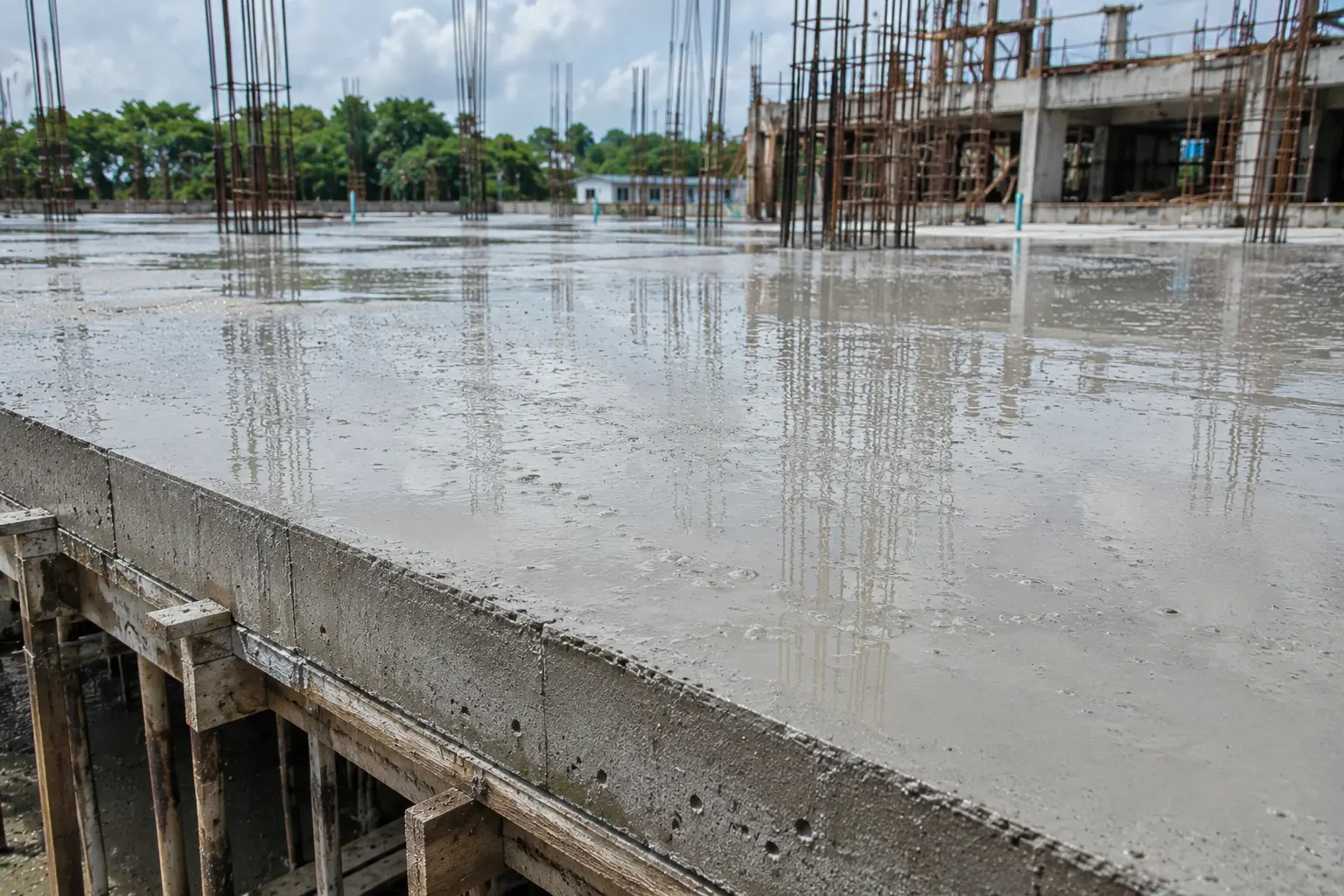
6. Bleeding — Water Rising to the Surface
In freshly placed concrete, water is naturally denser on the downside; as heavier solids settle, water works its way up through capillary channels to the surface. If a finisher trowels over that surface water instead of waiting for it to evaporate, it traps a weak, porous layer called "laitance" right at the top—the very layer everyone walks on and expects to be strong.
Bleeding is a normal part of curing in small amounts. The defect is in the finishing timing, not the water itself. → Full guide: Bleeding in Concrete
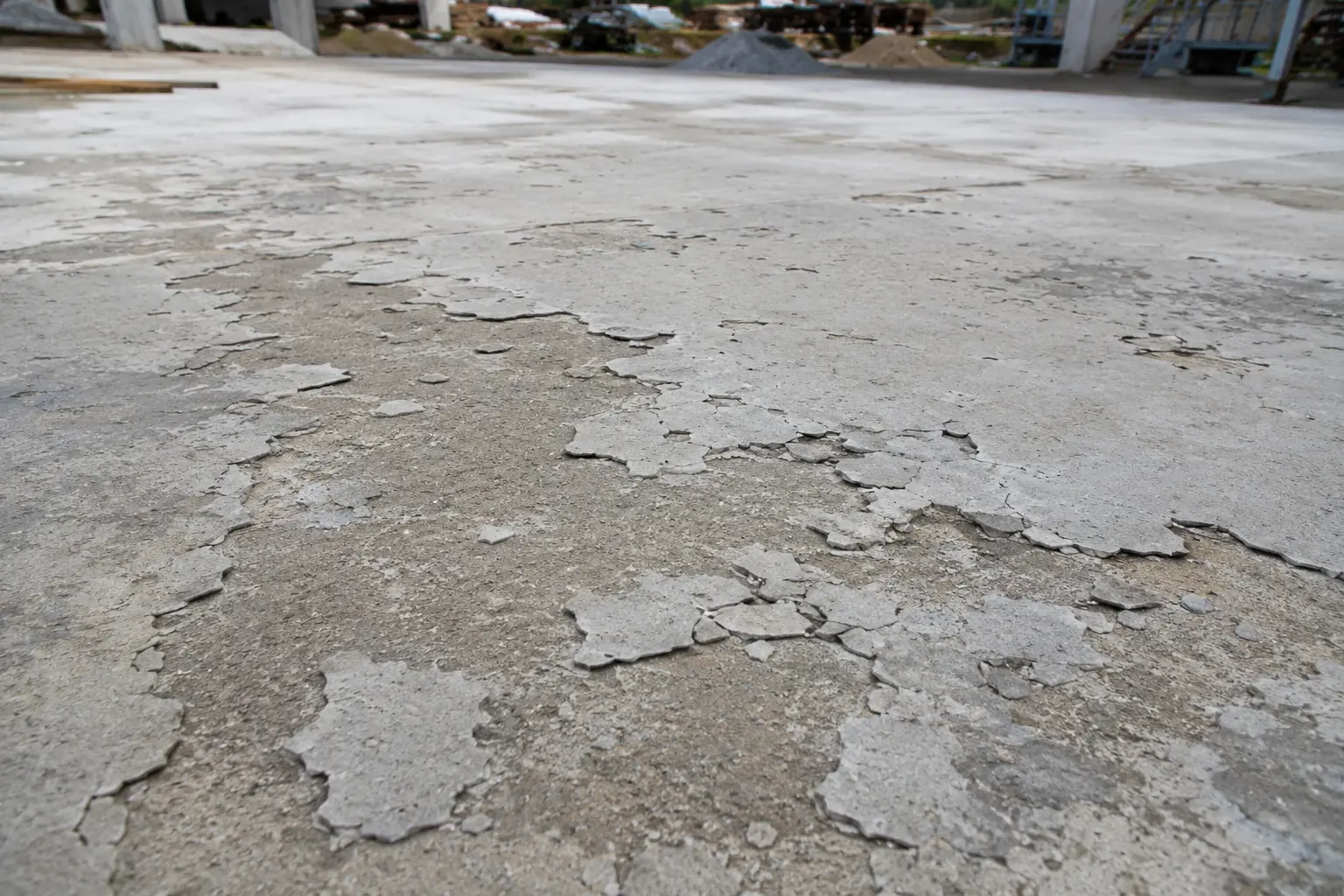
7. Scaling — Surface Mortar Flakes or Peels
Scaling shows up as flat, flaky pieces of surface mortar detaching, usually from a weak finishing layer caused by a high water-cement ratio, finishing over bleed water, or inadequate curing. From the surface, scaling and delamination can look similar — the real test is how deep the weakness goes. → Full guide: Scaling in Concrete
8. Delamination — The Defect Hiding Beneath an Intact Surface
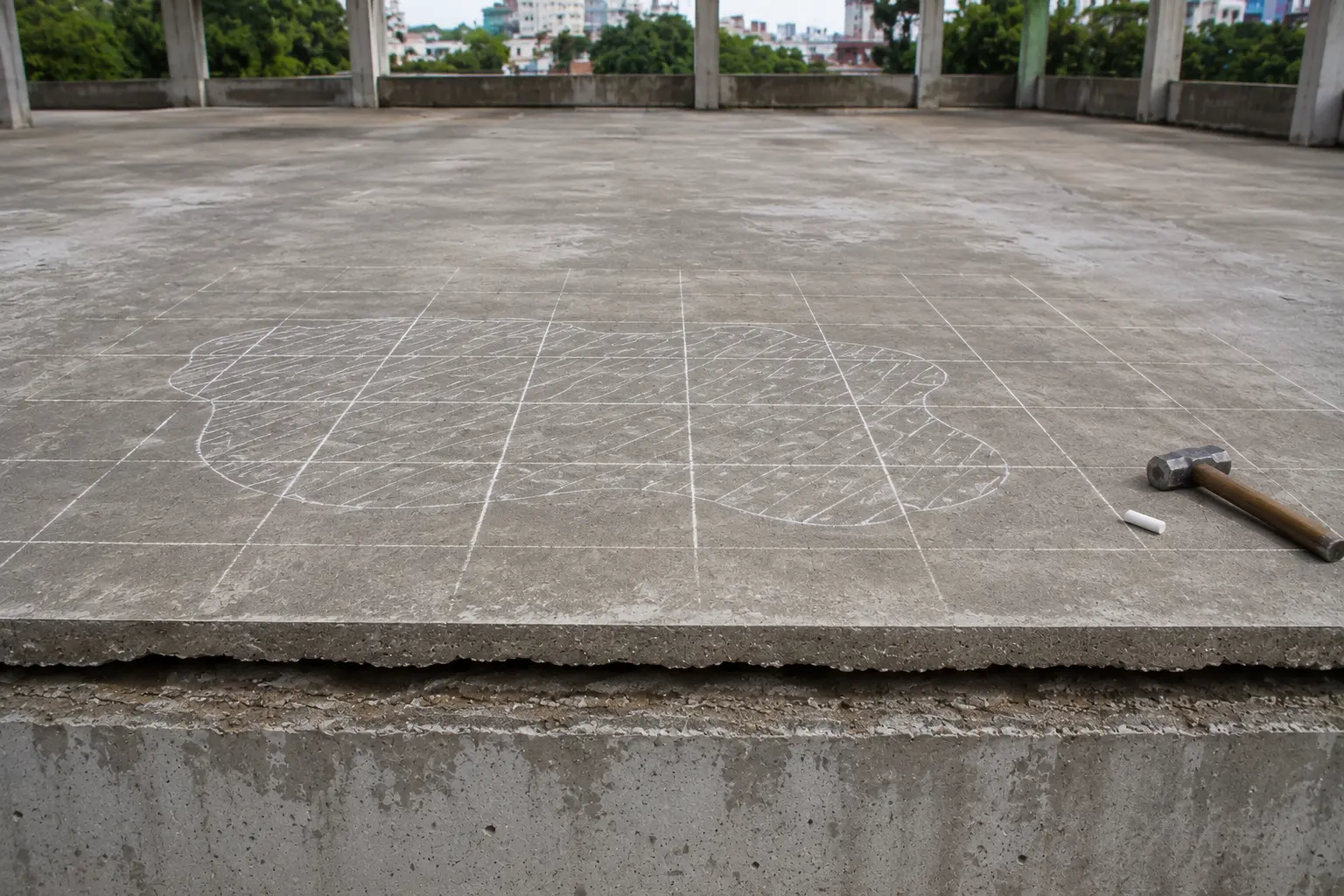
Delamination is deceptive: the top surface can look completely fine while a thin layer beneath has separated from the substrate, usually due to trapped air, corrosion, or moisture. The only reliable way to find it is sounding—tapping the surface systematically and listening for a hollow, dull note versus a solid, sharp one.
This is why professionals map delaminated zones with a hammer and chalk before deciding on any repair—appearance alone tells you almost nothing. → Full guide: Delamination in Concrete
9. Dusting—When a Finished Floor Turns to Powder
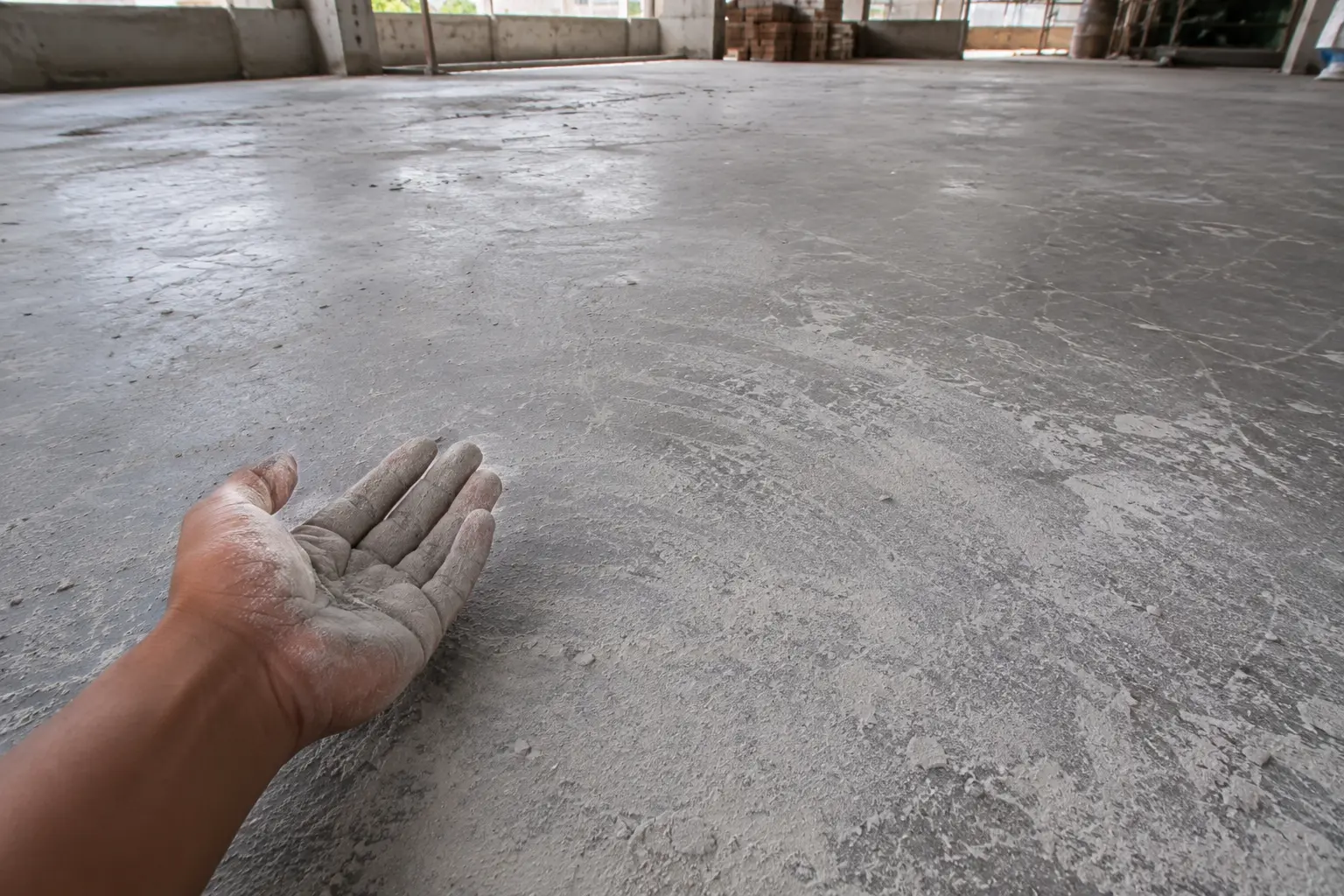
If your concrete floor releases a fine grey powder every time something rubs across it, you're looking at dusting—a weak, powder-forming layer at the very top of the slab, usually from high surface water content, finishing over-bleed water, or inadequate curing. The concrete underneath is often perfectly sound; it's just the top skin that's failed. → Full guide: Dusting in Concrete Floors
How to Do a First-Level Site Check Yourself
Before calling anyone, a homeowner can usually narrow things down with simple tools:
A hammer—tap the surface; a hollow, dull sound suggests delamination, while a sharp sound means well-bonded concrete
A crack width gauge or ruler—measure and date crack widths; if a crack keeps widening over a few weeks, treat it as active and structural until proven otherwise
A damp cloth test—wipe off efflorescence; if it returns within weeks, the moisture source is still active
A simple scratch test—rub a suspect floor patch; if it releases powder, that's dusting
None of these replaces a proper structural assessment, but they'll tell you whether you're looking at a cosmetic issue or something that needs urgent attention.
When to Call a Professional
As a rule of thumb, get an inspection if you notice:
Rust staining, especially with any visible concrete bulging or hollow sounds nearby
A crack that's diagonal, widening, or running through a load-bearing element
Any exposed reinforcement
Recurring efflorescence or damp patches that won't go away
A floor or wall section that sounds hollow across a wide area
Patching the surface without identifying the underlying cause is one of the most common (and expensive) mistakes homeowners make—a cosmetic fix over an active corrosion or moisture problem simply buys a year or two before the same defect reappears, usually worse.
Get a Proper Diagnosis Before You Repair
Every defect above needs a different repair approach—what fixes scaling won't touch spalling, and treating delamination like a surface crack usually means redoing the work within a season. If you're seeing any of these signs on your property in Trivandrum, the smart first step is a proper site assessment, not a guess.
Handy sQuad, a trusted civil contractor in Trivandrum, offers a Civil Work Inspection Consultation to accurately diagnose what's actually going on before any repair begins. Depending on what's found, our team handles it end-to-end:
Wall Crack Repair for shrinkage, settlement, or structural cracks
Concrete Repair Work for spalling, honeycombing, and damaged sections
Plaster Damage Repair for scaling, dusting, and surface-layer failures
Waterproofing Work to stop the moisture source behind efflorescence, bleeding, and recurring damp patches
Fixing the cause instead of patching the symptom is what separates a repair that lasts from one you'll be paying for again next monsoon.