

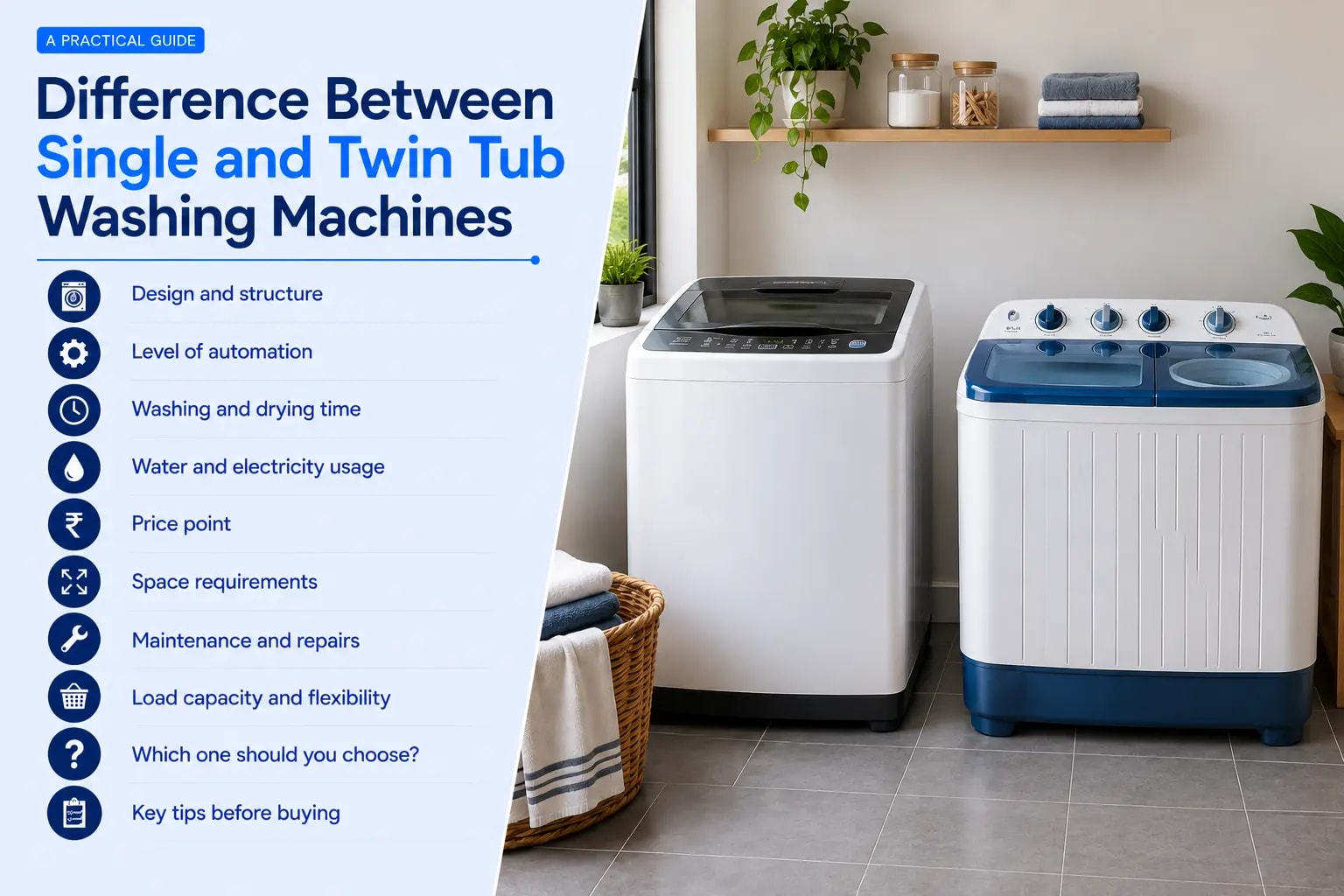
Buying a washing machine in India used to be simple—you picked whatever your neighbour had, and that was that. Not anymore. Walk into any appliance showroom today, and you'll be shown fully automatic front-loaders, semi-automatic twin tubs, single-tub models, and half a dozen variations in between, each with its own price tag and its own set of promises. If you've been going back and forth between a single tub and a twin tub washing machine, you're far from the only one. Both are common in Indian homes, but they work quite differently under the hood, and picking the wrong one usually means either paying for features you'll never touch or missing out on convenience you actually needed.
This piece walks through how single tub and twin tub machines actually differ, which type suits which kind of household, and what's worth thinking about before you spend your money. By the end, you should have a fairly clear sense of which one makes sense for your home.
What Is a Single Tub Washing Machine?
A single tub machine, as the name gives away, has just one tub handling both washing and, in a lot of models, drying too. Depending on the type, this could be a fully automatic machine—load the clothes, add detergent, pick a program, and the machine takes care of washing, rinsing, and spinning without you touching it again—or a semi-automatic single tub, where you switch manually between wash and spin functions within that same tub.
Fully automatic single tubs are what most urban Indian households buy today. They're compact, simple to operate, and once the clothes are in, there's really nothing left for you to do.
What Is a Twin Tub Washing Machine?
A twin tub, by contrast, comes with two separate compartments—one dedicated to washing, the other to spinning. Once the wash cycle finishes, you physically move the clothes from one tub to the other yourself. More hands-on, sure, but it also puts more control in your hands.
Twin tubs are almost always semi-automatic. You decide how long to wash for, and you decide when the load moves over for spinning. A lot of Indian households—especially in smaller towns, and among people watching their budget closely—still lean toward twin tubs, and there are good reasons for that, which we'll get into.
Key Differences Between Single and Twin Tub Washing Machines
1. Design and Structure
The most obvious difference is right there in the build. A single tub does everything, washing and spinning, inside one drum. A twin tub has two drums sitting next to each other, each handling its own job. Because of this, twin tub machines tend to be bulkier and eat up more floor space, even when the actual washing capacity is roughly the same.
2. Level of Automation
Single-tub machines, particularly fully automatic ones, barely need you around. Load, select, and walk away. Twin tubs need you present, or at least somewhere nearby, to shift the clothes from the wash side over to spin. If your schedule is packed and you'd rather just set it and forget it, a fully automatic single tub is going to suit you far better.
3. Washing and Drying Time
Here's something people don't expect—twin tubs can sometimes finish a full wash-and-dry cycle quicker than semi-automatic single tubs, mainly because washing and spinning can happen almost back-to-back without the drum needing to switch modes. That said, fully automatic single tubs balance this out by needing zero manual switching, so even if the cycle itself takes a bit longer, the time you spend actively managing it is much lower.
4. Water and Electricity Usage
Twin tub machines generally use water and electricity more efficiently, largely because you're the one deciding how much water goes in and how long each cycle runs. Fully automatic single tubs run on preset programs, which is convenient, but they can end up using more water than a smaller load actually needs, since the machine sticks to a fixed cycle unless it has load-sensing built in.
5. Price Point
For a lot of Indian families, this is the deciding factor, plain and simple. Twin tubs are usually cheaper than fully automatic single tubs, which makes them popular in budget-conscious homes, hostels, and smaller households. Single tubs cost more to begin with, but the convenience they offer is worth it for many people over time.
6. Space Requirements
Single-tub machines, top-load fully automatic ones especially, tend to have a smaller footprint and fit more easily into compact Indian kitchens or utility spaces. Twin tubs need more horizontal room because of the two-drum layout, which can be a real constraint if your apartment is on the smaller side.
7. Maintenance and Repairs
Fully automatic single tubs pack in more complex components—sensors, electronic controls, and motors managing multiple functions at once—so when something does go wrong, repairs tend to be more involved and cost a bit more. Twin tubs are mechanically simpler, which usually makes them cheaper and quicker to fix, and finding spare parts is generally easier too, even in smaller towns.
8. Load Capacity and Flexibility
One thing twin tubs allow that single tubs don't: you can start washing a fresh load while a previous batch is still spinning in the other tub. That's genuinely useful if you're dealing with a lot of laundry regularly, like in a bigger family or a shared household. Single tubs, in most cases, process one full load before you can start the next.
Which One Should You Choose?
There isn't a single right answer here. It really comes down to your household, your budget, and how much manual effort you're okay putting in.
A single tub, fully automatic machine probably makes sense if you want something completely hands-off, if your schedule doesn't leave much room for managing laundry manually, if you're fine spending a bit more upfront for the convenience, and if your utility space isn't too tight.
A twin tub might suit you better if you're working with a tighter budget, if you like having more control over water usage and timing, if you don't mind physically moving clothes between tubs, if a slightly bigger footprint isn't a problem, or if your area deals with inconsistent water supply and you'd rather manage that yourself.
A Few Practical Tips Before You Buy
Whichever way you lean, a few things are worth checking first. Look at your water pressure and how consistent your supply actually is—twin tubs tend to cope better when water isn't guaranteed, since you're filling and controlling it manually anyway. Think honestly about your family size too; bigger families with heavier laundry loads often benefit from a twin tub's ability to run two things at once. Don't just look at the sticker price either—factor in what you'll actually spend on water and electricity over time, because a cheaper machine upfront can cost more down the line depending on your habits. And measure your utility space before you finalise anything, since twin tubs genuinely need more room than most single tub models.
Keeping Your Washing Machine Running Smoothly
No matter which type you end up with, regular maintenance is what really determines how long it lasts and how well it performs. Clearing lint filters, descaling for hard water buildup, checking hoses for leaks, and cleaning the drum every so often—none of this is glamorous, but skipping it is how small issues turn into expensive ones.
This is where a dependable service partner makes a real difference. If you're in Trivandrum and need help—routine maintenance, a sudden breakdown, or setting up a brand-new machine—Handy sQuad's washing machine service Trivandrum covers both single-tub and twin-tub machines, with trained technicians who handle everything from small fixes to full servicing, so you're not stuck attempting a DIY repair that might make things worse.
Whether your fully automatic machine has suddenly stopped spinning, your twin tub's wash motor is acting up, or you just want annual servicing to keep things running smoothly, Handy sQuad's washing machine service in Trivandrum has you covered regardless of brand or model. Their team knows the specific mechanics of both single and twin tub setups, so you're getting the right expertise for whatever you actually own.
Final Thoughts
Single tub and twin tub washing machines both have their place in Indian homes, and honestly, neither is objectively better than the other—it comes down to what matters most to you. If convenience and minimal effort are the priority, a fully automatic single tub is likely the better call. If you'd rather have control, keep costs down, and don't mind simpler mechanics, a twin tub could serve you just as well, maybe even better depending on your situation.
Whichever one you go with, don't forget that regular servicing is what keeps a washing machine running well for years, saving you from breakdowns and repair bills you didn't see coming. Take a bit of time to think through what your household actually needs before you buy, and you'll end up with a machine that fits how you really live—not just something that looked good under the showroom lights.
Thanks for reading