

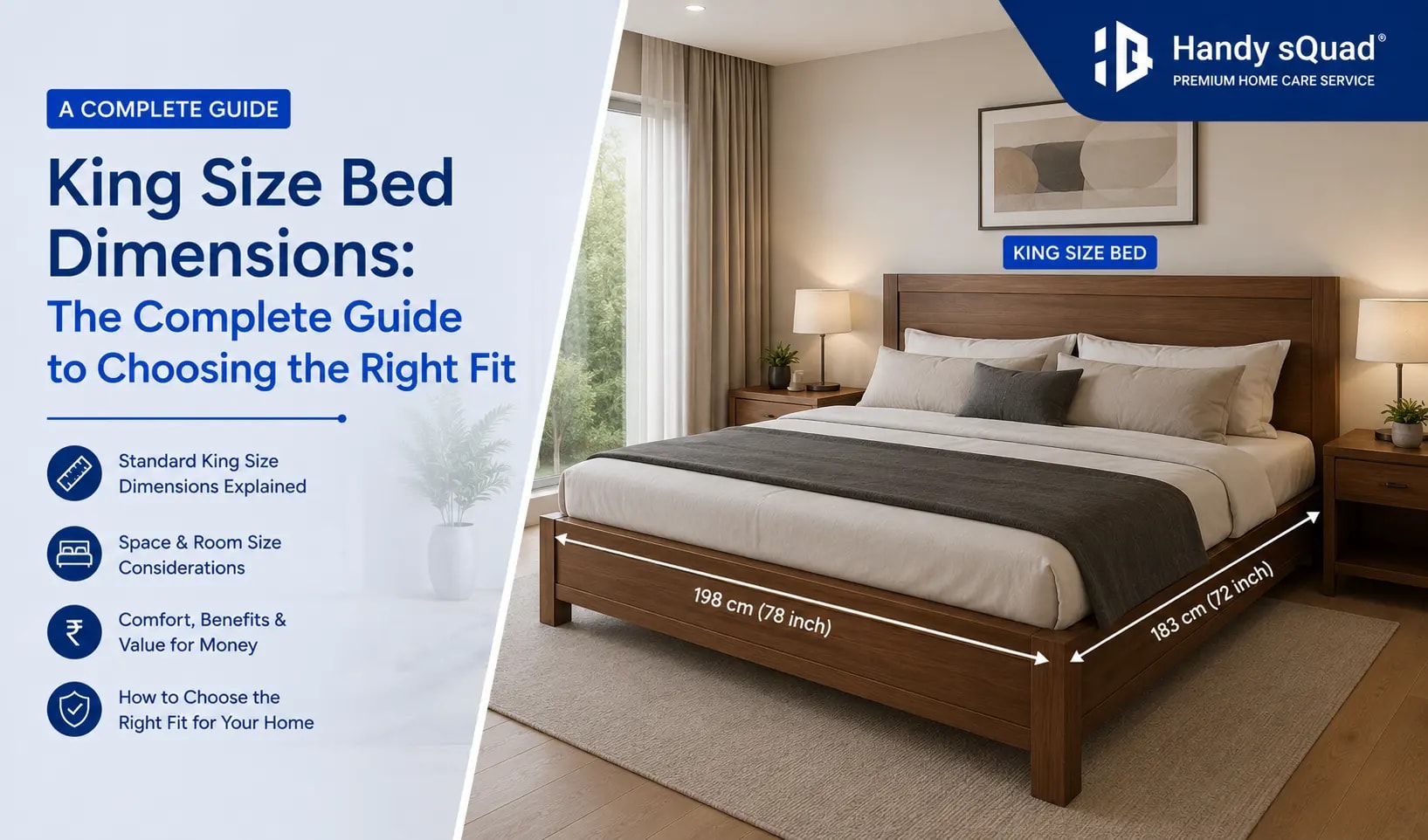
If you just want the number: a king-size bed is 76 inches wide and 80 inches long. About 193 by 203 in centimetres. Roughly 6.3 by 6.6 feet, if that's how you think. Simple enough on its own, except retailers don't always use "king size" consistently, so it's worth actually understanding what you're buying before you hand over money for one. Below is the full breakdown — measurements, what the term means, how it compares to a queen, and whether your bedroom can even take one without everything feeling squeezed.
Measurement | Inches | Feet | Centimeters |
|---|---|---|---|
Width | 76" | 6.3 ft | 193 cm |
Length | 80" | 6.6 ft | 203 cm |
These are the numbers most manufacturers work off. Still worth confirming with your seller though. Some brands round slightly differently, and in a small room, one inch genuinely changes things.
What Does "King Size" Even Mean?
Basically, it's just the name for the biggest mattress size sold in stores. Above queen, above full, and above twin. Nobody officially decided this—the mattress industry just started calling it that decades back, and it stuck, the same as "queen" did. So when a store says "king size," they almost always mean 76 by 80 inches. Occasionally, you'll see California King or Split King grouped under the same "king" label, and that's usually where people get confused mid-purchase.
How Wide Is a King Bed?
76 inches. Around 193 cm, or 6.3 feet. Sixteen inches more than a queen—which honestly doesn't sound like a lot written down, but lay two mattresses side by side and it's obvious. Roughly enough extra width for another whole person. Anyone who's slept on a queen with someone who steals the middle knows exactly what that gap fixes.
Dimensions in Feet and CM (For Comparing Listings)
Not every site lists sizes the same way, so here are all three units together:
Inches — 76" wide, 80" long. Feet — 6.3 ft wide, 6.6 ft long. Centimeters—193 cm wide, 203 cm long.
Keep this handy when you're jumping between listings and trying to figure out if two sites are describing the same mattress or something slightly different.
The King-Size Variations You'll Come Across
King isn't really one fixed size. A few versions turn up regularly while shopping:
Standard King, sometimes called Eastern King, is 76 by 80 inches—the default you'll see almost everywhere. California King runs 72 by 84, a bit narrower but longer, and taller sleepers usually prefer it for the legroom. A split king is really two 38-by-80 mattresses placed side by side, mostly paired with adjustable bases rather than a normal frame.
King vs. Queen — Which Is Bigger?
King. But only in one direction, which throws people off more than expected. A queen is 60 by 80 inches. King is 76 by 80 inches. The length is identical at 80 inches both ways. So the entire difference is width—those extra 16 inches, nothing else.
More space isn't always the win it sounds like. Plenty of people cram a king into a small bedroom and end up with less usable floor space than the queen gave them—technically, it fits, but everything around it gets tight. Measure your actual room before chasing the bigger mattress.
Measuring Your Bed the Right Way
Width goes first. Shortest side, edge to edge. Then, the length along the longest edge, head to toe. Round to the nearest inch, since mattresses aren't cut with laser precision anyway—half an inch off is completely normal.
Measure the room too, not just the mattress. Leave at least 24 to 30 inches of clear walking space around the bed, or getting up at night turns into an obstacle course. Keeping your old frame and just replacing the mattress? Measure the frame on its own—frames usually run a little bigger than what sits on top of them.
What Room Size Actually Works for a King?
General rule: 12 by 12 feet minimum before a king stops feeling like it's taking over the room. That's enough for walking space, nightstands on both sides, and maybe a dresser, depending on the layout. Smaller rooms can still fit the bed physically. There just won't be much left for anything else.
Who usually buys a king? Couples want more room at night. Parents who end up co-sleeping and need the extra space. Taller people often go for a California King instead of the added length. And people who simply like room to stretch out without overthinking it.
Setting Up the Frame the Right Way
This is where most problems actually start, and the mattress usually isn't to blame. A king frame carries far more weight and surface area than a queen frame, so it needs real support underneath—center beams doing the actual work, not just side rails holding things together loosely. Skip that part and you'll deal with sagging, creaking, and a mattress that wears out faster than it should have.
Honestly, better to hand this off than spend a Sunday wrestling with an Allen key. If you're in Trivandrum and need carpenters in Trivandrum who can put together a king frame properly, Handy sQuad does custom builds, headboard installs, and general furniture assembly, so you don't end up with a wobbly bed a few months in. Whether you want something built from scratch or just need a store-bought frame assembled correctly, a good carpenter avoids the usual issues—uneven support, loose joints, the small things that quietly wear your mattress down early. Handy sQuad's carpenter service page has the full details if you want to book one.
Frequently Asked Questions
What does king size mean?
The largest standard mattress size is sold off the shelf. 76 by 80 inches, ranked above queen, full, and twin sizes.
How wide is a king-size bed?
76 inches, about 193 cm. That's 16 inches more than a queen.
What are the measurements of a king-size bed?
76 by 80 inches. 193 by 203 cm. About 6.3 by 6.6 feet.
Which is bigger, a king or a queen?
King, because of the width alone. 76 by 80 versus a queen's 60 by 80. Length is identical.
What size room suits a king-size bed?
At least 12 by 12 feet, so there's still room to walk around and fit nightstands on either side.
How do I measure my bed size?
Measure the shortest side for width and the longest side for length, then compare against a standard size chart.
Final Thoughts
A bigger bed isn't automatically the right call. It comes down to what your room can actually handle and whether it genuinely helps you sleep better. A king does give real room to stretch out; that part's true, but only if the space around it and the frame underneath can actually support it. Sort the mattress size first. Don't skimp on the frame after. And if you're in Trivandrum, that second part is easy enough to handle—one call to a carpenter who knows the job, and one less thing creaking at 3 AM.
Thanks for reading