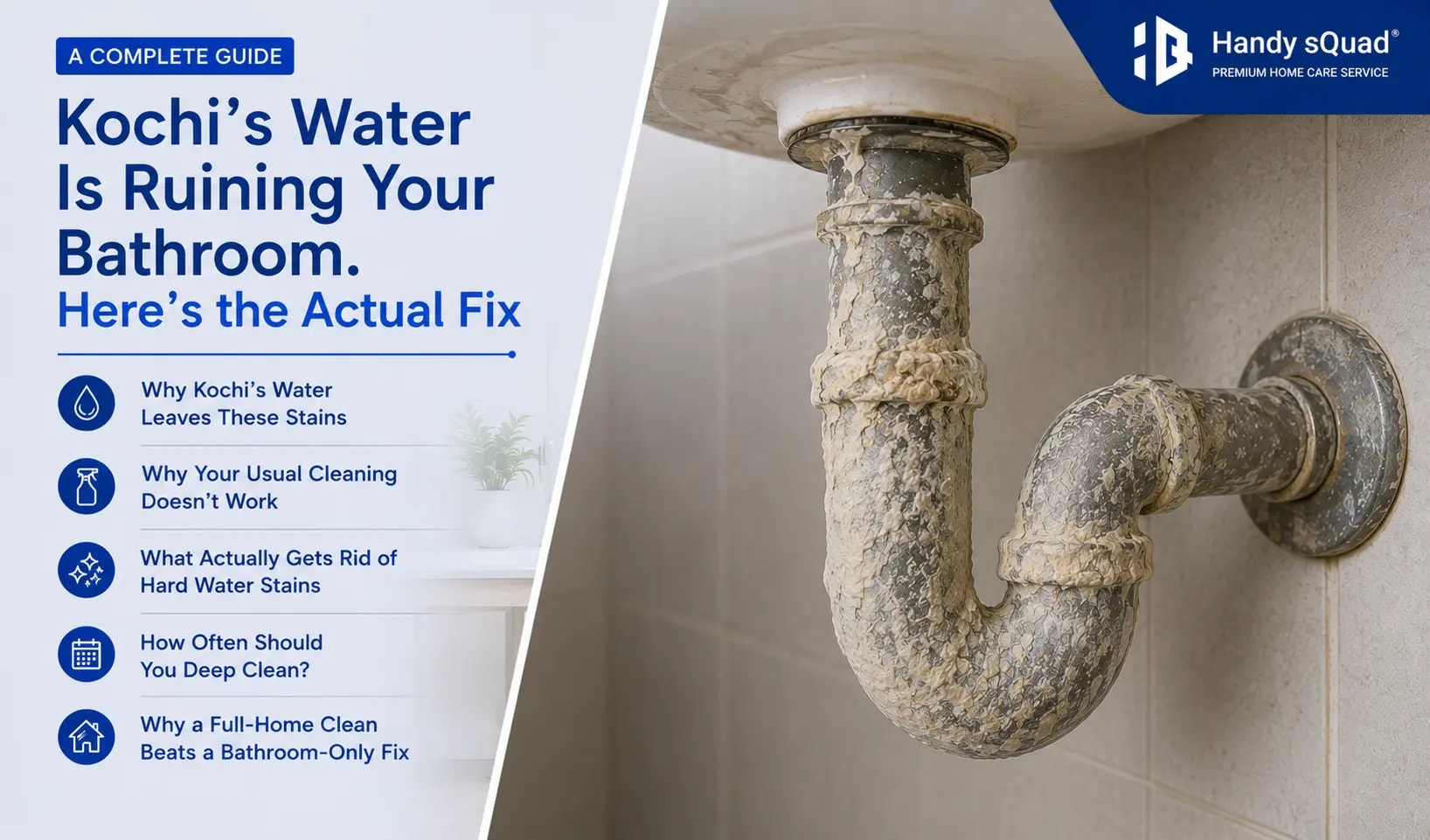
You scrub the bathroom tiles on Sunday. By Wednesday, that dull white crust is back on the taps like nothing happened. Sound familiar? If you're anywhere near Kakkanad, Infopark, or the backwaters side of Kochi, you already know this fight. And no, it's not you slacking off on cleaning. It's the water.
Kochi's water is hard — genuinely, chemically hard — and that's the whole reason this keeps happening. Below is what's actually going on, why the bottle of bathroom cleaner from the supermarket barely touches it, and what a real deep clean looks like when it's done properly.
Why Kochi's Water Leaves These Stains
Municipal and borewell water in this region tends to carry more dissolved calcium and magnesium than most people realize—an independent water quality audit found over a third of tested samples in Kochi exceeded standard hardness limits. Every single time that water sits on a tile or a tap and dries, it leaves behind a thin mineral film. Do the math on that over a few months of daily use, and you get limescale crusted around taps and showerheads, a hazy film on glass partitions that never fully wipes clean, yellow rings settling near drains and inside toilet bowls, and tiles and grout that feel rough instead of smooth when you run a finger over them.
Then throw in the monsoon and the general humidity, and things get worse fast. Bathrooms here barely get a chance, actually, to dry between uses. Mineral buildup mixes with soap residue, sometimes a bit of mold too, and the whole thing layers into grime that a sponge just isn't built to deal with.
Why Your Usual Cleaning Doesn't Work
Most under-sink cleaners are designed for dirt, oil, and soap scum. Not mineral deposits — that's a totally different chemistry problem, and it shows. Hard water stains bond to the surface rather than sit loosely on top of it, so wiping mostly just moves the film around instead of actually lifting it. Grout's porous enough that deposits sink into gaps no cloth can reach. Even the inside of your showerhead builds up limescale, quietly killing your water pressure over months without you noticing until it's pretty bad. And scrubbing harder to compensate? Often makes it worse—abrasive pads scratch glass and ceramic, and scratched surfaces grab onto stains even faster next time.
That's basically why people end up annoyed within days of cleaning their bathroom. The mineral layer underneath was never actually removed. Just pushed around a bit.
What Actually Gets Rid of Hard Water Stains
A proper deep clean isn't a stronger scrub — it's a different process entirely. At Handy sQuad, this is one of the top requests coming out of Kakkanad and Infopark, probably because most people have already tried every store-bought cleaner going.
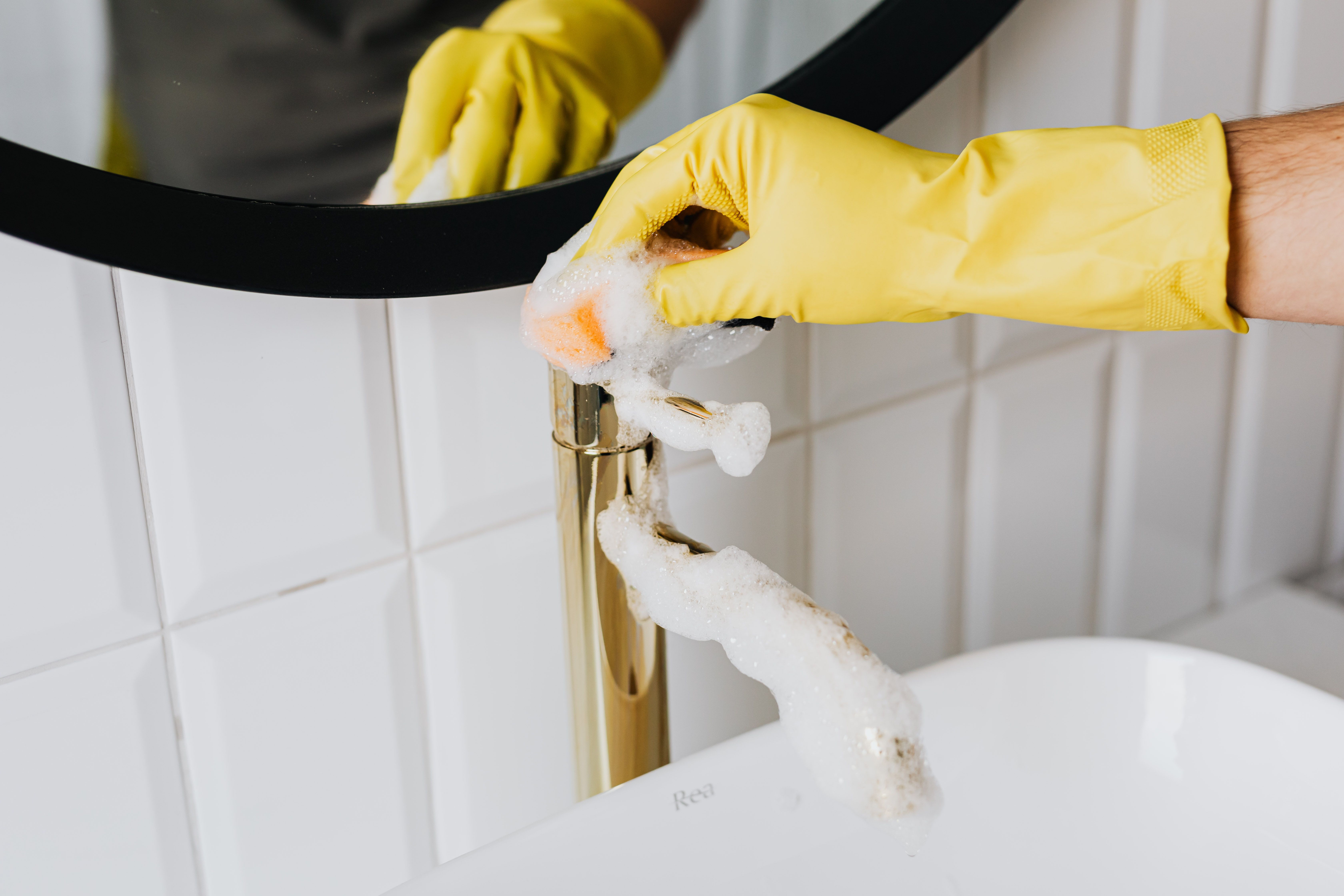
It usually starts with pH-balanced descaling agents that break down calcium and magnesium buildup without chewing into tile glaze, chrome, or glass coatings (regular acidic cleaners tend to be too harsh and dull the surface over time, which nobody wants). Steam handles the grout lines and tight corners—loosening embedded mineral deposits and mold without scrubbing at all. Showerheads and tap aerators often get taken apart and soaked separately, since, honestly, that's the only real way to clear blockages hiding inside them. Glass shower partitions need their own restoration pass to strip out the cloudy film. And if someone wants it, there's an anti-limescale sealant that can go on afterwards to slow the whole thing from coming back so fast.
It's a different tier of clean compared to a wipe-down on a Sunday morning. Closer to restoration than maintenance, if that makes sense.
Not every bathroom gets treated the same way, either. Older, porous grout behaves nothing like newer anti-scale tiling, and a bathroom four people use daily builds up differently than one that barely sees traffic. So our team actually looks at the tile type, the fittings, and how bad the staining already is—before deciding on descaling strength and how long the job's going to take.
Signs You're Past Regular Cleaning
Taps that feel gritty right after you've wiped them down. Glass partitions that stay foggy no matter what you throw at them. Grout has gone grey, yellow, and sometimes black in patches. Shower pressure that's clearly dropped off. A musty smell that just won't leave, even after cleaning. Two or more of these? The buildup's gone past what surface cleaning alone can fix, honestly.
How Often Should You Deep Clean?
Every 2–3 months works fine for most households. If you're on borewell water—which runs harder than the municipal supply, usually—monthly is safer. And doing it right before and after the monsoon is worth it regardless, since humidity speeds up mold and mineral buildup together.
Why a Full-Home Clean Beats a Bathroom-Only Fix
Something people don't always connect: the same hard water in your bathroom is running through your kitchen taps, washbasin, and utility area too. If your bathroom already shows visible limescale, your kitchen sink is probably building up the same thing quietly in the background. You just haven't spotted it yet.
That's really why Handy sQuad doesn't do bathroom-only or kitchen-only bookings as separate things. It runs as one full-home deep clean—bathrooms (tiles, grout, glass, taps, showerheads); kitchen (degreasing tiles and counters, sink descaling, chimney and exhaust); bedrooms and living spaces (dusting, upholstery, window tracks, switchboards, fan and light fixtures); balconies and utility areas too, which collect way more monsoon grime than people expect.
One visit, every wet area treated together, instead of the kitchen sink quietly staining up again a few months after the bathroom is already sorted. It's simpler for you too—one booking, one team, one day, and the whole house is done.
Getting Your Bathroom Properly Deep Cleaned
Hard water stains aren't a reflection of how clean you keep your place. It's chemistry, not effort, and it needs a fix to match. If scrubbing harder hasn't worked yet, it's probably not going to start working now.
Handy sQuad runs full-home deep cleaning across Kakkanad, Infopark, Thrikkakara, Kalamassery, and the rest of Kochi, using descaling agents and steam gear built specifically for this kind of hard water removal on tiles, grout, glass, fittings—the works. Your bathroom's handled as part of one full clean alongside the kitchen, bedrooms, living areas, and utility spaces, so nothing's left half-done.
Take a look at our deep cleaning service in kochi service page for packages, pricing, and booking a time that suits you.