

Quick story. A friend of mine moved into his new house last year, and for about a month he would not stop going on about the walls. Smooth, dead straight, not a mark on them. And then the rains. Within a week he found thin cracks running along the outside wall, plus a spot near the window that went tok-tok, like an empty coconut, whenever he knocked on it. Paint in one corner had puffed up like a blister. The bricks were fine. The plastering was the problem, and nobody had given it a second thought until that week.
Funny how plastering gets zero attention right up until it fails.
What Is Plastering Work? The Meaning in Plain Words
Plaster, in the simplest sense? A skin. Cement, sand, and water are mixed into a paste and smeared over brick or block walls and ceilings. Bare brick is lumpy and uneven and soaks up water like a sponge, so the plaster covers all that and takes the weather's abuse instead. Whatever you add later—paint, putty or tiles—needs it underneath.
Builders use the phrase "plastering work" loosely. It can mean just the coat itself, but really it covers everything around it too, from getting the wall ready to the final finish. You barely register it when it's right. When it's wrong, you notice it for years.
Plaster Material: What Actually Goes Into the Mix
Cement-sand mortar is what most houses here end up with. Here's what normally goes in:
Cement, the glue that holds it all together.
Sand, river sand, or M-sand (manufactured sand, which most Kerala sites use these days). Avoid dusty or muddy sand, because it makes everything weaker.
Clean water, and the amount matters. Too much and it shrinks and cracks. Too little and it won't bond.
Lime or gypsum, in some cases, for particular finishes or interior work.
Ratios change from site to site. You'll often hear 1:4 for outer walls with a leaner mix inside, and thickness somewhere around 12 mm indoors and 15 to 20 mm outside, though your engineer's specification beats any number I give you. What I will say is that skimping on sand quality or rushing the mixing never saves money. It just moves the bill to later.
How Plastering Is Done on Site
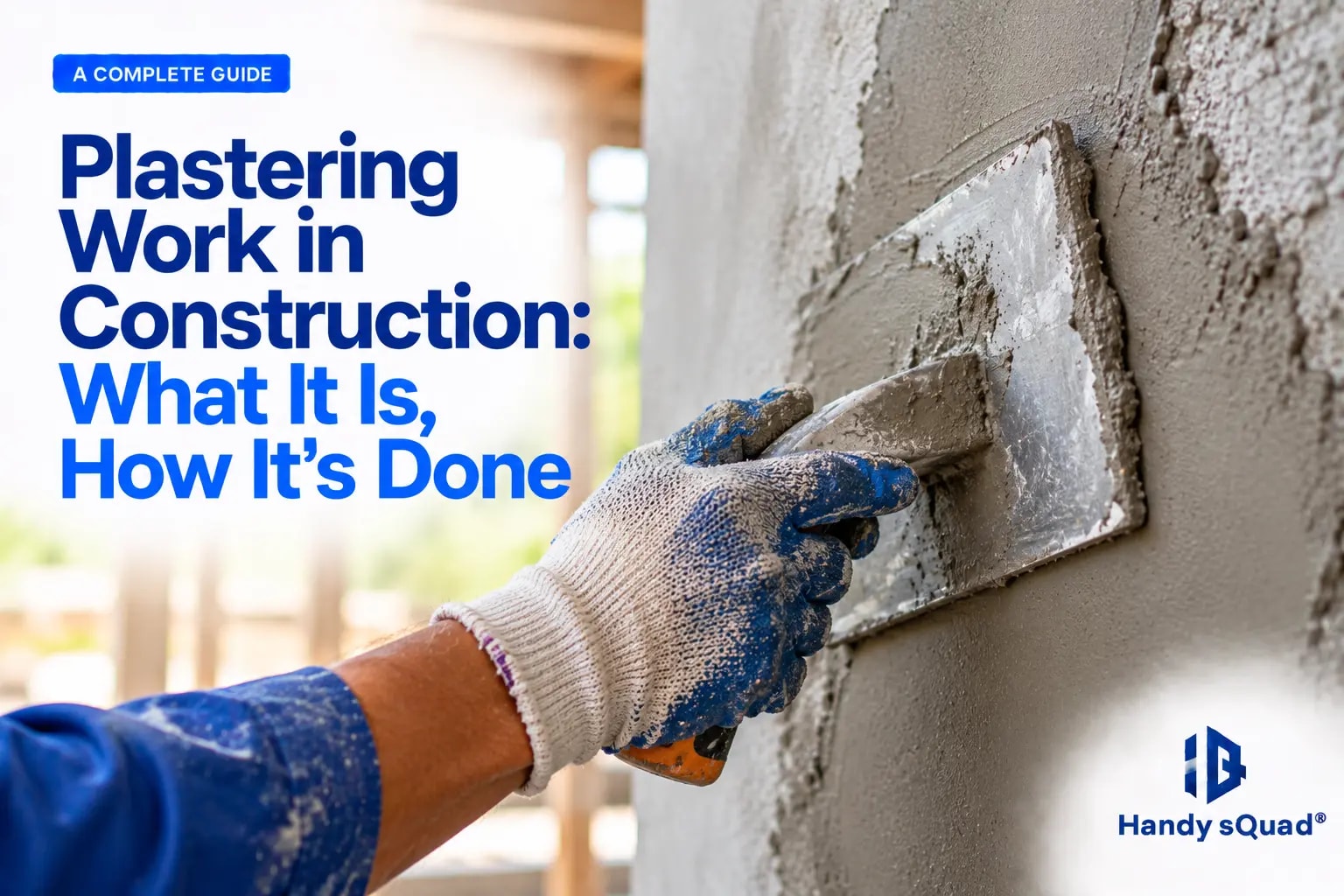
From the road, it looks like someone just slaps mortar on a wall. Not quite. There's a sequence. The wall gets cleaned and wetted first (dry brick sucks the water out of fresh mortar, and then the plaster just sits there, not bonding). Next, guide strips go up so the surface stays level. Mortar goes on, a straight edge drags it flat, and a float smooths it out. Where brick meets a concrete beam or column, things get fiddly, because the two materials don't move quite the same way, so a careful mason lays mesh across that joint. Skip it, and you'll often see a crack there within a season.
Watch a good one work, and you'll see him checking flatness every few minutes. Slow? Yes. Fussy? Also yes. Annoying when you're in a rush. But the fussing is the whole job.
Plastering Curing Time: How Long Plaster Needs Before Painting
This is the step everybody skips. Plenty of sites put the plaster on, and then nothing. No water, nobody checking, everyone already thinking about paint colours.
Cement doesn't really dry; it reacts with water, which means fresh plaster has to stay damp for it to get strong. The next day, once the surface has firmed up, start sprinkling it lightly. Carry on for roughly a week to ten days, longer if it's hot and dry. Let it dry too fast, and you get shrinkage cracks and a chalky surface you can rub off with your thumb.
Then there's the wait, which nobody enjoys. A cured wall still has moisture trapped inside it. Most painters ask for three to four weeks before putty and paint, a bit more if the plaster is thick or the weather's been wet. I know; everyone wants to move in. But paint over damp plaster, and it peels, or the colour dries patchy, and you're repainting by the next monsoon.
Pointing in Construction and the Types of Pointing
People mix up pointing and plastering constantly. Here's a simple way to keep them apart. Plaster goes over the whole wall. Pointing only fills the lines between bricks or stones on walls you've left bare on purpose. Those lines are where rain sneaks in, so pointing seals them, and honestly the wall looks a lot more finished afterwards.
Common types of pointing include:
Flush pointing, where the mortar is levelled with the brick face. Simple and neat.
Recessed pointing, where the joint is pressed in slightly. Looks sharp, but can collect water.
Struck or weathered pointing, which slopes to shed rain. Good for exposed walls.
Keyed (grooved) pointing, with a small channel pressed into the joint.
V-shaped and beaded pointing, mostly decorative.
For outdoor walls in a rainy place like Kerala, weathered or struck pointing tends to be the more practical choice.
Common Plastering Problems and Why They Happen
Cracks first, because they're what everyone complains about. Most of the time the culprit is too much cement, too much water, or no curing at all. Sometimes all three, which is a special kind of bad luck. Knock on a wall and it sounds hollow, like a drum? The plaster has come away from the brick underneath, usually because the surface was dirty or bone dry when it went on. White salty patches are efflorescence, which is moisture pushing salts out through the wall. And damp near the bottom of a wall often has nothing to do with the plaster. The water's coming from somewhere else entirely.
Most of this is avoidable, and fixing it costs far more than preventing it.
Getting Plastering Work Done Properly in Trivandrum
Good materials won't save you from careless work. Who does the job matters just as much as what goes into the mix.
If you're hunting for plastering work in Trivandrum, Handy sQuad is a decent place to start. They take on plastering along with related civil work, which means you're not chasing five different people for one wall. And if you've already typed plastering work near me into your phone because cracks or damp patches are staring back at you, get someone to look at it sooner rather than later. At that stage it's usually still a small repair.
Building something new or renovating a whole floor? Then it helps to have one team across the bigger picture. Handy sQuad's civil construction work Trivandrum service covers more than plastering, so nobody's looking at just their own piece of the job.
The Short Version
If I had to boil it down: good materials, a proper mix, curing that actually happens, and some patience before the paint goes on. See a crack, a hollow spot, or a damp patch? Don't wait to see what it does. A wall you're proud of in January can look rather sad by August otherwise.
Thanks for reading