

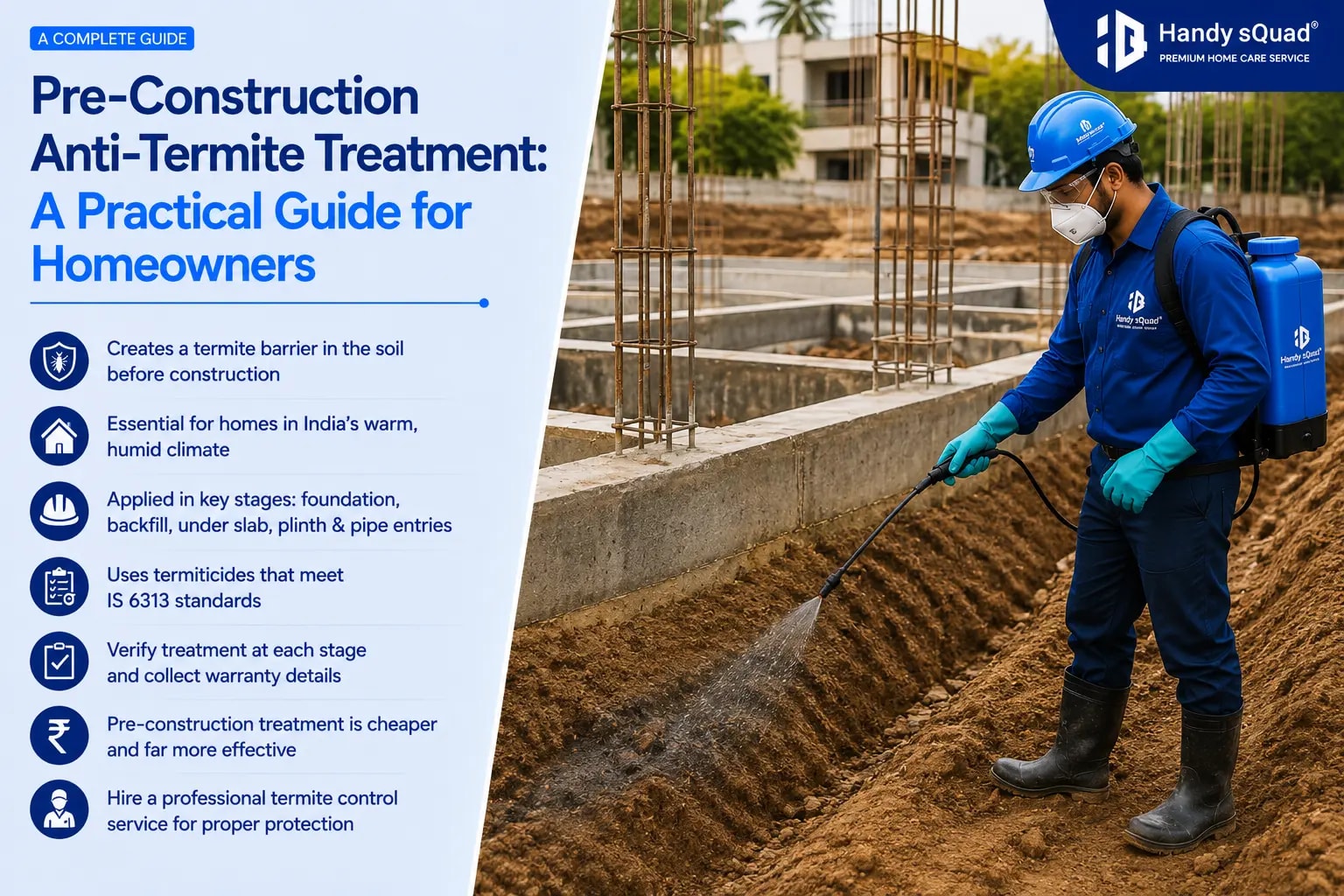
If you're in the middle of building a home, there's a decent chance "termite treatment" is sitting somewhere on your contractor's checklist, tucked between plumbing and electrical work. Most people just nod along, not really understanding what it involves or why it matters at this specific stage. It's a bit of a shame, honestly, because pre-construction anti-termite treatment is genuinely simple to get right while the building's still going up—and genuinely painful to fix once it's not.
This guide breaks down what the process actually looks like, why it happens in stages rather than all at once, and what's worth checking if you're overseeing a build right now.
What Is Pre-Construction Termite Treatment? Meaning and Purpose Explained
Put simply, it's treating the soil around and beneath a building, before construction wraps up, to create a barrier termites can't get past. Termites almost always come up from the ground through soil contact with the foundation, so the logic here is pretty direct—stop them crossing the soil, and you've stopped most infestations before they even get a chance to start.
This is different from post-construction treatment, which happens once a building's already occupied, usually involving drilling into an existing structure to inject chemicals in. More invasive, pricier, and honestly less thorough by comparison.
Why Termite Protection Is Essential for Homes in India's Climate
Termites love warm, humid conditions, which is basically most of India for a good chunk of the year. States with heavy monsoon rain and humidity that never really let up—Kerala's a good example—see termite activity in both older homes and newer builds fairly regularly. Throw in the fact that a lot of home construction here still uses a decent amount of wood—door frames, window frames, false ceilings, flooring, furniture—and you've got conditions that are pretty much ideal for termites to cause real damage, assuming nothing's stopping them.
Here's the frustrating bit: termite damage stays invisible until it's already fairly advanced. They tend to eat wood from the inside out, so a door frame or beam can look perfectly fine on the surface while being hollowed out underneath. By the time you can actually see damage, repair costs have usually climbed well past what treatment would've cost in the first place.
Pre-Construction Termite Treatment Process: Soil Barrier Method and Stages
This isn't a single application done once and forgotten. It happens in stages, each timed to a specific point in construction, and each one targeting a different spot where termites could otherwise sneak in.
First, the foundation trenches. Once these are dug but before any concrete goes in, the soil along the sides and base gets treated with a chemical solution—the first layer of the barrier, sitting right where the building will eventually stand.
Then there's the backfill soil. Once the foundation structure's up, whatever soil goes back around it needs treating too. Backfilled soil is loose by nature, which makes it an easy route through if nobody bothers treating it—an easy gap to miss if you're not paying attention.
Beneath the floor slab comes next, and this is probably the stage that matters most. Right before the ground floor slab gets poured, the soil underneath gets a proper chemical treatment, forming one continuous horizontal barrier across the whole footprint of the building. Once concrete seals over this, there's no going back—you can't just redo it later without literally breaking through the slab, so it has to be right the first time.
Around the plinth, once construction reaches that level, a vertical barrier goes in around the outside perimeter, along the base of the walls. Closes off whatever entry points might still be open from the sides.
And finally, anywhere pipes or conduits pass through the foundation or slab—plumbing, electrical, that sort of thing—these are notorious weak spots in an otherwise solid barrier. It's worth double-checking these specifically get treated, since it's easy for a gap to slip through unnoticed right around a pipe.
Get all of this right, across every stage, and you end up with a barrier — under and around the whole building — that termites genuinely struggle to get through.
Termiticide Chemicals and IS 6313 Standards for Termite Treatment
Modern pre-construction treatments generally rely on chemicals called "termiticides," diluted and applied straight into the soil. These are built to stay effective for a long time — often several years, sometimes well past a decade, depending on the exact product, the soil type, and local conditions. In India, most treatment methods follow the IS 6313 standard, which spells out specifications for anti-termite treatment in buildings, chemical concentrations, application methods, all of it. Worth asking your contractor or pest control provider whether the treatment they're using actually complies with this—it's a fair benchmark for quality and safety and a reasonable question to ask upfront.
Termite Treatment Checklist: What to Verify During Construction
If you're managing the build yourself or just keeping a close eye on your contractor, a few things are worth confirming directly rather than assuming they've been sorted.
Make sure treatment's actually happening at each stage mentioned above, not just once somewhere near the start. Ask exactly which chemical's being used, and get documentation or product details if you can. Confirm there's a warranty period attached — most reliable providers offer one — and understand what it actually covers if termite activity shows up later anyway. And if possible, be around, or have someone around, specifically during the floor slab treatment, since that's the one stage you really can't fix easily after the fact.
Cost of Skipping Termite Treatment: Pre- vs. Post-Construction Comparison
Tempting, sure, especially with construction costs piling up everywhere, to treat this as optional or something you can bolt on later if needed. In practice, though, skipping it almost always costs more down the line. Post-construction treatment on an already-built home is more invasive, generally pricier per treatment, and less thorough than a proper soil barrier laid during construction. And if termites do get in before any treatment happens, you're now also looking at repair costs on top of everything—damaged wood, furniture, and sometimes structural elements.
Hiring a Professional Termite Control Service for New Construction
Not really a step to leave to chance or to a contractor treating it as an afterthought. Proper pre-construction treatment needs the correct chemicals, applied at the right concentration, at each of the stages above. Miss one, and the barrier's got a gap termites will eventually find.
If you're building right now, it's worth bringing in an experienced termite treatment trivandrum provider early—ideally before foundation work even starts—so treatment can be scheduled around your construction timeline rather than squeezed in last minute. And if you're further along or dealing with an existing home where treatment wasn't done properly, a reliable termite control trivandrum team can assess things and tell you what actually needs doing.
Final Thoughts
Pre-construction anti-termite treatment is easy to underestimate simply because the payoff isn't visible—there's no dramatic before-and-after here, just years of a home that never develops a termite problem to begin with. Given how much cheaper and simpler this is to get right during construction versus fixing an infestation later, though, it's worth the attention. Building right now? Make sure this is genuinely on your contractor's checklist, and confirm each stage is actually happening, not just assumed.
The termite treatment professionals at Handy sQuad follow the correct process at every construction stage, using treatments suited to your soil and building type, so your home gets real protection from the ground up instead of a termite problem showing up years after you've already moved in.