

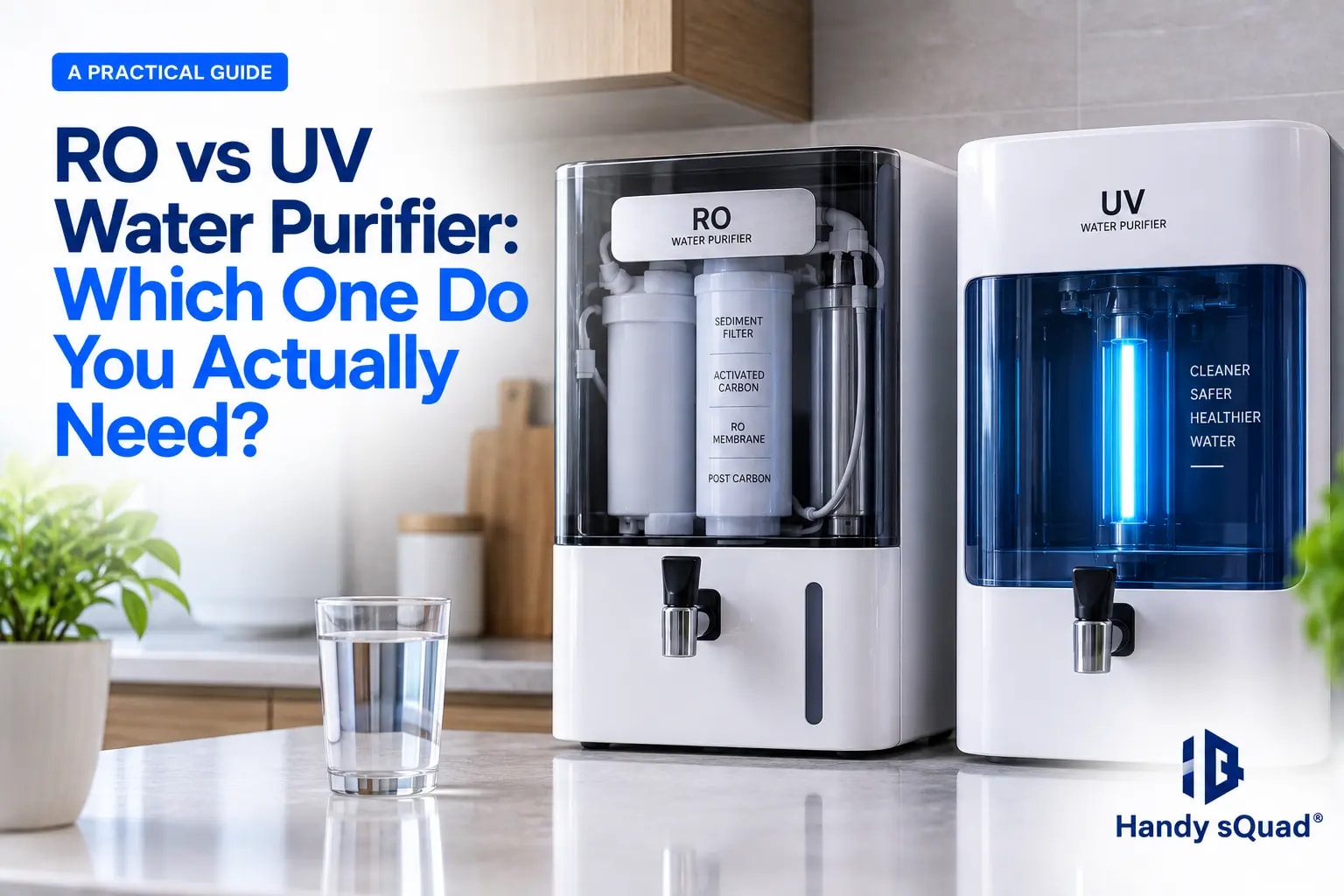
Walk into any electronics store in Trivandrum looking for a water purifier, and you'll get hit with terms like RO, UV, and UF, sometimes all three crammed into one unit with a price tag to match. Most people end up buying based on whatever the salesperson pushes hardest, rather than actually understanding what their own water needs. Not a great way to decide on something your family drinks every single day.
Here's what RO and UV actually do, how they work on completely different principles, and how to figure out which one, or which combination, genuinely makes sense for your water source in Kerala.
What Does UV Purification Actually Do?
UV (ultraviolet) purification is purely about disinfection, nothing more. Water passes through a chamber where UV light hits it, disrupting the DNA inside bacteria, viruses, and other microorganisms. Doesn't technically kill them, not in the strict sense. It scrambles their genetic material so they can't reproduce or cause infection, which effectively makes them harmless even though they're still physically floating around in there.
Here's the part people often miss. UV does nothing to remove dissolved solids, minerals, heavy metals, or chemical contaminants. Not a thing. It's purely a biological safety layer. High concentration of dissolved salts in your water? Excess fluoride, arsenic, lead? A UV purifier won't touch any of it. It also needs water that's already fairly clear to start with, since suspended particles and turbidity can shield microorganisms from the light and cut its effectiveness significantly.
What Does RO Purification Actually Do?
RO, reverse osmosis, runs on a completely different principle. Water gets forced through a semi-permeable membrane, pores small enough to block dissolved salts, heavy metals, and most contaminants, letting purified water molecules through. That's why RO systems get rated by how much they cut TDS, total dissolved solids, basically everything dissolved in your water that you can't actually see with your eyes.
The catch with RO is water wastage. Roughly every 10 litres going into the system, only about 6-7 litres come out the other end as purified drinking water. The rest goes down the drain as a concentrated reject stream, carrying off the excess minerals and contaminants with it. RO also strips out beneficial minerals like calcium and magnesium right alongside the harmful stuff, which is exactly why a decent RO unit adds a remineralisation stage afterwards, putting back a controlled amount of essential minerals instead of leaving you with water that's completely stripped.
Does Drinking Very Pure Water Harm You?
Worth clearing this up directly, there's a fair bit of confusion floating around it. Some people worry that RO-purified water, being low in minerals, somehow leaches electrolytes out of your body or causes deficiencies over time. Not accurate, at least for normal drinking. Your mineral intake from actual food—dal, vegetables, dairy, grains, dwarfs, or whatever tiny amount you'd get from mineralised tap water- and it's not even close. Your kidneys actively regulate electrolyte levels in your blood too, rather than just passively matching whatever you happen to be drinking, so normal water intake, even the low-mineral kind, doesn't meaningfully throw that balance off.
The real exception is prolonged, intense physical exertion in the heat, hours of strenuous activity with heavy sweating, where electrolyte replacement through drinks or supplements genuinely matters, regardless of what kind of water you're on that day. For everyday household use, though, it just isn't something worth losing sleep over.
What About TDS Levels Specifically?
TDS by itself isn't a great indicator of whether water's actually safe. Water sitting around 100-150 ppm, sometimes even lower, is generally fine to drink. It often tastes better too, thanks to that slight mineral presence, compared to water stripped down to near-zero TDS, which a lot of people find flat or oddly tasteless. What matters more than the number itself is what's actually dissolved in there. Fluoride, arsenic, lead, and certain heavy metals are genuinely harmful even in tiny amounts, while calcium and magnesium at normal levels aren't a concern at all. They're actually good for you.
Genuinely worried about your water quality? Get it tested properly through a lab rather than leaning on a TDS meter or DIY strips. Gives you a much clearer picture of what's actually in your supply and what treatment approach genuinely fits it.
Water Quality Considerations Specific to Trivandrum and Kerala
Municipal water in Trivandrum mostly comes from surface water sources, and TDS tends to run lower to moderate compared with the groundwater-heavy regions up north. That said, quality shifts noticeably during the monsoon. Heavy rain pushes turbidity up and raises the risk of microbial contamination in the supply, even without TDS spiking much on its own. This is exactly where UV disinfection earns its keep, guarding against biological contamination that gets more likely once supply water turns murky during heavy rains.
Households on borewell water, more common on the outskirts and independent houses rather than apartment complexes on municipal lines, tend to see a lot more swing in TDS and mineral content, sometimes running well above municipal levels. In those cases, RO filtration becomes a lot more relevant for handling dissolved solids than UV managing things on its own.
So Which One Should You Actually Choose?
Municipal supply with generally low TDS, and your main worry's biological safety rather than dissolved contaminants? A UV purifier on its own can work as a practical, low-maintenance, water-efficient choice, since it skips the wastage RO systems come with. Fits a good chunk of urban Trivandrum households reasonably well, particularly outside monsoon when turbidity stays manageable.
Borewell water, noticeably high TDS, or specific worries about fluoride, arsenic, or heavy metals? An RO system, or an RO plus UV combo, makes a lot more sense here. Combination units have become the default in plenty of Indian households exactly because they cover both bases at once, with RO taking care of dissolved solids and chemical contaminants and UV handling biological safety, particularly handy when your water source shifts in quality across seasons.
Infants, young children, or family members with existing health conditions at home? Lean cautious. Go with a proper RO plus UV combination, ideally after getting your water tested, rather than just assuming your local supply's fine without actually checking.
Getting the Right System Installed Properly
Picking RO or UV is only half the job. Proper installation matters just as much for how well the thing actually performs: correct plumbing, right pressure settings for RO systems specifically, and making sure the remineralization stage is actually doing its job rather than just sitting there as a line on a spec sheet.
If you're in Trivandrum and need help picking or setting up the right system for your water source, Handy sQuad offers professional water purifier installation Trivandrum covering RO, UV, and combination units across brands. Their team can help work out what actually suits your household based on your water source and usage, rather than just bolting in whatever unit you bought without any real guidance on whether it fits your needs.
Final Thoughts
RO and UV solve genuinely different problems, and getting that difference straight matters a lot more than most people realise while they're standing in a store trying to pick between models. UV handles biological safety efficiently, with no water wasted, but does nothing about dissolved contaminants. RO handles dissolved solids and chemical contaminants thoroughly, but wastes water doing it and needs proper remineralisation so your water doesn't end up completely flat.
Skip the brand name and the showroom sales pitch. Get your actual water source tested, find out what's really in it, and pick a system, or a combination, that genuinely addresses your household's real water quality rather than some generic idea of what "purified" is supposed to mean.