

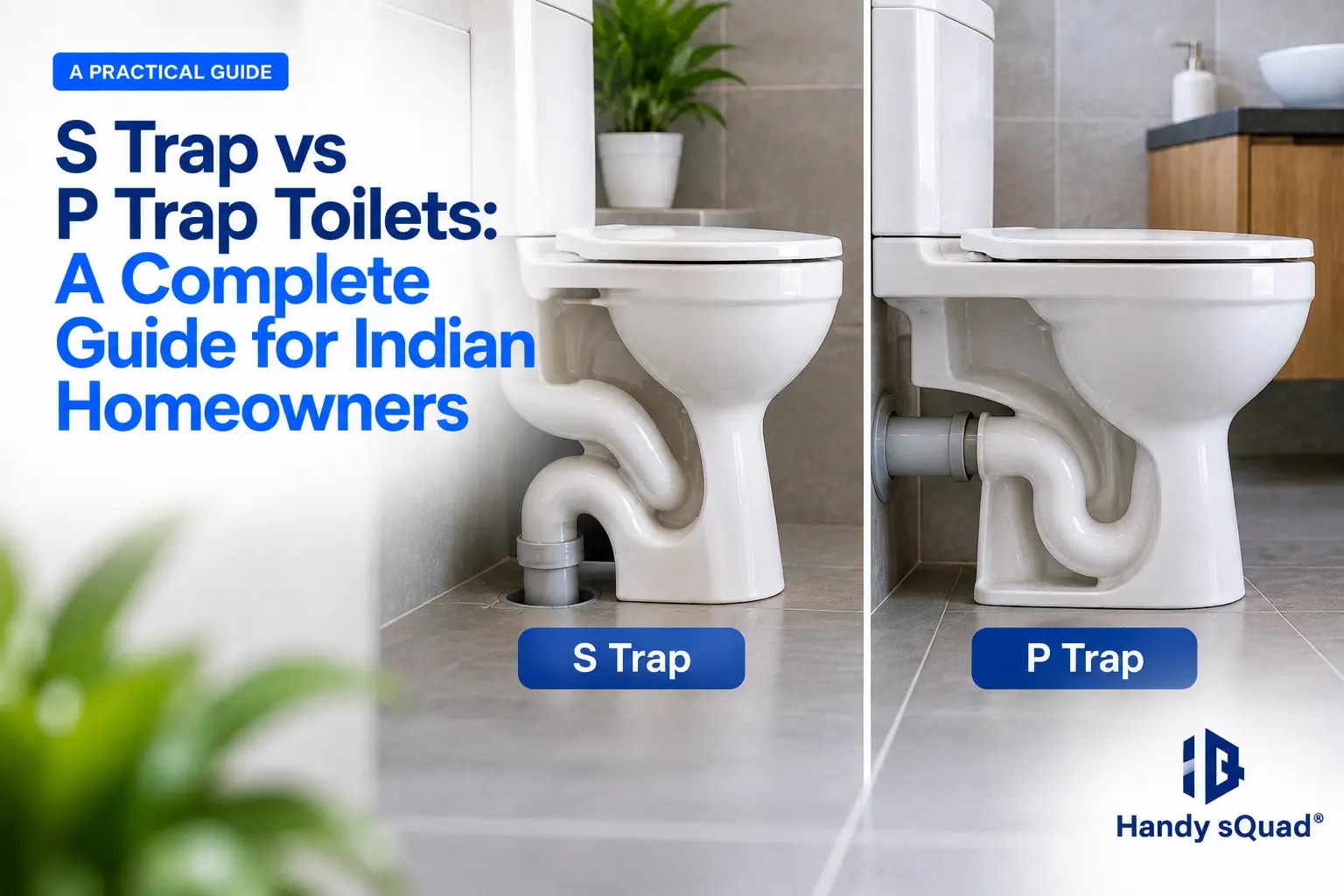
Go shopping for a new toilet, or call a plumber in for a renovation, and sooner or later you'll hear "S trap" and "P trap" get thrown around like everyone's supposed to already know what they mean. Most people just nod and move on. Then, a week later, the plumber shows up and says your bathroom needs one type and not the other, and suddenly you're stuck mid-purchase, unsure what to do. This guide is meant to clear that confusion up before it costs you a return trip to the store.
First, What's a Trap Actually For?
Before getting into S versus P, it helps to know what a trap even is. In plumbing terms, it's a curved bit of pipe that holds a small amount of water permanently. That water forms a seal, and that seal is what stops sewer gas from creeping back up into your bathroom. Without it, every flush would leave your bathroom smelling like the drain line itself, which isn't something anyone wants.
Every toilet has this built in somewhere. What changes between an S trap and a P trap is the shape of that curve, and more practically, which direction the outlet pipe goes once it leaves the toilet.
S Trap Toilets, the Older Style
With an S trap, the outlet runs straight down, disappearing into the floor beneath the toilet. Look at it from the side, and the pipe genuinely does trace something close to an S shape, dipping down, curving, then dropping vertically.
This is the older design, and honestly, it's still what you'll find in a lot of Indian homes, particularly ones built a couple of decades back or more. Makes sense too, since S traps pair naturally with floor-set drainage, which was the standard for a long time.
A few things worth knowing about S traps:
The outlet goes straight through the floor, right under the toilet
Common in older houses and older apartment buildings across India
Needs floor drainage to work
Tends to be the simpler install if that floor drainage already exists
P Trap Toilets, the Newer Standard
A P trap works differently. The outlet exits sideways, through the wall behind the toilet, rather than down into the floor. From the side, the curve looks more like a "P," bending and then running out horizontally instead of dropping.
You'll see this more in newer Indian construction, especially apartments and villas built in the last several years, where builders route drainage through the walls rather than the floor. It's also the more internationally common setup, and a lot of newer toilet models sold here now come built for P-traps or as convertible options that work either way.
Quick rundown on P traps:
Outlet exits through the wall
More common in newer apartments and villas
Needs wall-set drainage to function properly
Floors tend to look cleaner since there's no visible pipe near the base
Comparing the Two
Feature | S Trap | P Trap |
|---|---|---|
Outlet direction | Straight down, through the floor | Sideways, through the wall |
Where you'll find it | Older homes | Newer apartments, villas |
Drainage needed | Floor drainage | Wall drainage |
How the floor looks | Pipe visible near the base | Cleaner, pipe hidden inside the wall |
Ease of installation | Simple if floor pipes already exist. | Needs existing wall drainage |
Figuring Out Which One You Actually Have
This is usually the first thing people want to know, especially before a renovation or a new toilet purchase. It's not complicated to check.
Start by just looking behind and below your current toilet. Pipe disappearing into the floor? That's an S trap. Pipe going into the wall instead? P trap. Simple as that.
If you can't tell just by looking, the age of your building is a decent clue. Older homes, ones built before newer plumbing norms became standard, are far more likely to run S trap systems. Newer apartment complexes and gated communities usually go with P traps instead.
And if there's any doubt left, check with your builder or pull up the original building plans if you still have them; drainage layouts are typically documented somewhere. Honestly though, if none of that's available or you're just not sure, it's worth having a plumber take a quick look before you buy anything. Getting the wrong toilet type home means leaks, poor flushing, or in the worst case, tiles getting broken to fix a mismatch.
Switching Between the Two—Is It Even Possible?
Yes, but don't expect it to be quick or cheap. Converting an S trap to a P trap, or the other way round, usually means rerouting the entire drainage pipe. That often involves breaking into floor or wall tiles, repositioning the pipe, and sometimes adjusting the slope of the drain line so waste actually flows the way it's supposed to. This isn't a weekend DIY job; get it wrong and you're looking at blockages or odours creeping back in down the line.
Some manufacturers in India do sell convertible or "dual trap" toilets now, ones that can be set up either way. If you're renovating and genuinely unsure which system you'll end up needing, asking for one of these gives you a bit of breathing room.
So Which Should You Pick?
It's less about preference and more about what your existing drainage actually supports. A rough guide:
Replacing an old toilet in an older house? You're almost certainly looking at an S trap, unless a full plumbing redo is already on the cards. Living in a newer apartment or gated community? Check with maintenance or the building plans first; chances are it's a P trap. Building fresh, from the ground up? You've got room to choose, and a lot of plumbers these days lean toward recommending P-trap setups purely because the floor stays cleaner and wall-mounted drainage is generally easier to access if repairs come up later.
Mistakes People Make Without Realising
Buying the toilet before checking the existing trap type is probably the single most common (and expensive) mistake here. Always confirm what you're working with first. People also tend to assume toilets are just interchangeable; they're not without plumbing work involved. Attempting a DIY conversion is another one to avoid; cutting into floors or walls and getting pipe slope right needs real experience, not guesswork. And one thing that gets overlooked even by people who do know their trap type — water seal depth varies between models. Cheaper toilets sometimes cut corners here with shallower seals, which means the odour-blocking effect wears thin faster than it should.
Why Any of This Actually Matters
Get the trap type wrong, and it's not just an aesthetic problem with an awkward pipe sticking out somewhere. You're looking at weak flushing, blockages that keep coming back, smells that won't go away no matter how much you clean, and potentially water damage if the seal around the pipe isn't done right. Getting it right from the start, before you've bought anything, saves real money and a lot of hassle later.
This is genuinely one of those situations where a second opinion from someone experienced pays off. A plumber who's seen enough of these setups can look at your drainage for a couple of minutes and tell you exactly what'll work, rather than you finding out the hard way after installation.
Need Help in Trivandrum?
If you're in Trivandrum and not sure which trap type your bathroom's set up for, or you've already got a toilet giving you trouble, it's worth getting someone to actually look rather than guessing your way through it. Handy sQuad covers all kinds of plumbing work for homes across the city, from toilet installation and trap conversions right down to general repairs.
Whether you're redoing an old bathroom or starting fresh, experienced plumbers in trivandrum can check your drainage setup and tell you exactly what toilet type suits your home before you spend money on the wrong one. If you've been hunting for plumbers trivandrum residents actually rely on, Handy sQuad's team handles everything from quick fixes to complete bathroom plumbing overhauls.
And if "plumbers near me" has become a bit of a recurring Google search for you, Handy sQuad makes it easy to get trained professionals to your door in Trivandrum, with no guesswork involved.
Frequently Asked Questions
How do I know if my toilet is an S trap or a P trap?
Just check where the outlet pipe runs. Straight down into the floor means S trap, out sideways into the wall means P trap. If it's still not obvious, a quick look at your home's drainage layout, or five minutes with a plumber, settles it.
Can I fit a P-trap toilet on an S-trap outlet?
Not really, no. A P trap toilet is built for wall drainage, while an S trap outlet runs through the floor entirely. Force the wrong one onto an existing outlet, and you're looking at leaks or a connection that just won't seal properly. Your options are either picking a toilet that matches what you've already got or having a plumber reroute the drainage to fit the new one.
Which is better, S trap or P trap?
Neither, really; they're just built for different setups. S traps suit floor drainage, which is what most older Indian homes have. P traps suit wall drainage, more common in newer builds. If you're starting from scratch, plenty of plumbers lean toward P trap for the cleaner floor look and easier repair access, but "better" here really just comes down to what your home's plumbing already supports.
Can an S trap be converted to a P trap without breaking tiles?
Unlikely. Changing the direction a drainage pipe exits pretty much always means cutting into the floor or wall somewhere to reroute it. Some tile work is almost unavoidable in most cases. Still, worth asking a plumber to look at your specific layout; sometimes there's a workaround that isn't as invasive as you'd expect.
What trap type is standard in Indian homes?
There's no single standard; it really comes down to when and how the building was constructed. Older homes tend to run S trap with floor drainage, while newer apartments and gated communities increasingly go with P trap and wall drainage. The only sure way to know is to check your own home's plumbing layout directly.
Final Thoughts
S trap and P trap aren't just plumbing jargon meant to confuse you at the hardware store; they're two genuinely different drainage setups, and picking the wrong one creates real problems down the road. The good news is once you know what to look for, figuring out which one you need takes just a few minutes. When there's any doubt, get a plumber to check before you buy or install anything. It's a small step that saves a lot more time, money, and frustration than fixing a mismatched toilet after the fact.
Thanks for reading