

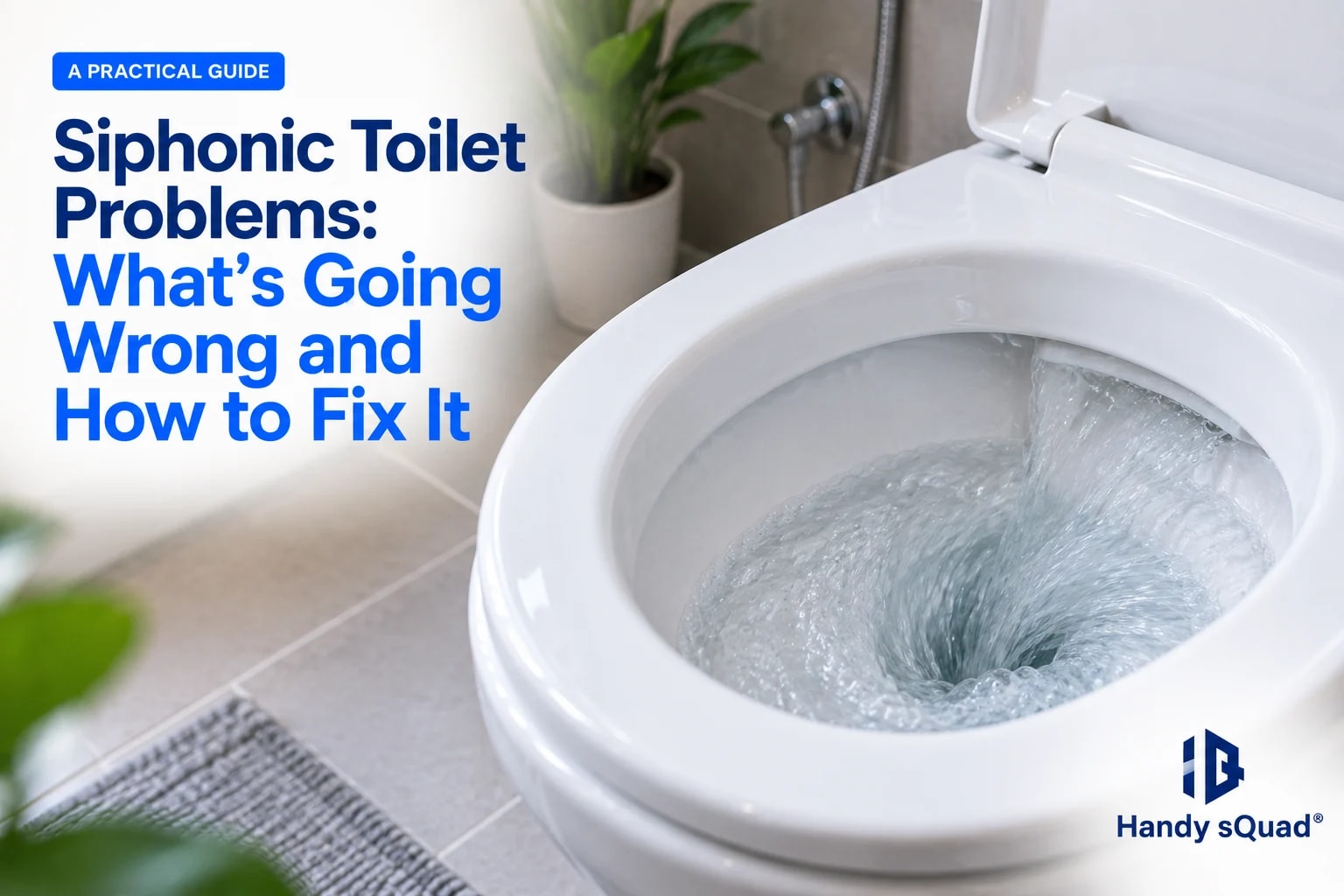
Most Western-style toilets in Indian homes today, the wall-mounted concealed cistern kind especially, common in newer apartments, run on something called siphonic flushing. Nobody gives it a second thought until it stops working. Then there's suddenly a weak flush, waste that won't clear, or a bowl that just sits there full, refusing to drain. This guide gets into what siphon flushing actually is, why it goes wrong, and how to troubleshoot the usual issues before you need to call anyone.
What Is Siphon Flushing, Actually?
A siphonic toilet doesn't just dump water in and let gravity do the rest. It's siphonic action, a physics principle. When you flush, water rushes into the bowl fast enough to fill the trapway, that curved pipe at the toilet's base. Once the trapway's filled, suction happens. An actual vacuum effect, pulling waste and water out of the bowl and down the drain. The siphon breaks once air makes its way back into the system, and the bowl refills with a small amount of standing water, set for next time.
Quite different from a simpler wash-down toilet, which leans mostly on water volume and gravity alone. Siphonic systems generally flush quieter and clear waste more thoroughly, which is a big part of why they've caught on in modern Indian bathrooms. But needing that siphon effect to actually trigger right is exactly what makes them fussier when something's off.
Why Siphonic Toilets Need a Specific Amount of Water
A lot of people only realise this once a water shortage actually hits. Siphon flushing needs a certain volume and speed of water hitting the bowl to set off the siphon effect properly. Too little water, and the trapway never fills all the way. No vacuum kicks in, and you're left with a weak, half-finished flush that doesn't clear things out.
That turns into a real headache during water shortages or whenever municipal supply drops. Wall-mounted toilets have the cistern built into the wall, hidden away, so you can't just pop it open and top up water by hand when supply's low. Floor-mounted toilets work differently; the tank sits right on top of the bowl, exposed, so pouring water in during a shortage is easy enough. Have a wall-mounted toilet and deal with patchy water pressure or supply? That's genuinely one of the more common reasons behind a flush that just won't get stronger, worth remembering before assuming the toilet itself is broken.
Pouring water straight into the bowl instead of through the cistern usually doesn't fix a weak flush either. A siphonic system needs that concentrated rush coming from the tank to actually build the right pressure and speed. Pour a bucket into the bowl, and it just spreads out and loses force, so you end up needing a lot more water for the same result, which is not great when water's already scarce.
Common Siphonic Toilet Problems and What Causes Them
Weak or incomplete flush. Beyond low water supply, this can be a partially clogged trapway, a cistern not filling to its proper level because the fill valve's faulty, or a flapper valve not opening all the way during the flush cycle. Mineral deposits building up inside the trapway, especially with hard water, can also narrow the passage enough to weaken the siphon.
Siphon not triggering at all. Flush sounds normal, water rushes into the bowl, but the siphon effect just doesn't kick in, and the bowl won't drain. Usually points to not enough water reaching the bowl fast enough, often a fill valve not delivering enough flow, or a flush valve that isn't opening wide or long enough.
Gurgling sounds during or after flushing. Generally a sign of partial blockage further down the drain line, not necessarily in the toilet itself. Trapped air's being forced past something blocking it, and this often shows up alongside slow draining elsewhere too, a nearby sink or floor drain sharing the same line.
Water level issues in the bowl. Is standing water sitting noticeably lower or higher than usual? Typically points to the trapway, either a partial blockage changing how much water sits in the bowl or occasionally a crack or vent problem throwing off the pressure balance.
Complete blockage. Nothing draining whatsoever usually means something's physically stuck in the trapway: excess toilet paper, there's a foreign object, or waste that's compacted enough to fully block the passage. This is the one case where a plunger, used properly with a good seal around the drain opening, is worth trying before anything else.
Basic Troubleshooting You Can Try Yourself
Begin with the cistern's water level. Should sit close to the marked fill line, and if it's clearly lower, the fill valve probably needs adjusting or swapping out. Worth checking the flapper valve too; a worn or misaligned one often won't lift or seal properly, and that hits flush performance directly.
Think it's a trapway blockage? A plunger's the first sensible move, and a handful of firm, steady plunges tend to beat one hard, aggressive push. Still stuck? A toilet auger, built specifically to work through that curved trapway without scratching up the porcelain, generally does better here than a regular drain snake would.
Mineral buildup weakening the flush? Leave a descaling solution sitting in the bowl overnight, then scrub with a stiff brush the next morning. That combination clears deposits inside the trapway that have been slowly narrowing the passage.
When It's Time to Call a Professional
Plenty of siphonic toilet issues are genuinely fixable with basic troubleshooting on your own. But certain situations really do call for a professional instead of more trial and error. Gurgling that refuses to stop, particularly if other drains in the house are acting up too, usually signals a blockage further down the plumbing system, one that needs proper equipment to actually clear. Cracks anywhere in the porcelain, water pooling strangely around the base, or the same clog returning again and again even after you've cleared it- all of that points toward something bigger than a quick fix.
Stuck in Trivandrum with a toilet that won't flush properly despite trying the basics? A reliable plumber Trivandrum can work out whether the real problem's inside the toilet or further along the drainage line, something that's genuinely hard to tell without proper inspection tools. Handy sQuad's plumbing team handles exactly this sort of troubleshooting on a regular basis, alongside the usual range of household plumbing problems people run into.
Renovating a bathroom or fitting a brand-new toilet? Getting plumbers Trivandrum homeowners already trust involved from the start helps sidestep siphonic flush problems before they even show up. Proper trapway alignment, correct cistern setup, and appropriate water pressure are sorted during installation instead of chased down and fixed later.
Beyond toilets, for whatever else comes up- leaking pipes, tap trouble, and drainage headaches- Handy sQuad works as a dependable plumber in Trivandrum for homes across the city. Quick fixes and bigger repairs are all handled without needing a different provider every time something new goes wrong.
Final Thoughts
Siphonic toilets are genuinely well-built systems when everything's running right. Quieter, more thorough, more water-efficient overall than simpler flush setups. But relying on a properly triggered siphon effect means small issues, low water pressure, a worn flapper, and mineral buildup show up as noticeably weaker performance instead of staying hidden the way they might in a simpler design.
Knowing how the siphon action actually works makes it a lot easier to spot what's genuinely going wrong, instead of just writing off the toilet as faulty. And when basic troubleshooting doesn't do the trick, getting someone to properly check the trapway and drainage usually gets things sorted faster than continuing to guess.
Thanks for reading