

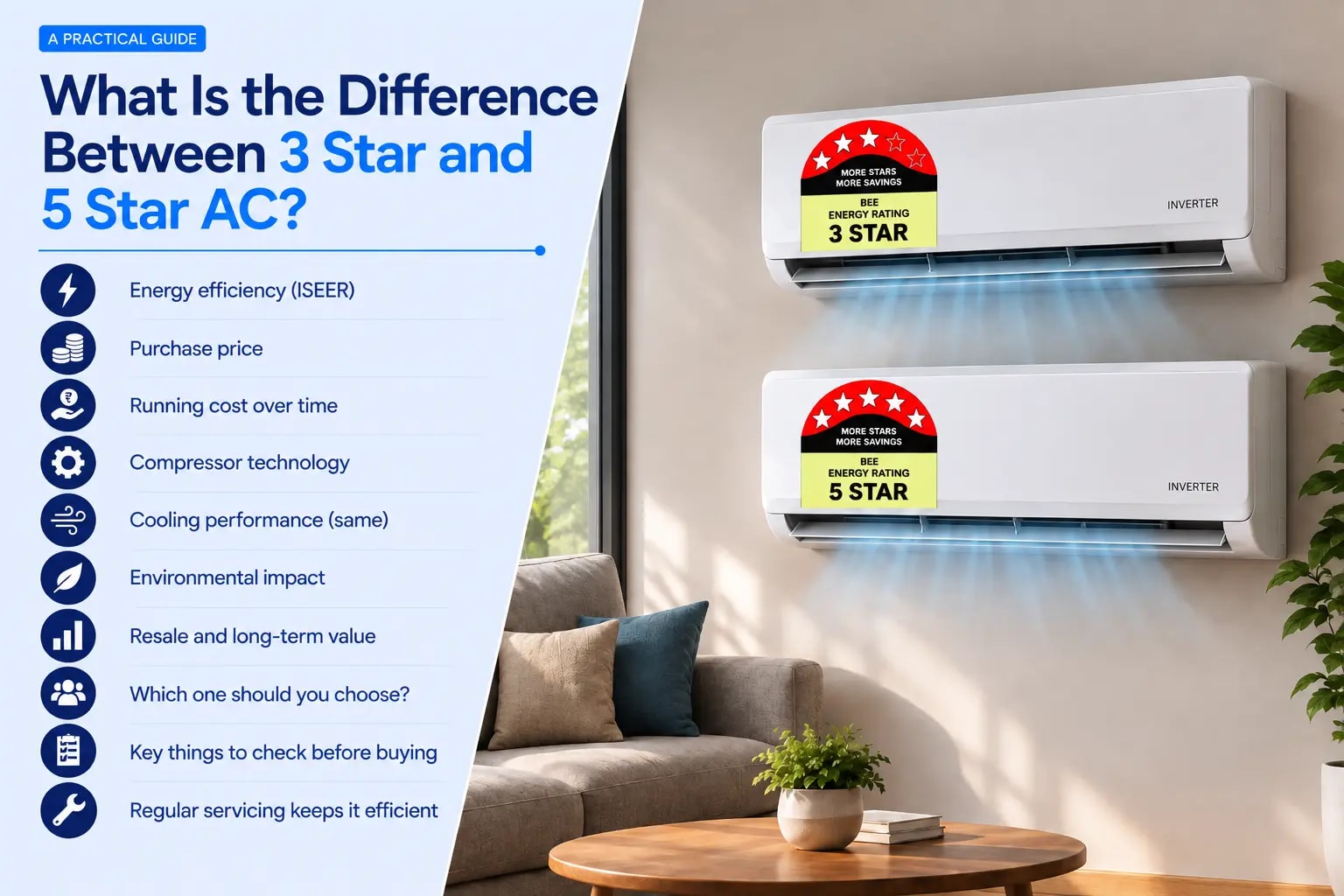
Anyone who's gone AC shopping in India knows this moment. You're standing in front of two units that look almost identical, one costing noticeably more than the other, and the only real difference you can spot is a little star sticker on the box—three stars here, five stars there. Is the extra money actually worth it? Does a 5-star AC really cut down your electricity bill, or is that just clever marketing dressed up as science?
That's a fair question, and it's worth answering thoughtfully rather than simply saying "5-star is always better" and moving on. Star ratings do matter, but exactly how much they matter depends on how you'll use the AC, your budget, and a couple of other factors most people never think to ask about. So let's actually get into it.
What Do Star Ratings on an AC Mean, Anyway?
In India, the Bureau of Energy Efficiency, or BEE, rates air conditioners on a scale from 1 to 5 stars based purely on how efficiently the unit turns electricity into cooling. The technical term for this is ISEER—the Indian Seasonal Energy Efficiency Ratio—which is really just a number showing how much cooling you get for every unit of power the AC eats up.
Simply put, a higher star rating means more cooling per unit of electricity. So yes, a 5-star AC is more energy-efficient than a 3-star one of the same size, by definition. One thing worth flagging—BEE updates these rating standards every couple of years as technology improves, which means a 5 star AC bought a while back might only scrape a 3 star rating under today's rules. Always glance at the rating year on the label instead of assuming ratings mean the same thing regardless of when the unit was manufactured.
Difference Between 3 Star and 5 Star AC: The Core Differences
1. Energy Efficiency
This is really where everything starts. A 5-star AC pulls less electricity to deliver the same cooling as a 3-star model. Run it over a full season, and that gap in consumption adds up—how much exactly depends on how many hours a day you're using it.
2. Price Difference Between 3 Star and 5 Star AC
Now here comes the trade-off. 5-star ACs cost more to buy than 3-star units of the same brand and capacity, often somewhere between ₹3,000 and ₹8,000 more, sometimes higher depending on tonnage and extra features. That's because manufacturers use better compressors, thicker insulation, and more refined components to hit that higher efficiency mark, and none of that comes cheap.
3. Running Cost Over Time
This, honestly, is the heart of the whole decision. You pay more for a 5 star AC upfront, but you pay less every month to run it. A 3 star unit is cheaper on day one but keeps drawing more power for as long as you own it. Whether the 5 star option actually works out cheaper in the end really comes down to how many hours a day and how many months a year you're actually running the thing.
Take Trivandrum, for example—the climate stays warm through most of the year, and ACs there often run for long stretches daily. In that kind of setting, a 5 star unit tends to recover its extra cost through savings much faster than it would somewhere with shorter, milder summers.
4. Compressor Technology
Most 5 star ACs these days come with inverter compressors, which adjust speed based on what the room actually needs instead of switching fully on and off over and over. Besides being more efficient, this also means the machine runs quieter and keeps the room temperature steadier. 3 star ACs can be inverter models too, but plenty of non-inverter 3 star units are still around, and those tend to use noticeably more power.
5. Cooling Performance: Do 3 Star and 5 Star ACs Cool Differently?
Here's something people often get wrong—a 3 star and a 5 star AC of the same tonnage will cool a room to the same temperature. Star rating has nothing to do with how "strong" the cooling is; it's purely about how efficiently that cooling gets delivered. So don't go in expecting a 5 star unit to cool faster or colder than a 3 star one at the same capacity. Actual cooling power depends on tonnage, full stop.
6. Environmental Impact
Less electricity used means less strain on power generation, which translates to a smaller carbon footprint over the AC's lifetime. If you care about that sort of thing, or you're just generally trying to keep your household's energy use in check, a 5 star AC is the more responsible pick long-term.
7. Resale and Long-Term Value
ACs with higher star ratings tend to hold their resale value a bit better, mostly because buyers browsing the second-hand market are increasingly clued in about running costs too. A well-kept 5 star unit is usually easier to find a buyer for than an older 3 star one.
So, How Much Can a 5 Star AC Actually Save You?
Everyone wants a straight number here, and while it really depends on your usage habits, local electricity rates, and the tonnage of your unit, there's a decent rule of thumb: the more hours per day and months per year you're running the AC, the more that 5-star rating actually pays off.
If you're only switching the AC on for an hour or two on the odd hot evening, for maybe a few months a year, the price gap between a 3-star and 5-star unit might take forever to recover through electricity savings—a 3-star model is probably the smarter buy in that case. But if you're running it for 6-8 hours daily across most of the year, which honestly isn't unusual in the warmer parts of Kerala, a 5 star AC often ends up cheaper overall once you tally up the savings over 3-5 years. That 3-5 year window is generally the payback period people mean when they ask how long it takes a 5 star AC to actually pay for itself.
Is a 5 Star AC Worth It? Which One Should You Actually Buy?
There's no single right answer, but here's a decent way to think it through. Heavy users—long hours daily, most of the year—will very likely see the extra cost of a 5 star unit pay for itself and then keep saving money after that point. That's when a 5 star AC is genuinely worth it. If your AC use is more occasional or seasonal, a 3 star model might make more sense financially, since you may never actually recover that price difference through savings.
Budget matters too, of course. If the extra upfront cost genuinely stretches things, a well-maintained 3 star AC—ideally an inverter model—is still a completely reasonable choice. Efficiency is great, but not at the cost of overextending yourself for savings that might take years to materialise.
A Few Things Worth Checking Before You Buy
Beyond just the star sticker, a handful of other factors deserve attention. Check whether the model is an inverter or non-inverter, since that often affects efficiency even more than the star rating itself, something a lot of buyers overlook. Get the tonnage right for your room size—an undersized AC, even a 5 star one, will strain itself and end up using more power than a properly sized 3 star unit. And take a close look at the warranty, particularly on the compressor, since that's usually the priciest part to replace if it ever fails.
Keeping Your AC Efficient, Whatever the Rating
Buying the right star rating is only half the job. Even a 5-star AC will start losing efficiency over time if it isn't serviced regularly—dirty filters, dropping refrigerant levels, dusty condenser coils, all of it quietly pushes your bill up regardless of what's printed on the box. Getting the unit serviced regularly, ideally before summer hits its peak and again before the monsoon, keeps it running closer to its rated efficiency for years.
If you're based in Trivandrum and want your AC checked, serviced, or fixed by people who genuinely know what they're doing, Handy sQuad offers dependable ac service Trivandrum homeowners can rely on for both routine upkeep and more serious repairs. Their technicians handle everything from gas top-ups and filter cleaning to compressor troubleshooting, whether you're running a 3-star or a 5-star unit.
Whether it's your annual pre-summer check, a sudden cooling problem, or strange noises coming from the outdoor unit, Handy sQuad's ac service in Trivandrum covers it, across brands and models. And if it's an actual breakdown rather than routine maintenance, their ac repair Trivandrum team can diagnose the issue properly instead of leaving you to guess with a DIY fix.
Frequently Asked Questions
What is the difference between 3 star and 5 star AC?
The core difference is energy efficiency. A 5 star AC delivers more cooling per unit of electricity than a 3 star AC of the same tonnage, which means lower running costs over time but a higher purchase price upfront. Cooling power itself is the same across both, since that depends on tonnage, not star rating.
Is a 5-star AC worth it?
Comes down to how often you'll actually switch it on. Running it several hours a day for most of the year? The extra you pay upfront usually comes back to you within 3-5 years through a lower electricity bill, and it keeps paying off from there. Only use it occasionally, a few months a year, and the maths doesn't work quite as well. A 3-star model probably makes more sense there, since you may never fully claw back that price gap.
Which is better, a 3-star or 5-star AC?
Depends who's asking, honestly. There's no blanket "better" here; it's really about how you use it and what you've got to spend. Heavy daily users come out ahead with a 5-star unit long-term, no question. But if you're only running the AC occasionally, or the budget's tight right now, a 3-star model, an inverter one ideally, is still a perfectly sensible pick. Nothing wrong with going that route.
What is the price difference between a 3-star and 5-star AC?
Usually somewhere in the ₹3,000 to ₹8,000 range, sometimes more depending on the brand and tonnage you're comparing. Why the gap? Better compressors, thicker insulation, and more refined parts overall, none of which manufacturers throw in for free.
Do 3-star and 5-star ACs cool a room differently?
Not really, no. Same tonnage, same cooling, regardless of star rating. What the star rating actually measures is efficiency, not cooling power, so people expecting a 5-star unit to chill a room faster than a 3-star one of the same size are working off a myth. Tonnage decides that part, nothing else.
What is the payback period for a 5-star AC in India?
Roughly 3 to 5 years for most households, assuming you're running the AC 6-8 hours daily through the hotter months. Use it less than that, and the payback period stretches out, sometimes past the point where it's still worthwhile before the unit itself needs replacing.
Final Thoughts
At the end of the day, it's a simple trade-off. Spend more now and save more later, or spend less now and accept slightly higher running costs going forward. Neither choice is wrong, really; it just depends on how you'll actually use the AC, how long you're planning to keep it, and what your budget can handle at the moment.
One more thing worth remembering, whatever rating you end up going with: regular servicing matters just as much as the star sticker, sometimes more. A 3-star AC that's well looked after can genuinely outperform a neglected 5-star one. Let the rating guide the purchase, sure, but don't let it be the only thing you think about afterwards.