

You've finally booked the pest control appointment. Maybe it's ants showing up the second you leave a plate unwashed or some pest problem that's been quietly building up around the house for a while now. Whatever it is, you've made the call, and a technician's arriving on a set date.
Here's what most people don't realise until it's too late—how you prep the house before the treatment and what you do in the days right after matters almost as much as the treatment itself. Rush the prep, and the technician simply can't get to the spots that need it most. Skip the aftercare, and you might watch everything come right back within a few weeks, wondering what went wrong.
So let's go through both halves properly. What to sort out before the team shows up, and what to do once they've left.
Why Pest Control Preparation Makes Such a Difference
Pest control isn't quite like a regular cleaning job where the team just walks in and gets going. For the treatment to actually reach where pests hide—behind furniture, inside cabinets, along skirting boards, under the sink—those spots need to be at least somewhat accessible. A cluttered home, or one with key areas blocked off, means the technician either can't treat those spots properly or ends up spraying around obstacles instead of directly where it counts.
This matters most for kitchens and bathrooms, honestly, since that's usually where the bulk of the actual problem is sitting.
How to Prepare Your Home Before Pest Control Service
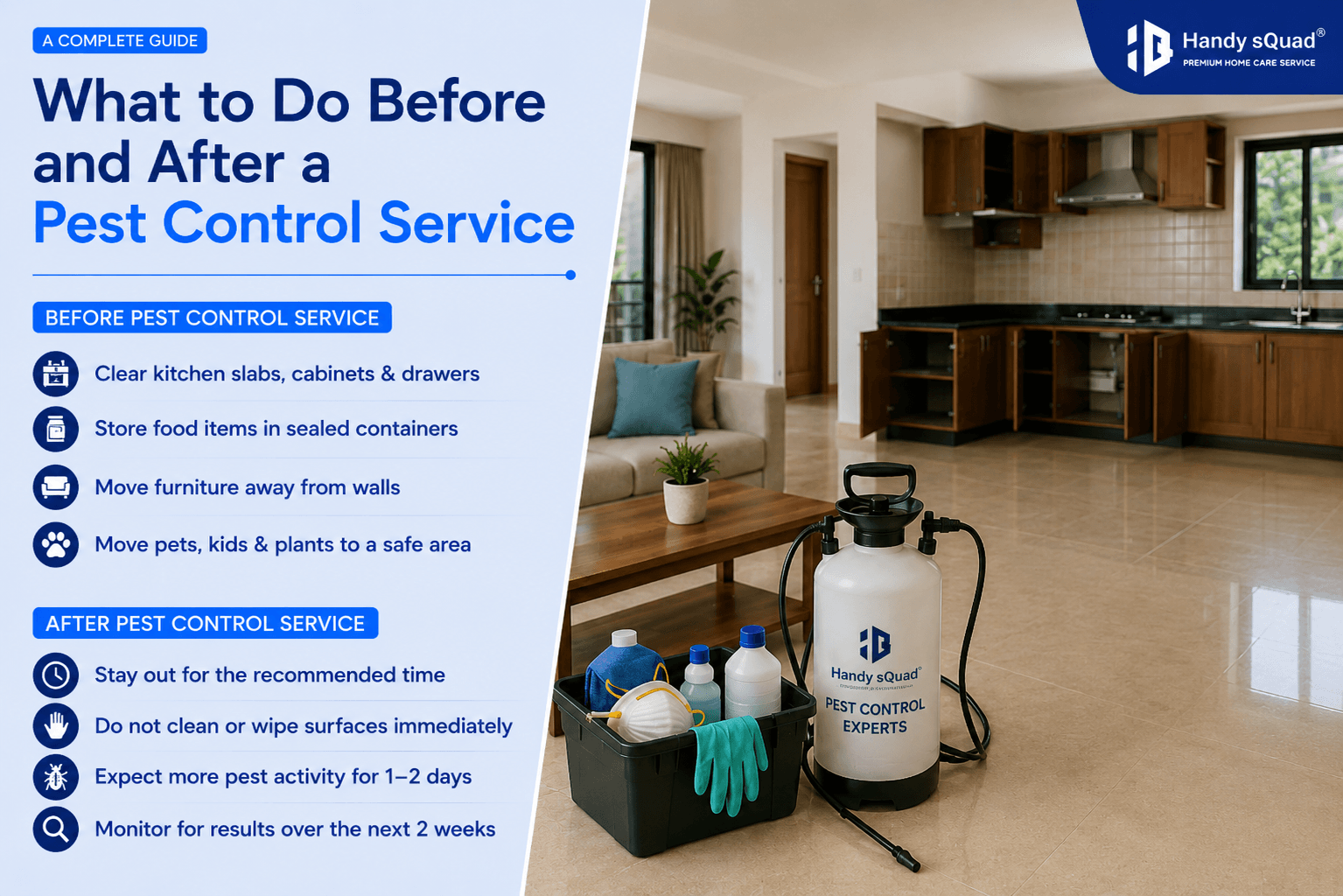
Start with your kitchen. Empty out the cabinets and drawers, or at the very least push everything toward the centre of each shelf so the technician has a clear shot at the back walls and corners—that's usually where pests tend to nest. Food items need to be sealed up properly too: grains, spices, snacks, and anything even slightly open, ideally kept out of the kitchen entirely for the day. Utensils and cutlery are best covered or tucked away in a cupboard that isn't getting treated. And once that's done, clear the countertops completely so nothing's blocking access to the base of cabinets or the space behind appliances.
Furniture matters more than people expect too. Pull sofas, beds, and cupboards a few inches away from the walls wherever you can manage it. Pest control mostly targets edges and corners rather than open floor space, and since pests tend to nest right along those gaps, anything pressed flush against a wall blocks precisely the spot that needs treatment the most.
A few other things worth sorting before treatment day: cover or move fish tanks, bird cages, and any open pet food or water bowls out of the room entirely. If you've got houseplants indoors, shift them outside or cover them, since certain treatments aren't great for sensitive plants. Mattresses and cloth-upholstered furniture should be covered with sheets or plastic if possible, and children's toys—especially anything that regularly ends up in a kid's mouth—belong in a sealed container, away from wherever the treatment's happening.
Then there's the human side of it. Most treatments recommend pets, young kids, elderly family members, and anyone with respiratory issues stay out of the treated area for a few hours, sometimes longer depending on what's being used. It's worth sorting this out in advance rather than scrambling on the day itself—a quick visit to a relative's place or just keeping everyone in one untreated room while the rest of the house gets done usually works fine.
Cover your electronics too—TV, computer, and kitchen appliances—with a cloth or plastic sheet if they're anywhere near the treatment area. Chemical residue on sensitive equipment isn't the end of the world, but a simple cover means you don't have to think about it later.
And before the technician even starts, it's worth asking a few quick questions. How long should you stay out? Is it fine to mop or wipe surfaces afterwards, and if so, when? Any specific precautions for pets or kids? A decent technician will usually walk you through most of this without prompting, but there's no harm in confirming.
Post-Treatment Care: What to Do After Pest Control
This next part trips people up more than the prep does, mostly because it's tempting to just get back to normal life too quickly.
Stay out for however long's recommended—most treatments need a few undisturbed hours to actually work, and walking back in early, opening windows, or switching on fans can undercut how effective they end up being.
Resist the urge to clean right away too. Wiping everything down the moment you're back in, especially in the kitchen, can strip away the very treatment that's supposed to keep working over the following days. Most services suggest waiting at least 24 hours, sometimes more, before mopping or wiping treated surfaces down. If you're not sure, just ask the technician before they head out—better than guessing.
Don't be alarmed if you notice a bit more pest activity than usual over the next day or two. That's generally a sign the treatment's working and driving them out of hiding, not a sign it's failed. It typically settles down within a few days on its own.
Once the waiting period's over, give kitchen surfaces, utensils, and anything else in the treated area a proper wash before you start using them again—just a sensible precaution, nothing more.
Keep half an eye out over the following couple of weeks. If the same pests start showing up again in the same spots, it's worth reaching out to the service provider. Most reliable companies build in a follow-up visit if the problem persists, so use it if you need to—that's exactly what it's there for.
And once things have settled, a bit of ongoing maintenance goes a long way. Keep food sealed, fix leaking taps or damp patches that tend to attract pests, seal up obvious gaps near doors and windows, and don't let garbage sit around longer than it needs to. The treatment clears out the current problem—the small habits afterwards are really what keep it from coming back.
Why Choosing a Reliable Pest Control Service Matters
Prep and aftercare help, no question, but none of it makes up for a rushed or poorly done treatment. Even with perfect prep on your end, a sloppy job just won't solve a real infestation. This is really where it pays to go with an experienced team rather than whoever's cheapest.
If you're dealing with a pest problem that isn't going away on its own, a solid pest control services trivandrum provider will handle the treatment properly and also walk you through exactly what to prep beforehand and what to expect afterwards—so you're not left guessing at any point.
Final Thoughts on Pest Control Preparation and Aftercare
Pest control works best when it's treated as a proper process, not a one-time spray and forget. A little preparation before the technician shows up makes sure the treatment actually reaches where it needs to, and a bit of care in the days after helps it stick. If the problem at home feels bigger than something a DIY spray can handle, booking a trusted pest control service in trivandrum is usually the fastest way to actually deal with it, rather than watching the same issue crop up again a month down the line.
The team at Handy sQuad handles the whole process for you—from telling you exactly how to prep beforehand, to using treatments suited to your specific situation, to guiding you through the aftercare properly. That combination is really what separates a treatment that actually works from one you end up paying for all over again a few months later.