We visited a house in Palarivattom last month. The homeowner had gone through two refrigerator compressors in three years. Her washing machine had stopped working six months after she bought it. The AC kept throwing error codes she couldn't make sense of.
Three appliances. Three different brands. All failing early.
When our electrician checked the mains voltage during the evening, it was reading 171V. By 10 PM, it had climbed to 247V. That kind of swing — happening every single evening — is enough to quietly destroy anything with a motor or a circuit board inside it.
She had no idea this was going on. Most people don't — until they start searching "how to fix voltage fluctuation in home" at 9 PM because something just switched off.
If that's how you got here, this guide covers exactly that: what a safe voltage range looks like, why it's happening in Kerala right now, and the specific steps to control it — appliance by appliance.
What Is the Safe KSEB Voltage Range for Home Appliances?
Indian appliances are rated for 220–240V AC at 50Hz. BIS standards allow a ±6% tolerance, which puts the safe operating range at roughly 207V to 254V.
During peak evening hours across Trivandrum and Kochi, KSEB supply regularly drops well below 200V — and sometimes swings past 250V later at night. Anything outside 207–254V consistently is outside safe range, and it's the reason appliances that should last a decade are failing in two or three years.
Why Voltage Fluctuates in Kerala Homes Right Now
KSEB is under real pressure. Peak electricity demand in Kerala has recently crossed 117 million units in a single day, with evening demand hitting over 6,000 MW — both records. The board has acknowledged that this surge is straining the transmission and distribution network, leading to voltage fluctuations across several areas.
A few other factors make it worse in specific homes:
The 6 PM–10 PM danger window. Every household in the neighbourhood runs ACs, TVs, washing machines, and cooking appliances at the same time. Transformers hit their load limits, voltage drops on the lines, and then swing the other way as demand eases late at night.
Older localities. Areas of Trivandrum and Kochi built before the mid-2000s often have distribution transformers sized for consumption patterns from twenty years ago. Household wiring is frequently undersized too — neither was built for today's load.
Monsoon damage. Lightning strikes hit equipment on the lines, wet earthing systems behave unpredictably, and the first heavy rain nights each June bring a noticeable spike in appliance failures.
Apartments have their own version. When multiple flats pull heavy loads from one distribution point, voltage inside the building varies — sometimes floor by floor. KSEB's supply to the building can be steady while what reaches your specific flat isn't.
How to Know If Voltage Fluctuation Is Your Problem
You often can't tell without measuring, but a few patterns are strong indicators:
Your inverter switches to battery power every evening around 7–9 PM
Appliances have failed more than once, in different brands, within a few years
Lights dim or brighten noticeably when a large appliance (AC, motor pump) switches on
ACs or washing machines throw error codes that service centres can't fully explain
The RCCB trips occasionally with no obvious cause
If two or more of these sound familiar, get an electrician to measure your mains voltage during the 7–9 PM window before spending money on anything else.
How to Control Voltage Fluctuation at Home: The Core Solutions
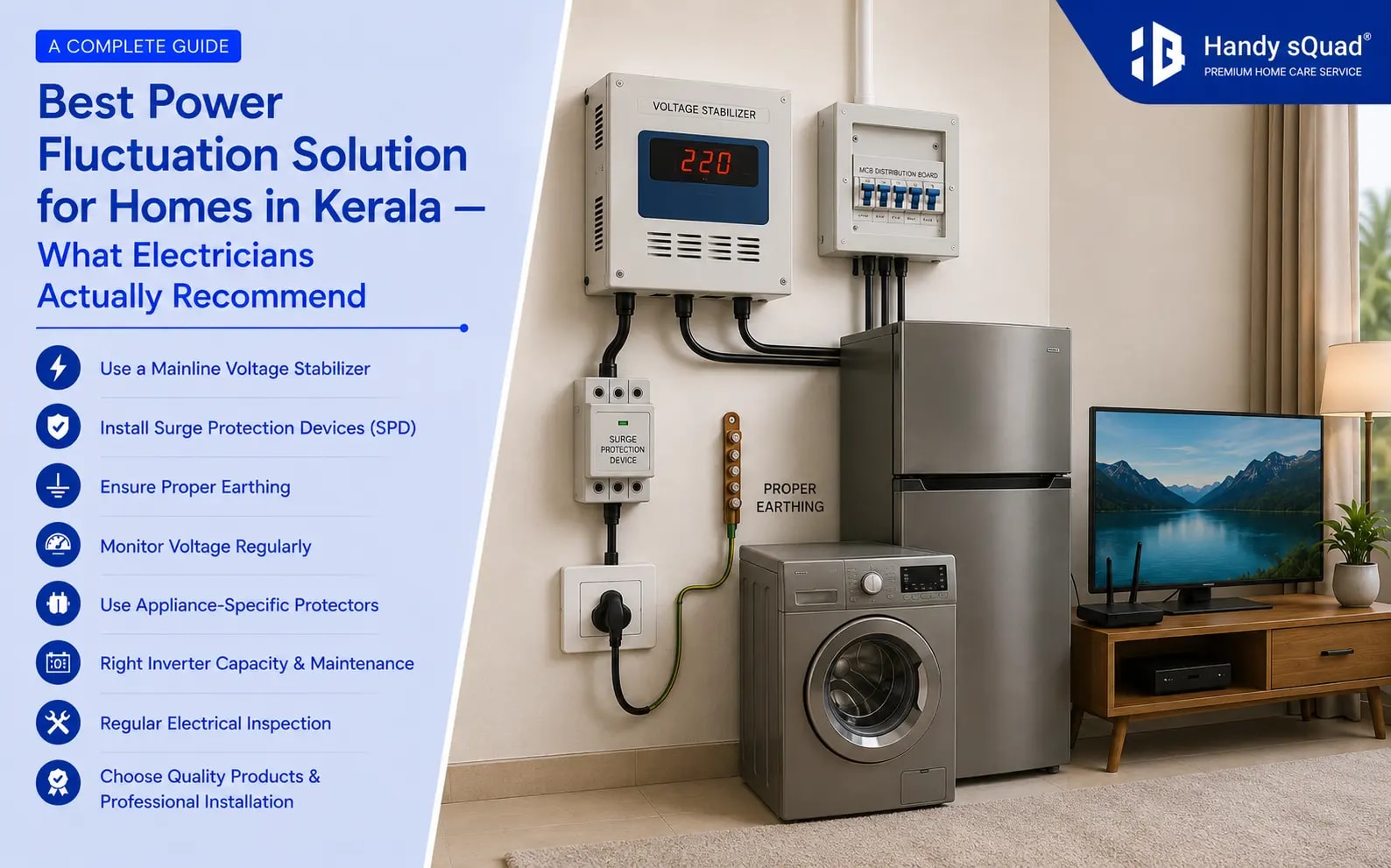
There's no single device that fixes every voltage problem. The right approach layers a few solutions — one for chronic fluctuation, one for sudden spikes, and proper earthing underneath everything.
1. Servo Stabilizers (for motor-driven appliances)
For AC, refrigerators, and washing machines, a servo stabilizer is the primary defence. It uses a servo motor to continuously adjust output voltage, holding accuracy within ±1% regardless of what's coming in from the grid. For Kerala conditions, look for one rated to handle input from 160V to 270V — that covers the realistic range on KSEB lines during bad evenings.
Sizing it correctly: take the wattage of the appliances you're connecting and add 20–25%. A 1.5-ton AC typically needs a 3–4 KVA stabilizer. Undersized stabilizers run hot and fail early.
Servo stabilizers have moving parts and need servicing every two to three years — a neglected one offers far less protection than people assume.
2. MCB and RCCB Protection
The MCB (Miniature Circuit Breaker) and RCCB (Residual Current Circuit Breaker) in your distribution board are the foundation of your home's electrical safety. The MCB cuts power if a circuit overloads. The RCCB detects earth leakage and trips in milliseconds — the kind of fault that causes shocks.
In many older Kerala homes, these are original fittings from ten or fifteen years ago. MCBs wear out, and RCCBs can become less sensitive over time. If your board hasn't been inspected in years, the protection it offers may be much weaker than you think.
3. Dedicated Earthing Systems
Earthing is the part of home electrical safety that gets the least attention and causes the most serious accidents when it fails. A proper system gives fault current somewhere safe to go — without it, that current finds another path, through a tap, an appliance casing, or a person.
Kerala's laterite soil and monsoon moisture accelerate corrosion of earth electrodes, so even a correctly installed system can stop working effectively over time. Earth resistance should measure below 5 ohms — the only way to know is to have an electrician test it with proper equipment.
4. Whole-House Surge Protection
A whole-house surge protector installs at the main distribution board and stops large external surges — from lightning or grid switching events — before they reach your home's wiring. This is different from the plug-in strip protectors you use for individual devices, which only handle smaller spikes.
For homes in coastal Trivandrum and areas around Kochi that take direct lightning during monsoon, this is worth serious consideration. Many modern stabilizers now include built-in surge protection, covering both problems in one device.
How to Fix Voltage Fluctuation Damage: Appliance by Appliance
Air Conditioners: Fit a servo stabilizer rated 20–25% above the AC's wattage, with a 160–270V input range. Inverter ACs are especially sensitive — their drive circuitry isn't forgiving of poor power quality, and fluctuation often gets misdiagnosed as a compressor fault. Have the electrician check the dedicated AC wiring at the same time; older homes are sometimes wired with cable too thin for today's units.
Refrigerators: Use a stabilizer with a time-delay relay of three to five minutes. This stops the compressor from restarting immediately after a voltage dip — the exact moment most compressor damage happens. V-Guard and Microtek both make models well-suited to Kerala conditions.
Washing Machines: Front-loaders with inverter motors handle fluctuation better than older top-loaders, but not indefinitely. The heating element is vulnerable to sustained overvoltage, and the motor controller can develop faults. A large share of the E7/E21 error codes service centres see in Kerala trace back to voltage, not mechanical failure.
TVs and Home Theatres: A UPS with AVR (Automatic Voltage Regulation) is the best option — it stabilises voltage and gives battery backup during cuts. 600VA to 1KVA is adequate for most setups. If budget is tight, a decent surge protector at the TV socket is better than nothing.
Routers and Computers: Always use a UPS, not just a power strip. Even a basic 600VA unit buffers enough to protect the router's power supply and prevent data loss on the computer during a cut.
How to Avoid Voltage Fluctuation Problems Long-Term
Buying a stabilizer is something you can do yourself. Earthing, distribution board work, and wiring checks need a professional electrician — getting MCB sizing wrong or installing an earth electrode incorrectly can make your home less safe than before it was touched.
Appliance failures that keep repeating usually have one root cause. An hour-long inspection finds it. Handy sQuad's electrical team works across Trivandrum and Kochi, handling distribution board inspections, earthing checks, MCB and RCCB upgrades, stabilizer installation, and full wiring assessments. When we come, we look at what's actually there — not what we hope to find. If something doesn't need fixing, we'll say so.
Frequently Asked Questions
Q: What is the current KSEB voltage range considered safe for home appliances? Indian appliances are rated for 220–240V AC at 50Hz, and BIS standards allow ±6% tolerance — roughly 207V to 254V. During peak evening hours, KSEB supply in parts of Trivandrum and Kochi regularly drops below 200V, which is outside the safe range.
Q: How do I solve a low-voltage problem in my home? Start by measuring the actual voltage during peak hours (7–9 PM) rather than guessing. If it's consistently below ~200V, a correctly sized servo stabilizer (160–270V input range) is the standard fix for motor-driven appliances, alongside a check of your distribution board and wiring.
Q: How do I control power fluctuation at home without replacing my board? A servo stabilizer addresses the fluctuation itself for individual appliances. It doesn't replace the need for a working MCB/RCCB and good earthing — those protect against faults, not swings, and both should be checked together.
Q: My inverter switches to battery every evening around 7–9 PM — is that a battery problem? Probably not. Inverters switch to battery when mains voltage drops below their lower threshold, usually around 170–180V. During peak hours, this happens regularly across many parts of Trivandrum and Kochi — the inverter is doing its job, and the problem is grid voltage, not the battery. Ask an electrician to measure mains voltage in that window before replacing anything.
Q: How do I know if my earthing is working? You can't tell visually. The only reliable check is an earth resistance measurement with a proper testing instrument — safe earthing reads below 5 ohms. Warning signs in the meantime: a mild tingle from a metal tap or appliance casing, the RCCB tripping without a clear cause, or occasional shocks from switches and sockets.
Q: Is a stabilizer enough, or do I need a surge protector too? Different devices, different jobs. A stabilizer handles ongoing voltage that's too high or too low. A surge protector handles sudden spikes — lightning, grid switching, or a nearby transformer fault. Kerala homes typically need both: a stabilizer for AC/fridge/washing machine, and surge protection for TVs, computers, and routers.
Book an Electrical Inspection with Handy sQuad
Appliances failing repeatedly. Inverter running on battery every evening. Never had the wiring checked since moving in. Any of these is a good reason to get an electrician in.
Handy sQuad covers Trivandrum and Kochi. We'll assess what's actually going on with your home's electrical system and tell you straight what needs fixing.
Book now: www.handysquad.in/trivandrum/electrician | WhatsApp: +91 9778629770
Thanks for reading