Water pressure that keeps dropping year after year usually gets blamed on the wrong thing. People check the motor, then the overhead tank, then call the water board to complain about the supply—and the actual problem is sitting inside the walls the whole time. Before starting any plumbing work, one question almost always comes up: Galvanized iron (GI) or Chlorinated PolyVinyl Chloride (CPVC)?
Both have been standard in Indian homes for decades, and both will carry water just fine on day one. Where they part ways is in how they hold up over the years, and that's really what determines whether you're still getting decent pressure a decade from now or fighting a slow, frustrating decline. Here's how each one actually performs and which one makes more sense depending on your situation.
Why the Pipe Material Even Matters for Pressure
Pressure loss inside a pipe isn't only about pump strength or how high your tank sits. A lot of it comes down to friction — specifically, how much resistance water meets as it rubs against the inner wall of the pipe on its way to your tap. A rough or narrowed interior forces water to work harder to get through, and that lost energy shows up as weaker flow at the outlet.
This is exactly where GI and CPVC start to diverge, and it's worth understanding why before comparing them side by side.
GI Pipes: Still Around, Still Working — For Now
Galvanized Iron pipe is steel with a zinc coating meant to keep rust away. It was the default option in Indian construction for generations, and a lot of older homes still run on it today.
Here's what actually happens to a GI pipe once it's been carrying water for a while:
The zinc layer, smooth as it starts, wears down gradually with continuous flow — faster if the water is hard. Once that protective coating thins out, the iron underneath is exposed, and rust begins forming on the inside where nobody can see it.
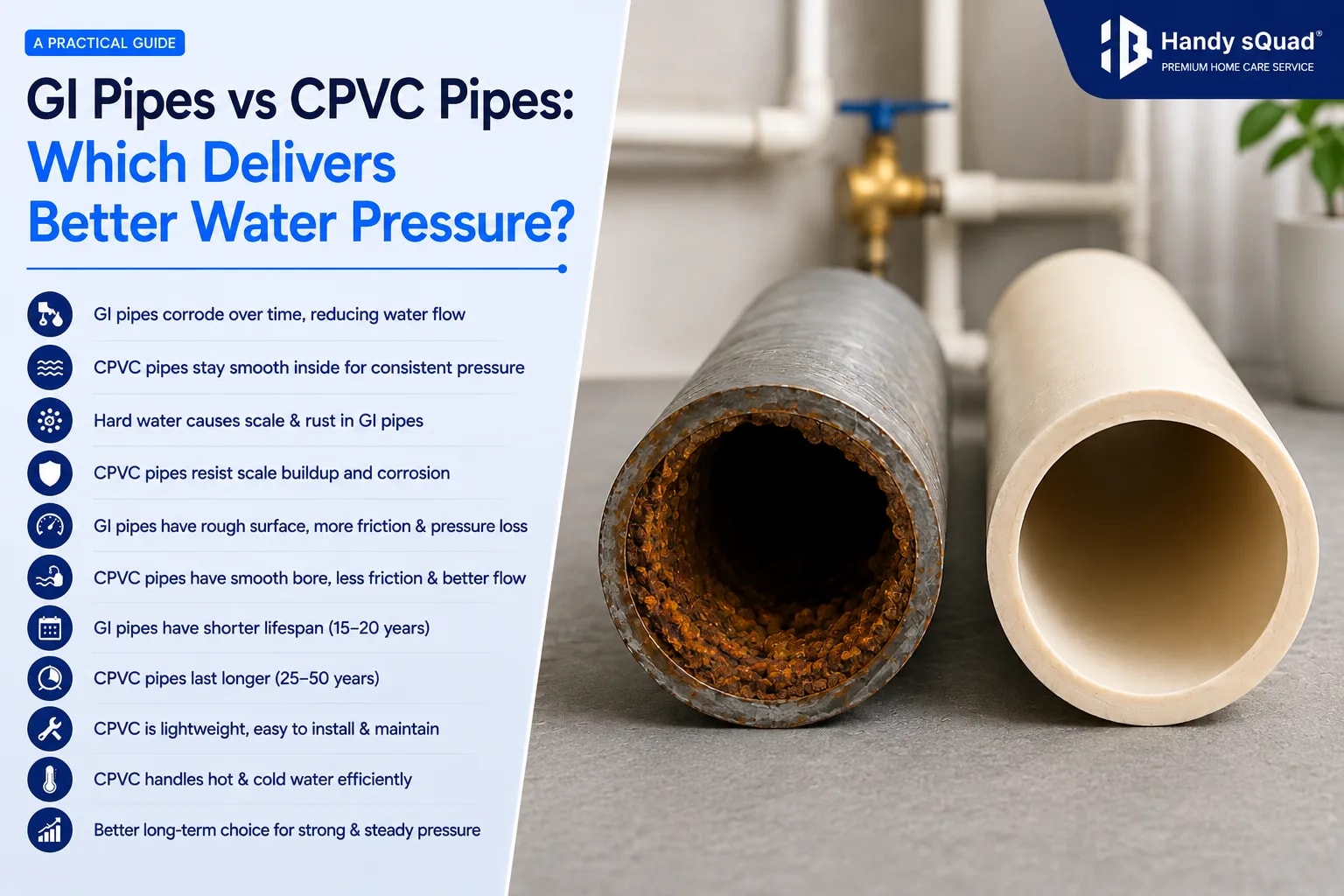
That rust doesn't just sit there either. It builds up along with mineral scale, and together they eat into the pipe's usable diameter. A pipe that was a clean 1 inch inside when installed can narrow enough after 10-15 years to genuinely restrict flow. Combine a narrower channel with a rougher, corroded surface, and you get exactly what you'd expect: more friction, more resistance, and a noticeable pressure drop—especially on upper floors or at the end of a long pipe run.
In areas with hard water, this whole process speeds up considerably. Limescale piles onto the rust, and what started as a minor rough patch can eventually turn into a partial blockage.
The honest summary here is that new GI pipe performs fine. It's the ageing process that quietly ruins it. Plenty of homeowners only figure out their pressure problem was never about the pump at all—it's when a plumber finally cuts open an old section of pipe and finds it half-choked with rust that the real cause becomes obvious.
CPVC Pipes: Built for the Long Haul
CPVC is a plastic pipe material engineered specifically for water supply—both hot and cold—and it's become the go-to choice in most new residential and commercial plumbing over the past couple of decades.
The advantages start with the surface itself. CPVC's inner wall is naturally smooth from the day it's installed, and unlike GI, it doesn't gradually roughen with use. Less friction from the start means better sustained flow.
It also just doesn't corrode. Being a plastic compound, there's no rust, no reaction with the water passing through it, nothing eating away at the pipe wall from the inside. The diameter you install is basically the diameter you keep for the entire life of the pipe.
Scale is less of an issue too. CPVC's surface is non-porous and doesn't give mineral deposits much to latch onto, so even homes with genuinely hard water tend to see far less buildup compared to GI over the same time period.
Put those things together, and you get a pipe where day-one pressure and year-fifteen pressure look remarkably similar. There's no slow bleed of performance the way there is with corroding steel—which is really the core advantage CPVC has over GI when it comes to pressure, specifically.
How They Actually Stack Up
Factor | GI Pipes | CPVC Pipes |
|---|---|---|
Initial water pressure | Good | Good to excellent |
Long-term water pressure | Declines from corrosion & scaling | Stays consistent |
Corrosion resistance | Poor — rusts over time | Excellent |
Scale buildup in hard water | High | Low |
Typical lifespan | 15-20 years, often less with hard water | 25-50 years |
Installation | Heavier, needs threading/welding | Lightweight, solvent-cement joints, quicker |
Cost | Cheaper upfront | Slightly more upfront and cheaper over its life |
Hot water use | It works, but corrodes faster with heat | Purpose-built for hot and cold |
Impact/crush resistance | Higher | Decent, but less than steel |
So Which One Wins on Pressure?
If you're only looking at brand new pipe straight out of the box, honestly, there isn't much difference. Both will deliver strong flow when sized and installed properly. The gap opens up over time, and that's where the real answer lives.
GI starts its decline almost the moment water starts running through it — slowly at first, then more noticeably as corrosion and scale take hold, particularly in India's many hard-water regions, where it doesn't take long at all. CPVC, on the other hand, holds onto its smooth, corrosion-free interior for decades, so what you feel in year one isn't far off from what you'll feel in year fifteen.
If consistent, long-term pressure is what you actually care about — and it usually is, especially for multi-story homes where pressure already has to fight gravity and distance — CPVC comes out ahead more often than not.
That doesn't make GI obsolete. It still earns its place where raw structural strength and impact resistance matter more than flow consistency—certain exposed outdoor runs, high-traffic utility areas, that sort of thing.
A Few More Things Worth Weighing In
Pressure isn't the only factor in this decision, so before locking anything in, it helps to think through a handful of other practical points:
Your local water quality. Hard or mineral-heavy water tilts the decision further toward CPVC, since that's precisely the condition GI struggles with most.
Upfront cost vs. what you'll spend later. GI is cheaper to install initially, sure, but factor in the cost of replacing corroded sections down the line, dealing with weaker flow, and possibly patching leaks—the lifetime math often favours CPVC.
How the installation itself goes. CPVC's lighter weight and solvent-weld joints usually mean faster work and lower labour costs compared to threading and welding GI pipe.
Whether hot water is involved. Geysers and water heaters age GI pipe faster due to heat-accelerated corrosion. CPVC doesn't have that weakness — it's rated for sustained hot water from the start.
What's already in your walls. Renovating an older home with existing GI lines and noticing weak pressure? Get the pipe interior checked before assuming the pump or tank is the problem. Corrosion-narrowed pipes are one of the most overlooked causes of "mystery" pressure loss, and it's a lot more common than people expect.
Bottom Line
For most homes today, particularly anywhere the water runs hard or mineral-rich, CPVC is the more reliable pick if long-term water pressure is the priority. Its corrosion-free, smooth-bore design spares you the slow, invisible decline that eventually catches up with ageing GI pipework. GI still has its uses in specific structural or budget-driven situations, but if you'd rather not think about your plumbing again for two decades, CPVC is generally the safer bet.
Whether you're replacing old GI lines, putting in fresh CPVC, or just trying to figure out why your pressure suddenly feels weaker than it used to, getting the pipe sizing, routing, and installation right matters just as much as choosing the material itself. The experienced plumbers in trivandrum at HandysQuad Plumbing handle all of this for you—from inspecting old pipework for hidden corrosion to recommending and fitting the right material for your home's actual water pressure needs. And if you're already dealing with low pressure, a leak, or planning a full re-piping job, a trusted plumber trivandrum technician from the same team in Trivandrum can take a look at your specific setup and sort it out properly.
Thanks for reading