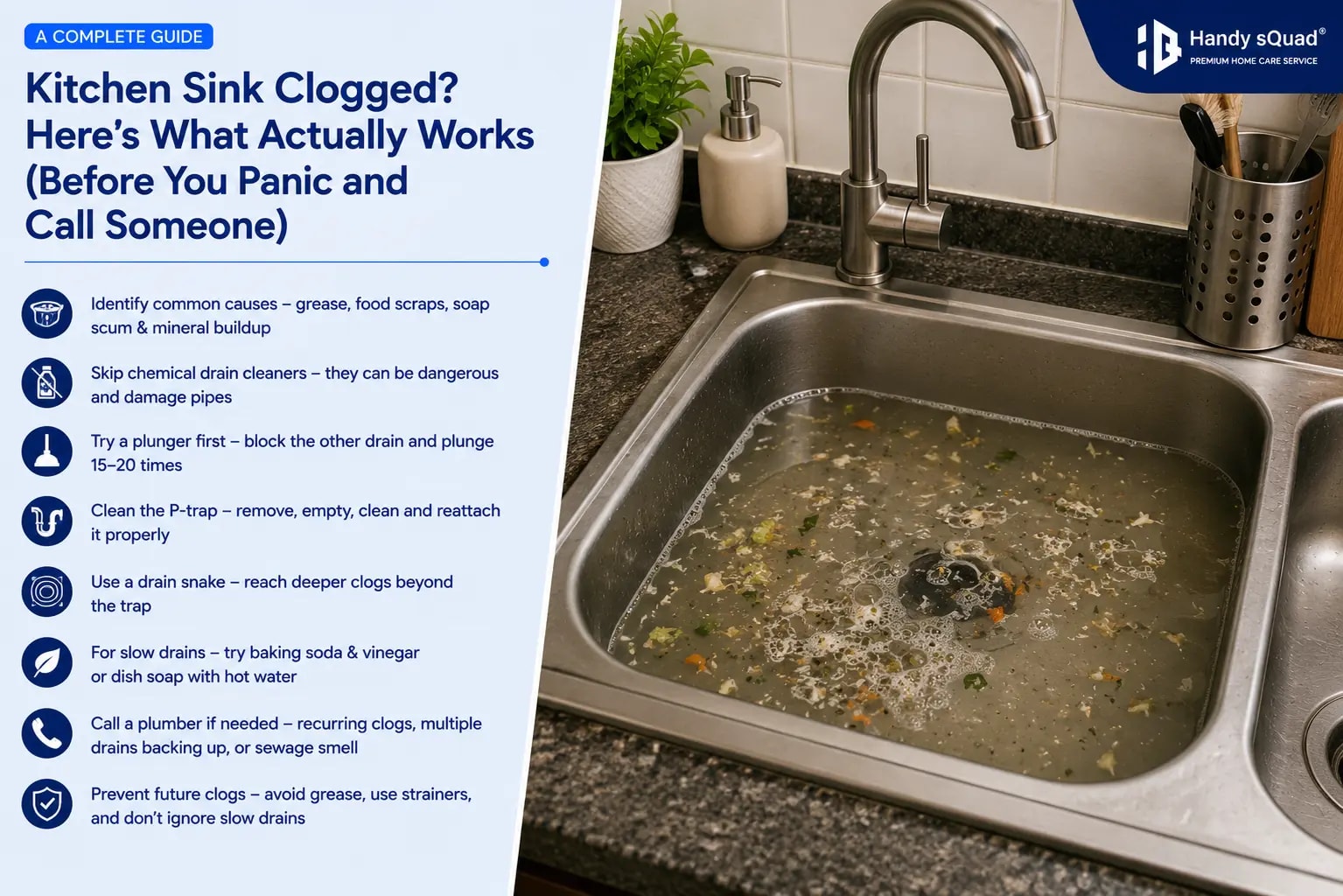
You're washing up after dinner, and suddenly the water isn't going down the drain. It just sits there, rising, while you stare at it hoping it'll drain on its own. It won't. If this is happening to you for the first time as a new homeowner, take a breath—this is one of those classic "welcome to owning a house" moments, and honestly, it's rarely as bad as it feels at 9 pm with a sink full of dirty water.
Most kitchen sink clogs aren't complicated. You just need to know where to start, what to skip, and when it's genuinely time to hand it over to someone who does this for a living. Here's how to think through it.
What's Actually Causing the Clog
Kitchen drains take a beating over the months without us really noticing. A few usual suspects build up inside the pipe:
Cooking oil and grease, which cools and hardens into a waxy layer
Bits of food that slip past your strainer — rice, dal, vegetable peels, that sort of thing
Soap scum, which loves to bond with grease and form a sticky paste
Mineral deposits from hard water, common in a lot of Indian homes, that slowly narrow the pipe over time
Here's something people often miss: if you've got a double-basin sink with a garbage disposal on one side, and the other side is the one backing up, the disposal probably isn't your problem. The blockage is usually sitting further down the shared line, not inside the disposal unit itself.
First, Skip the Drano
I get the instinct—you see standing water and want the fastest possible fix. But ask around, and most plumbers (and honestly most people who've dealt with this before) will tell you the same thing: chemical drain cleaners should be your last resort, not your first move.
A few reasons this matters:
Chemical cleaners are built to keep an already-slow drain flowing, not to blast through a full blockage. If it doesn't clear the clog and you then need to plunge or snake the drain, that leftover chemical can splash back at you—which is genuinely dangerous, not just an inconvenience. And if you're using these repeatedly, older pipes (especially the mix of PVC and metal fittings you find in a lot of Indian homes) don't love it either.
If you want something gentler, enzyme-based cleaners are worth considering, but set expectations correctly — they work slowly on grease over several hours, sometimes overnight, and they're not going to blast through a solid clog by dinnertime.
Try a Plunger. Seriously, Just Try It First.
This sounds almost too simple, but a basic sink plunger (get a separate one from your toilet plunger, please) solves more clogs than people expect. It costs next to nothing and takes five minutes.
If you've got a double basin, block off the second drain first—a wet cloth stuffed in there or a small bowl pressed down works fine. This matters more than people realize, because without it, all your suction just escapes through the other opening instead of working on the clog.
Add a little water to the sink so the plunger head is actually submerged, then place it over the clogged drain and make sure you've got a full seal. Push down gently once to push out trapped air, then go at it—firm, steady plunges, maybe 15 to 20 of them. Pull it away and check.
A lot of everyday kitchen clogs die right there. No tools, no mess, no chemicals.
Next: Open Up the P-Trap
If plunging didn't do it, move to the P-trap—that curved section of pipe right under your sink. Nine times out of ten, this is exactly where the clog has settled, and cleaning it out takes most people well under 15 minutes once they know what they're doing.
You'll want a bucket, gloves (trust me on this one), and an adjustable wrench.
Slide the bucket under the trap before you touch anything—there's water sitting in there, and it will come out. Loosen the slip nuts on either end by hand if you can manage it or with the wrench if they're stuck. Once it's off, empty the contents into the bucket. This is the unglamorous part of the job—expect some smell, expect some gunk, and be glad you wore gloves.
Clean out the inside of the trap with an old toothbrush or a piece of wire, then reattach it. Tighten the nuts until snug, but don't go overboard—older plastic fittings can crack if you're too aggressive. Run the tap and check both that water drains freely and that nothing's leaking at the joints.
Quick tip: snap a photo of how everything was connected before you start pulling it apart. Future-you, trying to remember which nut went where, will thank present-you.
Still Stuck? Bring In a Drain Snake
If the trap was clean but the water's still not moving properly, the clog has probably moved further down the pipe than you can reach by hand. This is where a hand-powered drum auger earns its keep—feed it into the drain and let it break up or hook onto whatever's blocking things. They're cheap, they're reusable, and honestly, if you own a home in India—especially an older building with narrower or aging pipework—it's worth just keeping one around.
For Slow Drains (Not Full Blockages), Try This
If your drain is just running slow rather than fully backed up, a couple of gentler options are worth a shot before things escalate:
Baking soda is followed by white vinegar, left to fizz away for 15–20 minutes, and then flushed through with hot water. Or a generous squeeze of dish soap straight down the drain, left to sit, then chased with a pot of boiling water—this one works particularly well if grease is the culprit, since the heat helps the soap cut through it.
Neither of these is a miracle cure for a proper clog, but for maintenance, they're genuinely useful.
When to Stop DIY-ing and Call a Plumber
If you've plunged, cleaned the trap, and even run a snake through it and you're still fighting the same clog, it's probably time to stop. Definitely call someone if:
Water is backing up in more than one place — not just the kitchen sink. You're smelling sewage rather than just old food. You've already poured a chemical cleaner down there and now need mechanical help (tell whoever you call about this beforehand; it matters for their safety). Or the clog just keeps coming back every few weeks no matter what you do.
That last one especially is usually a sign of something bigger going on—a blockage further along the main line, a pipe that isn't sloped correctly, or plumbing that's simply old enough to need replacing. Those aren't DIY jobs, and trying to force them usually just costs you more time and money in the end.
If you're in Kerala, plumbers in trivandrum from HandySquad can take a proper look at your kitchen drainage, clear out whatever's stuck, and flag any bigger issues before they turn into a real headache. If you're searching for "plumbers near me" at 10 pm with a sink full of water, booking someone reliable is usually a lot less painful than another round of trial and error.
A Few Things Worth Avoiding
Don't mix different chemical drain cleaners—the fumes this creates can genuinely be dangerous. Don't go overboard with the plunger either; older seals and pipe joints can crack if you're too rough. Stop pouring oil and grease down the sink going forward—let it cool in a container and bin it instead. And don't ignore a drain that's just running a bit slow — that's usually your early warning, and it's a lot cheaper to deal with now than after it turns into a full clog.
Bottom Line
Almost every homeowner deals with a clogged kitchen sink at some point—it's not a sign you're doing something wrong; it's just what happens over time. Start with the plunger, move to the P-trap if that doesn't work, and keep a drain snake in your back pocket for anything stubborn. If none of that clears it, or the same clog keeps returning, that's your cue to call in someone who does this every day rather than keep wrestling with it yourself.
Either way, you'll have your sink draining properly again soon—and next time this happens (it will), you'll already know exactly where to start.
Thanks for reading