

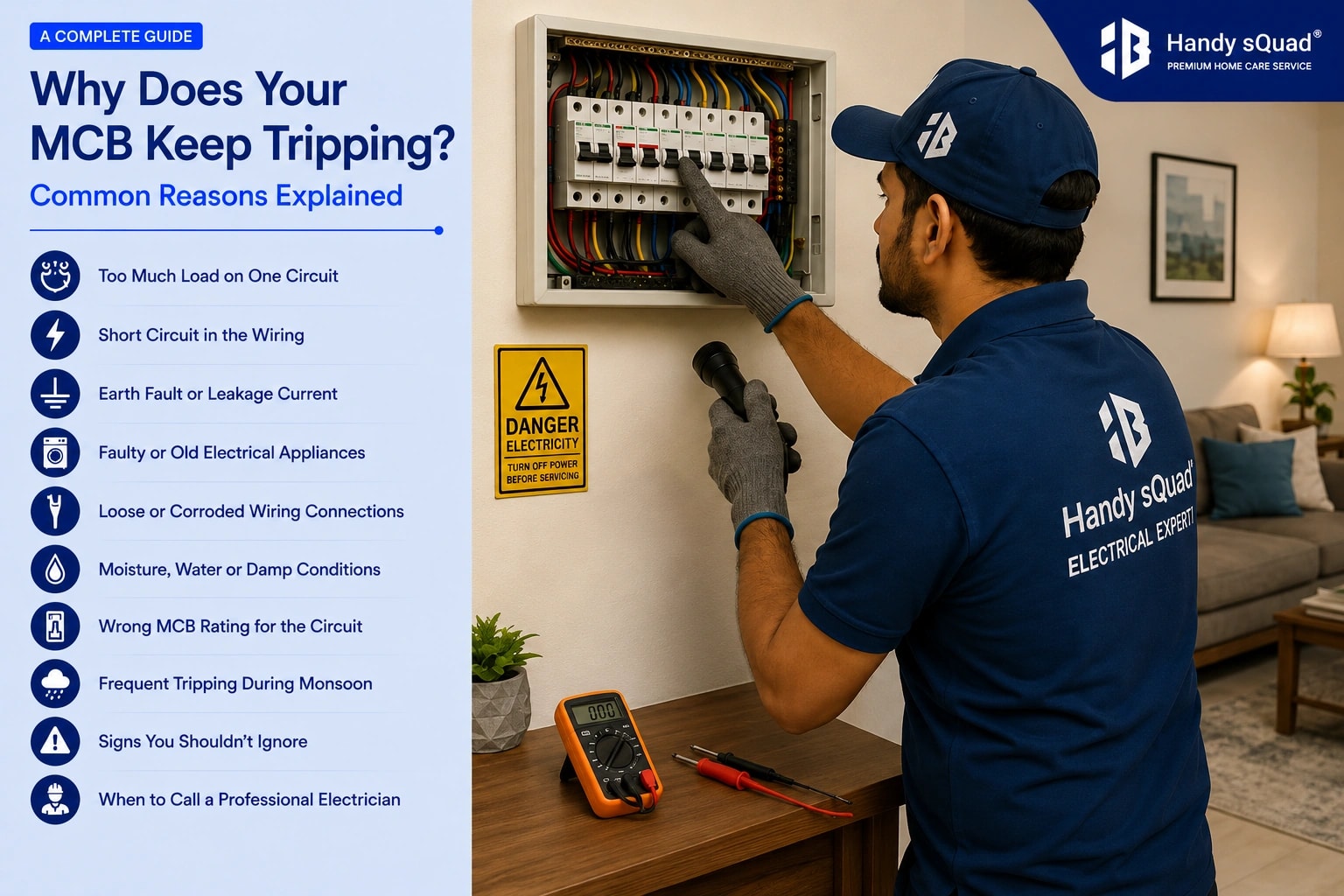
A tripping MCB isn't random—it's your home's wiring telling you something's wrong before it turns into a real hazard. This guide breaks down why your MCB goes down again and again, the most common causes, how to fix it yourself where possible, and when it's time to call a professional.
Picture this—you're halfway through cooking, or maybe you've just sat down for a movie, and the lights die on you. No warning, nothing. You get up, walk to the panel, and flick the switch back up. Fine for two hours. Then it happens again.
Sound familiar? A friend of mine dealt with this for close to three weeks in her old flat near Pattom before she finally gave up and called an electrician. Turned out to be something silly, a loose terminal that cost almost nothing to fix. But she'd spent weeks resetting the same breaker every evening, thinking it would just sort itself out eventually. It doesn't, usually.
Quick refresher for anyone who isn't sure what an MCB even is: Miniature Circuit Breaker. That's it, that's the acronym. And no, it hasn't gone faulty just because it keeps tripping again and again. It's actually doing its one job properly. Something along the wiring is off, and the breaker's cutting power before that "something" turns into a shock, a fire, or a ruined appliance. Resetting it again and again without figuring out the cause is a bit pointless, honestly, like ignoring the fuel light because the car's still moving.
Anyway. What's actually behind it? Here's the rundown. And if you want the bigger picture beyond just MCBs, this ties into a lot of what we've covered in our complete home electrical maintenance guide for Kerala homeowners, which is worth a read if you're trying to keep your whole setup in check, not just one breaker.
What an MCB Is Actually Doing (and How It's Different From an MCCB)
Imagine a bouncer standing at your circuit's front door. Current flows in, and as long as it stays under a certain limit, he waves it through. The second it crosses a line, he shuts the whole door. No warning. No exceptions made.
Older homes used rewirable fuses instead, thin wires that literally burned through and had to be replaced by hand every single time. MCBs don't work that way. You flip a switch, and it resets. So one trip isn't a big deal by itself. Several trips in a short window, though? That's the wiring trying to tell you something.
Worth a quick mention: an MCCB (Moulded Case Circuit Breaker) is a bigger cousin of the MCB, generally used for higher current loads, like a building's main incoming supply rather than individual home circuits. If it's a single room or appliance tripping, you're dealing with an MCB. If it's the entire house losing power at once, it could be the main breaker, which may be an MCB or an MCCB depending on your home's setup, and it's worth having an electrician confirm which one is actually causing the trip.
1. Too Much Load on One Circuit
This is the reason behind most trips, hands down. Circuits are built to handle a fixed amount of load, no more. Run the kettle, the iron, and the microwave off one line at the same time, and you're basically asking a wire meant to carry one appliance's worth of power to carry three. The breaker notices the strain and shuts it down before the wiring gets dangerously hot.
The fix for this one's straightforward. Spread the heavy appliances across separate circuits. Don't cram five high-wattage things into a single extension board and expect it to hold up.
2. A Short Circuit
This happens when a live wire touches a neutral wire directly, bypassing whatever appliance was supposed to sit in between. The result is a sudden, sharp spike in current—much bigger than what an overload produces—and the breaker trips almost instantly.
What causes it? Insulation that's cracked with age, wires chewed through by rats or mice (more common than you'd think), water that's found its way into a socket, or an appliance shorting out internally. You can't fix this one by unplugging a few things and hoping for the best. It's a wiring problem, plain and simple, and it needs someone to actually open things up and check.
3. An Earth Fault
An earth fault means current has strayed off its intended path and is finding its way to the ground—through a metal appliance body, a damp wall, exposed wiring, or whatever offers the least resistance. It doesn't sound like much until you realise that stray current could pass through anyone who touches the affected surface. So when the MCB trips because of this, it's actually protecting you, not malfunctioning.
If the trip lines up with one specific appliance being switched on, that's your starting point.
4. An Old or Failing Appliance
Sometimes the wiring's totally fine, and the real issue is one appliance that's quietly degraded on the inside—a motor giving out, moisture sitting inside the casing, or internal wiring gone brittle. Water heaters, washing machines, and irons—these tend to be the usual suspects, mostly because they take on more heat and moisture over the years than most things plugged into your wall.
The best way to narrow it down is to unplug things one at a time, resetting the breaker each time you do. Whichever appliance stops the tripping is your answer.
5. Loose or Corroded Wiring Connections
Connections loosen with time. Terminals inside a switchboard corrode, especially in humid environments. Either way, resistance builds up at that exact point, resistance creates heat, and heat leads to current fluctuations the breaker picks up on. This kind of fault sneaks up slowly—an occasional annoyance today can turn into a daily one a few months down the line if it's left alone.
6. Weather, Moisture, and Voltage Fluctuations
Coastal cities deal with this a lot, and monsoon season makes it worse. Moisture creeps into switchboards and outdoor sockets; small leakage currents build up, and eventually that's enough to trip a breaker. If you've got anything exposed outdoors, get it sealed before the rains hit, not after.
There's also plain old voltage fluctuation to think about. Bad weather, an unstable local grid, or whatever—a sudden surge can shove more current through than the breaker's rated for, and it trips even though nothing in your house is actually wrong. If you notice your MCB only ever acts up when there's a storm going on or during those weird power fluctuations Kerala's grid throws up now and then, that's probably your answer. A stabiliser or a decent surge protector usually sorts it out.
7. Wrong MCB for the Circuit
And sometimes, honestly, nothing's wrong at all except the breaker itself. Someone puts in a 10A or 16A MCB on a circuit that's regularly pulling more than that, and it's going to trip doing nothing unusual whatsoever. It happens more than you'd think, usually in homes where a new circuit got added or a heavier appliance came along later, and nobody went back to check if the original breaker could actually take the extra load.
How to Fix an MCB That Keeps Tripping
Okay, so it's tripping, and you want it to stop. Work through this roughly in order before calling anyone.
Start by unplugging everything on that circuit and resetting the breaker. Holds fine with nothing running? Good, now add things back one at a time until it trips again; that's your culprit. Pay attention to when it happens too; does it go the second you switch something specific on, only when it's raining, only when three things are running together? The pattern's usually telling you exactly what's wrong; you just have to notice it.
If it's clearly an overload, the fix is simple enough: move a couple of the heavier appliances onto a different circuit, or just don't run them all at once.
Here's the bit people miss, though. If the MCB won't stay up at all, flips back down in seconds even with the whole circuit unplugged, that's not an overload. That's a short circuit, an earth fault, or something wrong with the breaker itself, and no amount of resetting fixes it. Don't keep forcing it back on either. Every reset just delays finding the actual problem, and depending on what's actually wrong, it's not exactly harmless to keep doing.
Past a certain point this stops being a DIY job. Short circuits, earth faults, loose connections buried inside a switchboard, none of that gets diagnosed properly without the right testing equipment. That takes an electrician, not more patience.
When Do You Actually Need to Call Someone?
A single trip during a thunderstorm, or that one time you overloaded a power strip by accident — not really something to worry about. But repeated tripping, tripping the second a specific device gets plugged in, a burning smell, discolouration near the switchboard, and a panel that feels warm to touch — that's your cue to stop resetting it yourself.
These patterns rarely show up for no reason. There's almost always a cause behind them, and it's usually not something you'll spot with a glance. Testing insulation resistance, checking earth continuity, and physically inspecting every wiring joint—that takes tools and training. Not just patience.
Where Handy sQuad Comes In
This is really where it pays off to bring in someone who does this professionally instead of guessing your way through it. If you're in the city and need reliable electricians in Trivandrum, Handy sQuad is a good place to start. Their team deals with everything from tracking down why your MCB won't stop tripping to rewiring problem sections and swapping out old switchboards—and they treat it as a proper job, not a quick patch-up.
Whether you're looking at a one-time short circuit or something that's clearly been building for months, getting an experienced electrician in Trivandrum involved means the actual cause gets caught the first time, instead of getting papered over and turning up again a few weeks down the line.
The Bottom Line
A tripping MCB is annoying; no argument there. But it's also one of the more genuinely useful warnings your home's electrical system gives you. Resetting it repeatedly without asking why doesn't make the problem go away—it just puts off dealing with it until a far less convenient moment. Notice when it trips. Notice what's plugged in. Notice how often it's happening. Honestly, that pattern alone tells you most of what you need to know, and if it's clearly more than a simple overload, don't wait around; get a professional in.
Frequently Asked Questions
Why does my MCB keep tripping again and again?
A handful of possible reasons here: too much drawn off one circuit, a short circuit, an earth fault, an appliance quietly failing, wiring that's gone loose or corroded, moisture, voltage swings, or just an MCB that's rated too low for what the circuit actually pulls. One trip, don't worry about it. Keeps happening though? Go through it plugged-in item by plugged-in item; that's genuinely the fastest way to land on the real cause.
Why does my MCB keep going down?
"Going down" is just people's way of saying it tripped, switch flips from up to down (or sits in the middle on some models) and the power's cut. Nothing wrong with the switch itself, it's reacting to something on that circuit, could be overload, a short, an earth fault, a dying appliance. Once is nothing. More than that in a short stretch, and it's worth actually looking into instead of just flipping it back up each time.
Why does the MCB keep falling again and again?
Same thing, different word for it, really. "Falling," "tripping," "going down," people use all three for the exact same thing, the switch dropping on its own. A single instance, don't think twice. If it's a repeat offender though, especially at the same time each day or with the same appliance running, it's one of the usual suspects, overload, a short, an earth fault, a failing appliance, loose wiring, damp, or a breaker that's simply undersized for the job.
What does it mean when the MCB is down?
Means the breaker's tripped and killed power to that circuit. That's the switch doing its job, not breaking. Push it back up, and if it stays, take note of what was running when it went. Trips again soon after? That's not bad luck, that's a pattern, and it deserves a proper look.
Should the MCB switch be up or down when it's working normally?
Up's on, down's off (or tripped). Spot one switch sitting low while the rest on the panel are up, that's your culprit, flip it back and you're usually sorted. Won't stay up though, or trips again within the hour, stop resetting it and start figuring out why.
Can an MCB trip because of high voltage?
Yes, it can. A surge from the grid, common enough during storms or wherever the local supply's a bit shaky, can push current past what the breaker's built to handle, even with everything inside your home perfectly fine. Different animal from an overload or a short circuit altogether. Notice it only trips during bad weather or known power swings in your area, that's your answer, and a voltage stabiliser is worth looking into.
What should I do if my MCB keeps tripping even with nothing plugged in?
If there's genuinely no load on the circuit and it still trips, overload's off the table straight away. You're looking at a short circuit, an earth fault, or something wrong with the MCB itself. Not a reset-and-hope situation, this one needs an electrician with proper testing gear.
Thanks for reading