If you'll run the AC 6+ hours a day (bedrooms, WFH rooms, most Kerala homes March–November), get an inverter AC—the electricity savings outweigh the higher price and repair risk. If it's for occasional use (guest room, a few hours in the evening) or your area has frequent voltage fluctuations without a stabiliser, a non-inverter AC is the safer, cheaper choice.
Ask anyone who bought an AC last summer how they decided, and you'll get one of two answers: they trusted an online buying guide, or they called their usual AC technician. The irritating part is that those two sources rarely agree—and nobody explains why.
The technician tells you to skip the inverter and go simple. "Less trouble," he says. Every buying guide online is meanwhile pushing you toward a 5-star inverter model. Both are right. They're just answering different questions.
Why Your Technician Doesn't Trust Inverter ACs
A technician doesn't read spec sheets—he shows up when something breaks. And what breaks, over and over, is the PCB (the circuit board that controls compressor speed) inside inverter units.
In cities with unstable voltage—Trivandrum, Kochi, and most of Kerala during monsoon included — these boards can fail without warning. PCB repair typically costs ₹10,000–₹20,000, sometimes more depending on the brand. That's a real dent in the "savings" you bought the unit for, especially if it happens 2–3 years in.
A non-inverter AC is mechanically simple by comparison: the compressor is either on or off, full speed only. Fewer electronic parts means fewer failure points. Technicians routinely see non-inverter units run 15–20 years with nothing worse than a capacitor swap—a ₹300–₹500, 20-minute fix.
Why Every Buying Guide Pushes Inverter Anyway
The electricity math is genuinely compelling for heavy users. In Kerala or Bangalore, where an AC often runs nightly from March through October:
A well-sized 5-star inverter AC saves ₹3,000–₹6,000 per season versus an older 3-star non-inverter unit.
Over 5 years, that's real money back—and the unit pays for its price premium and then some if you use it heavily.
Inverter units also hold temperature more steadily: instead of blasting on, cooling, shutting off, and cycling back on, the compressor runs at a lower steady speed. Quieter, more consistent, and better for sleep.
Buying guides are optimising for the heavy-use case. The problem is they write it as if everyone uses their AC the same way—they don't.
How to Tell If Your Current AC Is Inverter or Non-Inverter
Not sure which type you already have? Three quick checks:
Check the model name/label on the outdoor unit—inverter models almost always say "Inverter" somewhere in the model number or nameplate (e.g., "1.5T Inverter Split AC").
Listen to it. A non-inverter AC cycles—you'll hear the compressor kick on at full power, run, shut off completely, then kick on again every so often. An inverter AC hums continuously at a steadier, quieter volume without those hard on/off cycles.
Check your electricity bill pattern. If cooling the same room for the same hours produces wildly different monthly bills across otherwise similar months, and the unit runs constantly without cycling off, that's inverter behaviour.
If you genuinely can't tell, a technician can confirm in under five minutes during a routine service visit.

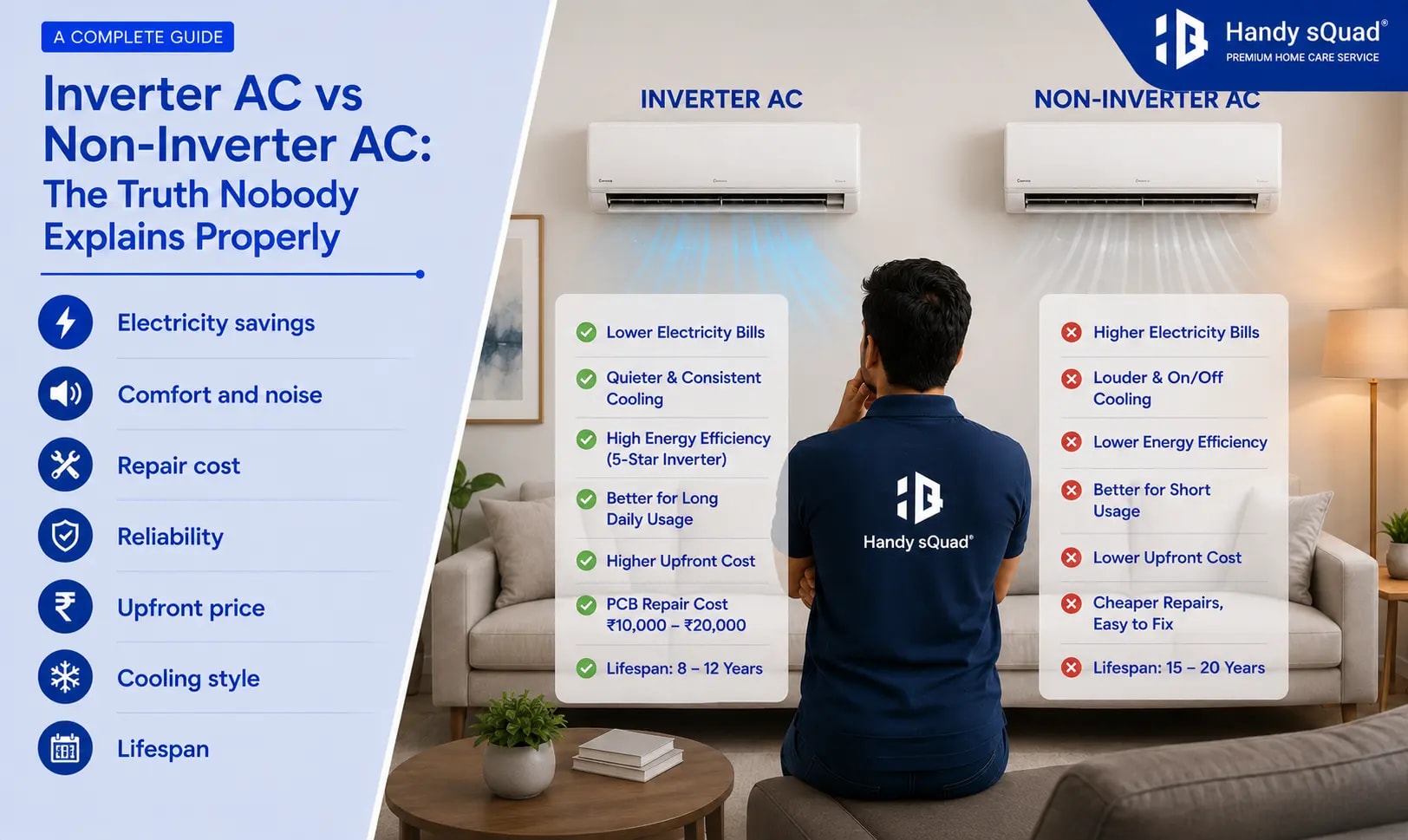
Inverter AC vs Non-Inverter AC — Full Comparison
Factor | Inverter AC | Non-Inverter AC |
|---|---|---|
Electricity bill | Lower—compressor adjusts speed to demand | Higher—compressor runs full power every cycle |
Upfront price | Higher (₹5,000–₹10,000 more, typically) | Lower |
Repair / PCB cost | ₹10,000–₹20,000 for PCB replacement | A few hundred rupees for common mechanical fixes |
Complexity | More electronics, more failure points | Simple, fewer things to go wrong |
Cooling style | Gradual, steady | Fast, powerful bursts |
Typical lifespan | 8–12 years | 12–20 years |
Best for | 6+ hours/day daily use | Occasional or seasonal use |
Voltage fluctuation risk | More vulnerable—needs a stabiliser | More tolerant |
The 30-Second Decision Guide
Go inverter if:
You run the AC 6+ hours daily
It's a bedroom unit you sleep with running
You work from home through the afternoon heat
You have a stabiliser or reasonably stable power supply.
Go non-inverter if:
It's for occasional evening use or a guest room
Your area has frequent power fluctuations, and you don't want to add a stabiliser
You want the simplest, cheapest-to-maintain option
Either way, get a good voltage stabiliser (~₹2,500). It has saved plenty of inverter ACs from a ₹15,000 PCB replacement, and it protects non-inverter units too.
Star Ratings — What They Actually Mean
A 5-star and 3-star AC of the same tonnage cool a room in the same time. The star rating only reflects how much electricity is used doing it. Heavy daily use → 5-star pays for itself within 1–2 years. Light, occasional use: a 3-star does the same job for less money upfront, and you'll likely sell or replace the unit before the electricity savings would have mattered.
Installation Matters More Than the AC You Buy
You can spend ₹45,000 on the right unit and still sit in a warm room weeks later—because of the installation, not the machine. The most common causes we see at Handy sQuad:
Poor unit placement—restricted airflow makes the unit work twice as hard
Bad copper piping—thin-walled or badly joined pipes are the most common cause of gas leaks
Improper drainage slope—causes water backup, mould, and compressor stress
Skipped annual servicing—an uncleaned coil can run at ~70% of rated efficiency
Book an AC Service in Trivandrum with Handy sQuad and our technicians will flag any installation issues before the unit goes in—right brackets, right piping, right drainage.
FAQ: Inverter AC vs. Non-Inverter AC
Q: What's the actual difference between inverter and non-inverter AC? An inverter AC's compressor continuously adjusts its speed to match cooling demand, using a PCB to control it—this saves electricity but adds a failure-prone component. A non-inverter AC's compressor only runs at full speed or switches off entirely—simpler, cheaper to fix, but less efficient over long runtimes.
Q: Why do technicians say inverter AC "is not good"? It's not that inverter tech is bad—it's that the PCB is fragile against voltage spikes, and repair costs (₹10,000–₹20,000) are steep compared to a non-inverter's typical mechanical fixes. Technicians see the failures, not the electricity bill savings, so their advice skews toward reliability.
Q: Why is non-inverter AC considered "costly" long-term? Because the compressor always runs at full power, electricity bills add up fast with daily heavy use—often costing more over a few years than the inverter's higher upfront price and occasional repair.
Q: Does a non-inverter AC have a PCB at all? Yes—it's simpler than an inverter's PCB, mainly handling on/off switching, timer functions, and fan speed, rather than continuously modulating compressor speed.
Q: How much does an inverter AC actually save on electricity per year? For a 1.5-ton unit running 8 hours daily through a 6-month season, expect roughly ₹4,000–₹7,000 more savings versus a 3-star non-inverter. Running only 2–3 hours in the evening shrinks that gap significantly—sometimes not enough to justify the price difference.
Q: Inverter AC vs non-inverter—which is better for a bedroom? Inverter, almost without exception. Non-inverter units cycle on and off all night at full blast; inverter units hum steadily and quietly. If you're a light sleeper, this difference is noticeable.
Q: Should I buy an inverter AC if my area has frequent power cuts or fluctuations? Be careful. The PCB is the first thing to fail when power spikes. If your area's supply is unstable, either invest in a proper stabiliser (5 KVA minimum for a 1.5-ton unit) or go non-inverter.
Q: Is inverter AC worth it specifically for Kerala homes? For most Kerala homes running the AC 8–10 hours a day for much of the year, yes—the electricity savings show up clearly on the bill. Pair it with a stabiliser given the state's occasional voltage fluctuations.
Need help deciding, installing, or servicing your AC? Our technicians across Kerala handle installation, servicing, and gas top-ups with upfront pricing. Book an AC service in Trivandrum →