If you've ever been quoted a bill that costs more than the AC itself just to install the outdoor unit, you're not alone. A recent Reddit discussion captured this perfectly: someone bought a 1.5-ton AC for ₹37,000, only to be told that placing the outdoor unit on the terrace would cost an extra ₹40,000 — almost entirely due to a 75-foot copper pipe run.
The thread pulled in responses from technicians, long-time AC owners, and hobbyists, and together they built a genuinely useful picture of how to think about outdoor unit placement. Here's everything you need to know, organised so you can actually use it.
Why Outdoor Unit Placement Costs Spiral Out of Control
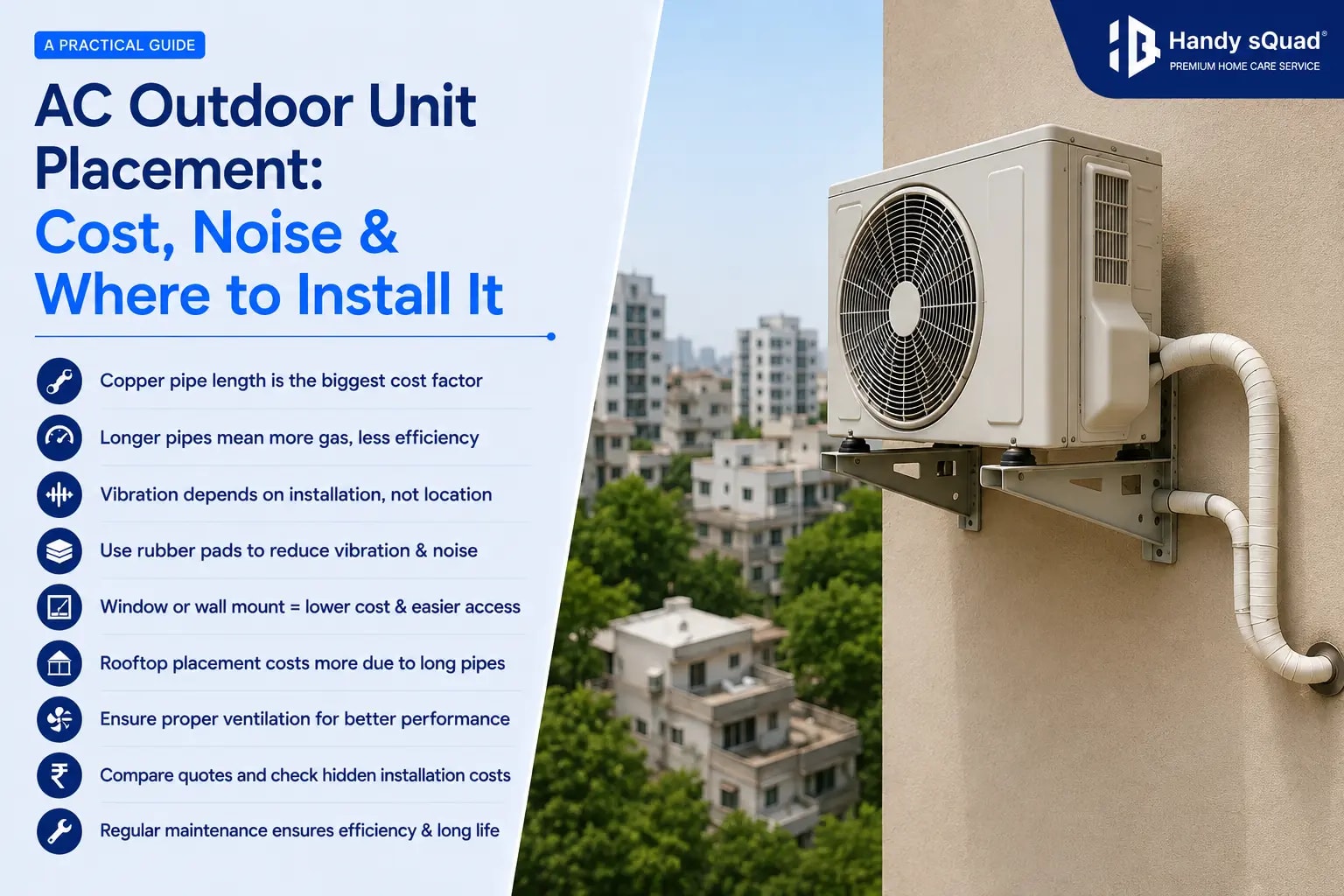
The single biggest cost driver isn't labor — it's copper pipe length. In the original case, the technician quoted around ₹393 per foot for copper, and with 75 feet needed to route the pipe from a lower-floor flat up to the terrace, the math added up fast. Other commenters mentioned getting quotes as low as ₹250–300 per foot from different vendors, which is a reminder that shopping around for copper (or buying it yourself and having the technician install it) can cut costs significantly.
Beyond copper, longer pipe runs bring real technical downsides that several commenters flagged:
More refrigerant gas needed—extra length means an extra gas charge (some estimated 3–4 kg more for a 75-ft run).
Reduced cooling efficiency — the compressor has to work harder to move refrigerant through a longer circuit
Higher electricity bills — inefficiency translates directly into higher running costs
More points of potential leakage—every extra joint and bend is a place where a leak could eventually develop
Shorter compressor lifespan—sustained extra load on the compressor from long pipe runs can reduce its working life
So before agreeing to a rooftop installation with a long pipe run, it's worth asking, "Is there a shorter route available?"
Does the AC Outdoor Unit Really Cause Vibration?
The honest answer is it depends entirely on installation quality, not on where you place it.
Multiple experienced commenters (including people who'd had window and wall units for 5–10 years) converged on the same conclusion:
Vibration is caused by loose, improper, or cantilevered mounting — not by the unit itself.
If the outdoor unit is bolted securely to a wall bracket or windowsill with proper contact, vibration is minimal to negligible.
The noise you do hear is usually just fan noise, which is closer to white noise than a mechanical rattle — comparable to a ceiling fan on medium speed.
One commenter offered a helpful physical explanation: the compressor cycles on and off like a refrigerator's does, running until it reaches your thermostat's set temperature, then shutting off until the room warms up again. Vibration is only present while the compressor is actively running — it isn't continuous.
Higher-quality outdoor units (brands like Hitachi and Daikin were mentioned specifically) are engineered with metal brackets that have minimal contact area with the wall, further reducing how much vibration energy actually transfers into the building structure.
The consistent verdict: a cantilever installation (where the unit juts out from a wall with no direct support beneath it) is the setup most likely to cause noticeable vibration, since the unit's weight and motion aren't properly grounded.
Practical Ways to Reduce Vibration and Noise
If you're worried about vibration regardless of placement, the thread offered several inexpensive, proven fixes:
Vibration/rubber isolator pads—placed between the outdoor unit and its stand or bracket. Several commenters specifically credited these with eliminating vibration almost entirely. Many brands (LG was mentioned) include these pads with the unit at no extra cost.
Rubber fittings under the unit—one AC parts seller estimated this reduces vibration by roughly 95%, even if it's not 100% eliminated.
Secure, non-cantilever mounting—a bracket that's properly anchored into the wall, rather than resting on an angled or overhanging support, removes most of the mechanical looseness that causes rattling.
Soundproofing your windows instead—if outside noise (traffic, neighbours, etc.) is your bigger concern rather than the AC itself, a few commenters suggested that money is better spent on sound-dampening window treatments. Quotes mentioned were around ₹8,000 per window installed — which may be more cost-effective than an expensive rooftop AC installation if your actual goal is a quieter room.
Where Should You Place the Outdoor Unit?
Based on the range of experiences shared, here's a comparison of the common placement options:
Placement | Pros | Cons |
|---|---|---|
Window/window grill | Shortest pipe run, cheapest install, easy technician access for servicing, minimal vibration if properly padded | Can block window/light; may need a small hinged cutout in the grill for access |
Wall bracket (nearest exterior wall) | Balances cost and practicality, most commonly recommended by commenters, good airflow | Requires exposed piping along the wall, may need drilling |
Ground floor to shared roof/terrace | Better airflow and ventilation, less likely to disturb neighbours, easier long-term maintenance access | Higher upfront cost due to longer pipe if your flat isn't on the top floor |
Terrace directly above a top-floor flat | Ideal if achievable with a short pipe run; best ventilation | Cost balloons quickly if piping has to travel multiple floors sideways or vertically |
One commenter offered a genuinely creative middle-ground solution for people on lower floors who still want to avoid a costly rooftop pipe run: cut a small, lockable gate-style outlet into your existing window security grill. This lets a technician access and service a window-mounted outdoor unit safely from inside, without the cost of hauling copper pipe up multiple floors. It's a modest one-time cost (grill cutting, hinge, and a lock) that can save tens of thousands compared to rooftop piping.
A Few Other Things Worth Knowing
Get multiple quotes. The wide range in copper pricing (₹250–393 per foot) in the same thread shows there's real room to negotiate or shop around, including buying copper pipe independently and having a technician install it.
Check if installation is meant to be free. Several commenters pointed out that standard installation is usually included when you buy a new AC — extra charges typically apply for distance, extra copper, or specific placement requests. It's worth calling customer care to clarify what's actually chargeable versus what should be complimentary.
Consider your building's setback and ventilation. One commenter raised a good point: proper outdoor unit ventilation matters for AC performance, and government norms often require a minimum setback from neighbouring walls anyway—so "just anywhere on the terrace" may not even be viable depending on your building's layout.
Maintenance access matters long-term. A wall- or window-mounted unit is easier and cheaper for technicians to service regularly (extra visit charges were mentioned in the ₹200 range for hard-to-reach outdoor units). A rooftop unit might look tidy, but every future gas refill or cleaning could cost more in labour and access time.
The Bottom Line
The most consistent, expert-backed advice from the thread comes down to this: place your outdoor unit as close to the indoor unit as your building allows, prioritise proper wall/bracket mounting over cantilevered setups, and always add vibration-isolation pads regardless of where you place it. Rooftop installation isn't inherently better for vibration — it primarily costs more because of the extra copper piping, not because it's a fundamentally quieter location.
If noise from outside your window is the real concern rather than the AC itself, soundproofing your windows may solve the actual problem for less money than a rooftop installation would.
Before signing off on any quote, it's worth asking your technician directly: how much copper is genuinely necessary, and is there a shorter route available? That single question, based on this thread, could be the difference between a reasonable bill and paying more for installation than for the air conditioner itself.
Getting all of this right — proper bracket mounting, correct copper length, vibration isolators, and an honest quote — really comes down to who you hire. The experienced ac service trivandrum technicians at HandysQuad will take care of these details for you, from assessing the shortest practical pipe route to fitting proper isolation pads so vibration and noise aren't an issue after installation. If your unit is already up and causing problems—noise, poor cooling, or a leak from a long pipe run—the same team handling ac repair trivandrum requests can diagnose and fix it without the guesswork this Reddit thread had to go through.
Thanks for reading