You switch the AC on expecting that first blast of cool air, and instead the airflow just keeps getting weaker. Sometimes it stops altogether. Open up the front panel and there's a layer of ice sitting right on the coils, or you notice frost creeping along the copper pipes outside. Congratulations, your AC has frozen up — one of the more common issues in Indian homes, especially with how the weather swings between humid and properly hot. Good news, though: nine times out of ten this is fixable once you actually know what's behind it.
Below, why this happens, what you can check yourself before picking up the phone, and when it's genuinely worth calling in someone qualified.
Common Causes of AC Freezing: Low Refrigerant, Airflow Issues, and More
An air conditioner cools your room by pulling warm air over a set of cold coils. For that to work properly, those coils need to sit at a fairly specific temperature — not too warm, obviously, but not too cold either. Throw that balance off, and the coils drop colder than they should, and moisture in the air starts freezing onto them instead of just condensing the way it's meant to. Once ice starts forming, it blocks airflow further still, which is really the annoying part—the problem feeds itself the longer you leave the unit running.
There isn't usually just one cause. A few things tend to be behind it.
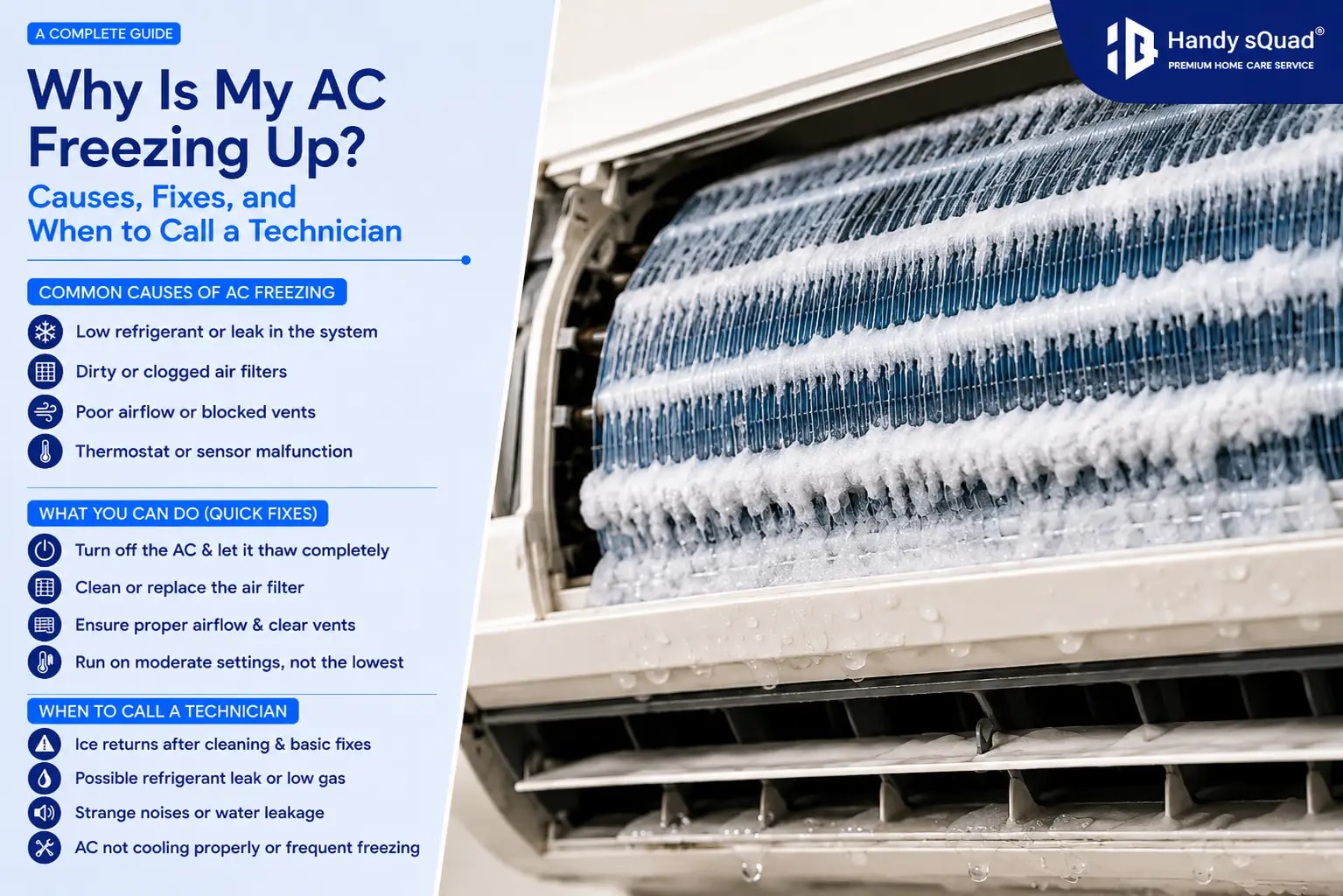
Low refrigerant is a big one. If your AC's running low—usually because of a small leak somewhere in the system—the pressure inside the coils drops, and lower pressure means lower temperature—cold enough, in many cases, for ice to start forming. This is genuinely one of the most common reasons ACs freeze up in Indian homes, especially units that have been running a few years without much attention.
Then there's airflow. A dirty filter causes more of these freezing problems than people realise, and filters clog up fast in most Indian cities given the dust levels. Less air passing over the coils means they end up colder than intended, and ice starts building. Blocked vents, a door shut in a way that restricts flow, or a dirty blower can cause more or less the same result.
Running the AC on its lowest setting for hours on end, especially overnight, can also push things over the edge—particularly if there's already a minor airflow or refrigerant issue sitting in the background that you don't know about yet. Similarly, running the unit when it's already cooler outside, or at night with low humidity and the fan speed turned down, can make it harder for the system to hold proper coil temperature.
A faulty thermostat or sensor is another possibility worth knowing about. If whatever's supposed to regulate coil temperature isn't reading correctly, the compressor can end up running longer than it should, pushing the coils colder than they can actually handle.
And then, simply, dirty coils. Same logic as a dirty filter — coils caked in dust and grime can't transfer heat properly, which throws off the whole cooling balance over time.
Signs of a Frozen AC Unit You Shouldn't Ignore
Usually it's fairly obvious once you know what you're looking for. Weak or lukewarm air from the vents, even with the unit running full blast, is often the giveaway. Sometimes there's visible ice or frost on the indoor unit, the coils, or the copper lines outside. Water pooling near the indoor unit happens a lot too, since that ice has to melt and go somewhere. And now and then you'll hear the compressor working hard while feeling basically nothing in terms of actual cooling, which might be the most frustrating version of this whole thing.
See any of this? Switch the AC off. Don't try to push through it and hope it sorts itself out — it won't.
How to Fix a Frozen AC: Step-by-Step Troubleshooting
Turning it off and letting it defrost is the step people skip most, and it's the one that matters the most. Keep a frozen unit running, and you just build up more ice while putting unnecessary strain on the compressor, which happens to be one of the pricier parts to fix or replace. Switch the whole unit off—leave the fan on if your AC allows that; it speeds up the thaw—and give it a few hours. A badly iced-up unit might take longer than you'd guess.
While you're waiting, check the filter. Dusty or clogged? You've probably just found your answer. Most Indian AC units use a removable, washable filter—rinse it under the tap, let it dry fully, slot it back in. This alone fixes a good chunk of freezing complaints, especially in homes where nobody's touched the filter in months.
Also worth a look: anything blocking airflow near the indoor unit, vents obstructed by furniture or curtains, that sort of thing. Got a split AC? Check that the outdoor unit has breathing room too and isn't boxed in against a wall.
Once it's back on, ease off the temperature setting for a while—moderate rather than lowest, at least until you're fairly sure the actual cause has been dealt with.
Then just watch it. Freezes again within a day or two, even after a clean filter and a proper thaw? You're likely dealing with something beyond a quick fix—a refrigerant leak, most commonly, or a part somewhere inside that's starting to fail.
When to Call an AC Technician for Refrigerant or Repair Issues
Some causes genuinely need a trained technician, and pushing through a DIY fix in these cases usually ends up costing more down the line, not less. Refrigerant issues especially fall into this category—handling refrigerant properly requires the right equipment, and a leak needs to be found and sealed before any gas gets topped up. Just adding refrigerant without fixing the leak is a band-aid at best; you'll be back here again in a few weeks.
Call a professional too if the AC keeps freezing despite a clean filter and clear airflow, if there are unusual noises alongside it, if water damage is starting to show up near the indoor unit, or if the unit's a few years old and hasn't seen a proper service in some time.
Regular servicing — once or twice a year depending on how much you use it — genuinely prevents a lot of this from happening at all. A technician checks refrigerant levels, cleans the coils and filters properly, and catches the small stuff before it turns into a fully frozen, non-functional unit right in the middle of a heatwave, which is exactly when you don't want to be dealing with it.
If your AC keeps freezing or it's simply been a while since it was last looked at, booking a reliable AC service trivandrum provider is usually the fastest way to actually get to the bottom of it. A trained technician picks up on things that aren't obvious from the outside—a slow leak, a coil that's starting to wear thin—well before they turn into something bigger.
Final Thoughts: Preventing AC Freezing With Regular Maintenance
An AC freezing up can feel a bit alarming the first time you see it, particularly if you're counting on it to get through peak summer heat. Truth is, it's rarely something you can't fix. Nine times out of ten it's a dirty filter, restricted airflow, or refrigerant that's run low, and some basic troubleshooting will usually point you to which one. Turn it off, let it thaw properly, check the filter, and see whether the issue comes back.
If it does, or you'd rather skip the guesswork around refrigerant altogether, a dependable AC service in trivandrum can sort it out properly and get things running normally again. The AC technicians at Handy sQuad know how to trace exactly what's causing the freeze, fix it at the source instead of just the symptom, and get your unit back to working reliably—so you're not stuck dealing with the same thing again the next time the temperature climbs.
Thanks for reading