Quick price snapshot (unit only, before installation):
Tonnage | Typical price range | Best for |
|---|---|---|
1 ton | ₹38,000 – ₹48,000 | Small cabin, shop counter |
1.5 ton | ₹45,990 – ₹63,000 | Home living room, small office, clinic |
2 ton | ₹60,000 – ₹95,000 | Large living-cum-dining, showroom |
3 ton | ₹90,000 – ₹1,30,000 | Banquet hall, restaurant, large hall |
Installation adds ₹6,500 – ₹28,000 on top of the unit price, depending on false ceiling work, copper piping length, and drainage complexity. A full cassette AC setup — unit plus installation — typically lands ₹15,000–₹35,000 more than an equivalent split AC, most of that gap coming from the false ceiling and ducting work a split doesn't need.
Walk into a large living room, a restaurant, or an open-plan office anywhere in India, and there's a decent chance you'll spot a flat, square unit sitting flush in the ceiling instead of the usual split AC bolted to a wall. That's a cassette AC — the option for bigger spaces where a standard split unit just doesn't quite manage. Here's the full picture: real prices, real trade-offs, and whether it's worth it for your space.
What Is a Cassette AC?
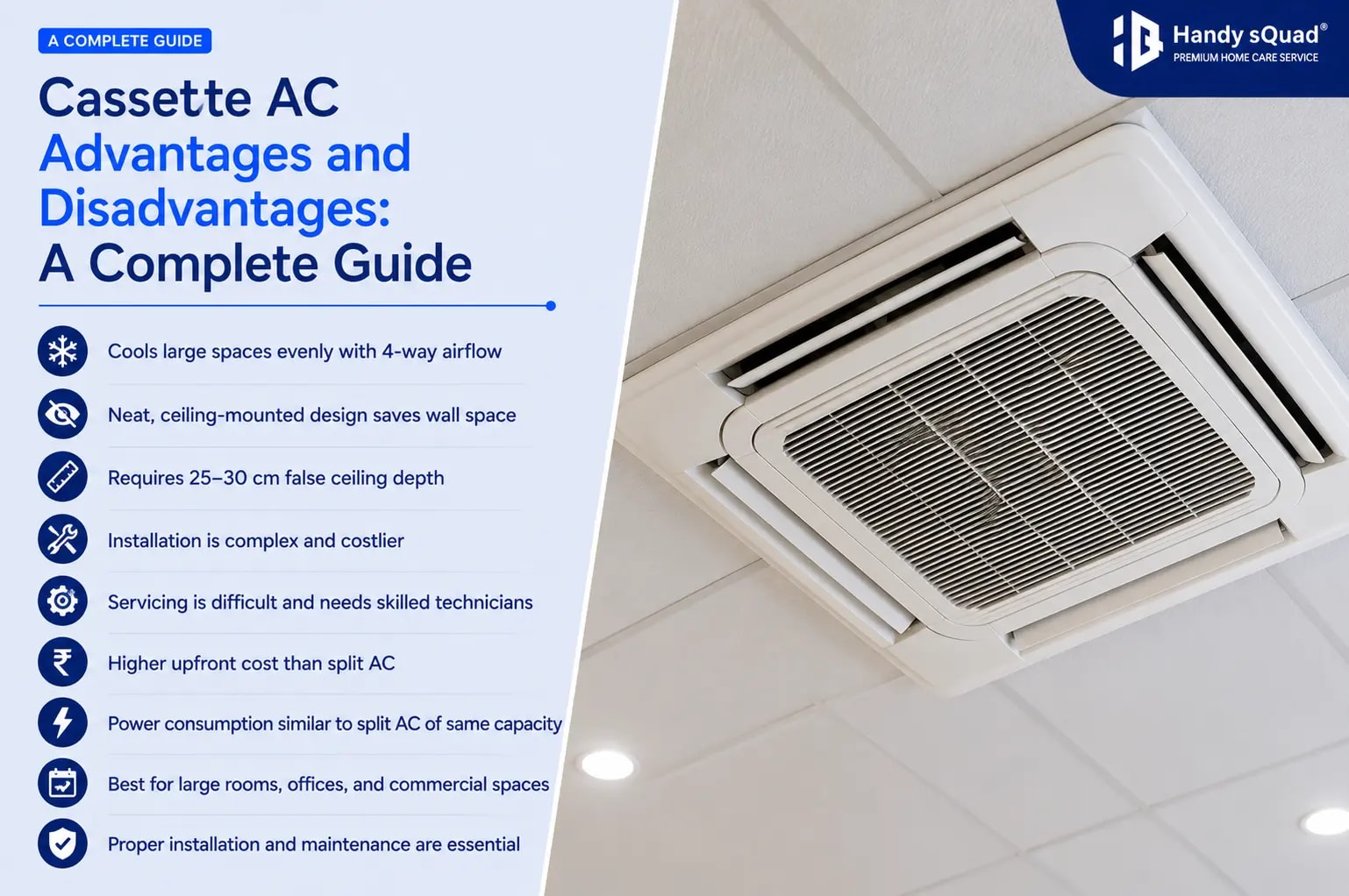
A cassette air conditioner is a ductless AC unit that installs directly into a false ceiling, sitting flush with the surface rather than mounted on a wall like a split unit. Only the front panel shows from below — everything else stays tucked away above the ceiling. It cools a room from the centre outward, usually in four directions at once, which is why it suits larger, more open spaces so well.
Cassette AC Price in India — Full Breakdown by Tonnage
Prices vary by brand, star rating, and whether it's a 4-way or 1-way (slim) cassette. Here's what the market looks like across major brands:
Tonnage | Unit price (approx.) | Installation cost | Ideal room/space size |
|---|---|---|---|
1 ton | ₹38,000 – ₹48,000 | ₹6,500 – ₹15,000 | Up to 150 sq ft |
1.5 ton | ₹45,990 – ₹63,000 | ₹8,000 – ₹18,000 | 150–220 sq ft |
2 ton | ₹60,000 – ₹95,000 | ₹10,000 – ₹22,000 | 220–350 sq ft |
3 ton | ₹90,000 – ₹1,30,000 | ₹12,000 – ₹28,000 | 350–500 sq ft |
A quick way to estimate tonnage: divide your room's area in square feet by 150. A 300 sq ft room needs roughly a 2-ton unit. Add 0.5 ton if the ceiling is above 10 ft, or if the room gets strong afternoon sun or has a lot of glass.
One-way vs four-way cassette price: one-way (slim) cassettes, which fit shallower false ceilings, generally run ₹5,000–₹10,000 cheaper than four-way units of the same tonnage, since they're simpler and need less ceiling depth. Budget brands like Voltas and Blue Star sit at the lower end of these ranges; Daikin, Mitsubishi Electric, and Panasonic sit at the upper end, generally with quieter operation and longer warranties.
These are India-wide market ranges — always get a proper site-visit quote, since your exact false ceiling condition, wiring, and piping run distance change the installation number.
Cassette AC vs Split AC — Price Difference
This is the question most people are actually trying to answer: is the extra cost worth it?
Factor | Split AC | Cassette AC |
|---|---|---|
Unit price (1.5 ton) | ₹28,000 – ₹42,000 | ₹45,990 – ₹63,000 |
Installation | ₹1,500 – ₹4,000 | ₹8,000 – ₹18,000 (needs false ceiling work) |
Total cost (1.5 ton) | ₹30,000 – ₹46,000 | ₹54,000 – ₹81,000 |
Airflow coverage | One direction | Four directions (or focused, for one-way) |
Best room size | Small–medium rooms | Large, open-plan rooms |
Ceiling requirement | None | False ceiling with 9–14 inches depth |
Servicing ease | Easy — unit is on the wall | Harder — unit is inside the ceiling cavity |
Bottom line: for a standard bedroom, a split AC does the same cooling job for roughly half the total cost. Cassette AC earns its higher price in larger, open spaces — living-cum-dining rooms, showrooms, restaurants — where one cassette can replace what would otherwise need two split units and two sets of wall-mounted eyesores.
Cassette AC Working Diagram: How It Actually Cools a Room
The basic idea isn't wildly different from a split AC — there's still an indoor unit and an outdoor unit connected by refrigerant piping, with the outdoor unit doing the heavy lifting via compressor and condenser. What changes is where the indoor unit sits and how air moves through the room.
The indoor unit tucks inside the ceiling, front panel flush against the surface below. Warm air from the room gets pulled up through a central grille, passes over the cooling coil, and gets pushed back down through vents around the edges of the panel — usually all four sides at once. This four-way airflow is what lets one unit spread cool air evenly across a wide area, instead of blasting in a single direction the way a wall-mounted split does.
Show Image
Cassette AC Dimensions and False Ceiling Depth
Space is one of the most practical things to sort out before installation. Cassette ACs need clearance above the false ceiling for the unit body, plus room for ducting, drainage, and refrigerant lines.
1–1.5 ton: needs roughly 9–10 inches (about 23–25 cm) of false ceiling depth
2 ton: needs roughly 10–12 inches (about 25–30 cm)
2.5–3 ton: needs roughly 12–14 inches (about 30–36 cm)
The visible front panel — the only part you'll see once installed — is typically around 570mm × 570mm for a standard unit, with larger commercial-capacity units running bigger.
If you're planning new construction or a major renovation, discuss ceiling height and false ceiling depth with your contractor and AC installer together, rather than locking in the ceiling design before the AC is chosen.
Show Image
Which Is Better, Cassette AC or Split AC?
Depends entirely on the space — there's no single right answer.
Cassette ACs generally win for larger, more open rooms, since four-way airflow cools a wide area far more evenly than a split unit's one-directional blast. They sit flush with the ceiling too, which a lot of people prefer visually, especially in living rooms or commercial spaces where a bulky wall unit would look out of place. Limited wall space, or an interior that doesn't suit a visible AC unit? Cassettes are the more practical call.
Split ACs win on affordability — easier to install without a false ceiling, and simpler to service since the indoor unit sits right there on a wall. Smaller rooms, bedrooms especially, are where split ACs make the most sense: cheaper, less hassle, and installation is a fraction of the effort.
Got a big hall, a large living-cum-dining space, a shop, or a restaurant? A cassette AC is probably worth the extra spend. A standard bedroom or smaller room? A split AC does the job just as well for a lot less money and disruption.
Disadvantages of Cassette AC
Worth knowing before you commit:
More involved, pricier installation — needs a false ceiling with proper depth, correct ducting, and a carefully sloped drainage line
Trickier servicing — the unit sits inside the ceiling, so repairs or deep cleaning need a technician who specifically knows cassette systems, not just any general AC repair visit
Higher upfront cost — both the unit itself and the installation work cost more than an equivalent split AC
Hard to retrofit — since it needs to be planned into the ceiling from the start, adding one to a home where the false ceiling wasn't designed for it can mean redoing the whole ceiling
Does Cassette AC Consume More Electricity?
Not really. Power consumption comes down mainly to capacity (tonnage) and star rating — the same factors that decide a split AC's electricity use. A 1.5-ton cassette and a 1.5-ton split with matching star ratings use a broadly similar amount of power for an equivalent space.
That said, cassette ACs typically end up in larger spaces, which need higher-capacity units to cool them properly — naturally bumping up power use in absolute terms. That's down to more cooling capacity being used, not the cassette format being inherently less efficient. A higher star rating, correctly sized for the room, does far more for your electricity bill than whether you picked cassette or split in the first place.
Getting It Installed and Maintained Properly
Given how much planning goes into installation and how specialised the servicing can get, it's worth going with technicians who genuinely know cassette systems. Poor installation — particularly around the drainage line — is one of the most common causes of leaks and water damage in cassette AC setups down the line.
Planning a cassette AC installation, or need servicing for one you've already got? Handy sQuad's AC service in Trivandrum team handles ceiling planning, sizing, and installation from day one — and can give you an exact quote for your specific space rather than a national average range.
Frequently Asked Questions About Cassette AC
How much does a cassette AC cost in India? Unit prices range from ₹38,000 for a 1-ton model to ₹1,30,000 for a 3-ton commercial-grade unit. Including installation (₹6,500–₹28,000 depending on false ceiling and ducting complexity), a full 1.5-ton setup typically lands between ₹54,000 and ₹81,000.
What is the price difference between cassette AC and split AC? For a comparable 1.5-ton unit, a split AC costs ₹30,000–₹46,000 fully installed, versus ₹54,000–₹81,000 for a cassette — roughly ₹20,000–₹35,000 more, mostly from the false ceiling and ducting work a split doesn't need.
How much does a 2-ton cassette AC cost? A 2-ton cassette AC unit costs ₹60,000–₹95,000, with installation adding another ₹10,000–₹22,000 depending on ceiling and site conditions.
How much does a 1.5-ton cassette AC cost? A 1.5-ton cassette AC unit costs ₹45,990–₹63,000. Budget brands like Voltas sit near the lower end; premium brands like Daikin and Mitsubishi Electric sit near the upper end with quieter operation.
Is cassette AC more expensive than split AC? Yes — generally ₹20,000–₹35,000 more for a comparable capacity once installation is included, due to the false ceiling work, additional drainage, and more complex ducting a cassette AC requires.
Is cassette AC better than split AC? For large rooms, open-plan spaces, restaurants, offices, and shops needing evenly distributed cooling, yes — the ceiling-mounted four-way airflow covers a wide area better than a split's single direction. For bedrooms and smaller rooms, a split AC is usually more practical and considerably cheaper.
What is the size of a cassette AC? The visible front panel is typically 570mm × 570mm for a standard unit. The full indoor unit needs roughly 9–14 inches of false ceiling depth depending on tonnage (9–10 inches for 1–1.5 ton, up to 12–14 inches for 2.5–3 ton).
Which company's cassette AC is best? Depends on room size, budget, and priorities. Daikin, Mitsubishi Electric, and Panasonic lead on quiet operation and efficiency at a premium price; LG, Samsung, and Blue Star offer strong mid-range options; Voltas is typically the most budget-friendly. Compare tonnage, star rating, warranty, and local service availability rather than picking on price alone.
Not sure what cassette AC fits your space — or want an exact quote instead of a national price range? Handy sQuad's technicians in Trivandrum can assess your ceiling, size the unit correctly, and quote installation for your exact setup. Book an AC service in Trivandrum →
Thanks for reading